Review · Software & AI
 Make review
A visual scenario builder from Celonis that connects 3,500+ apps, with AI agents, the Maia assistant and an MCP server.
By the DBotMaker research desk · Updated November 18, 2026
Short answer · output
Make is a visual automation platform, owned by Celonis, where workflows called scenarios are drawn as a canvas of connected modules and billed in credits, mostly 1 credit per module action. It has a free plan with 1,000 credits a month, and Core starts at $12 a month billed annually ($16 month to month) for 10,000 credits a month. It suits operators and small teams building branching, multi-app workflows who want to pay less per action than Zapier; prices and limits were checked against Make's US pricing data and help center in November 2026.
- Capabilities (40%)
- 9.1
- Ease of setup (30%)
- 8.5
- Value (30%)
- 8.8
In pictures · 3 images
Verdict printout · Make
Buy Make if your automations branch, loop over lists and run often, and you want a visual map of every step: Core at $12 a month billed annually buys 10,000 credits a month, routers, filters and error handlers cost nothing, and 3,500+ apps are listed. Skip it if your workflows have dozens of steps that run thousands of times a month, because every module action uses a credit; n8n counts one full workflow run as one execution. Skip it too if you need self-hosting, which Make does not offer. The deciding fact is the billing unit: per its pricing FAQ, a single scenario run can use anywhere from two credits to thousands.
ReadOverview
Make builds automations as scenarios: a trigger module watches an app or webhook, and the following modules search, create, update, transform, aggregate or iterate data, with routers splitting the flow into branches. Make's integrations page lists 3,500+ apps, and the pricing FAQ says custom apps can connect any service with a public API, while more than 300 REST API endpoints let teams manage Make itself. The footer on make.com credits Celonis, Inc., which owns the product. Data lives in one of four data zones (US1, US2, EU1, EU2), chosen per organization.
The current plan line-up is Free, Core, Pro, Teams and Enterprise. According to the US price data on Make's pricing page in November 2026, Core costs $16 a month or $144 a year for 10,000 credits a month, Pro costs $28 a month or $252 a year for 120,000 credits a year, and Teams costs $51 a month or $456 a year for 120,000 credits a year. Each plan scales up in credit tiers, for example Core at 300,000 credits a month for $321 monthly. Enterprise is quoted by sales. Companies with fewer than 20 employees can apply for a Start-up Plan at 50% off Business.
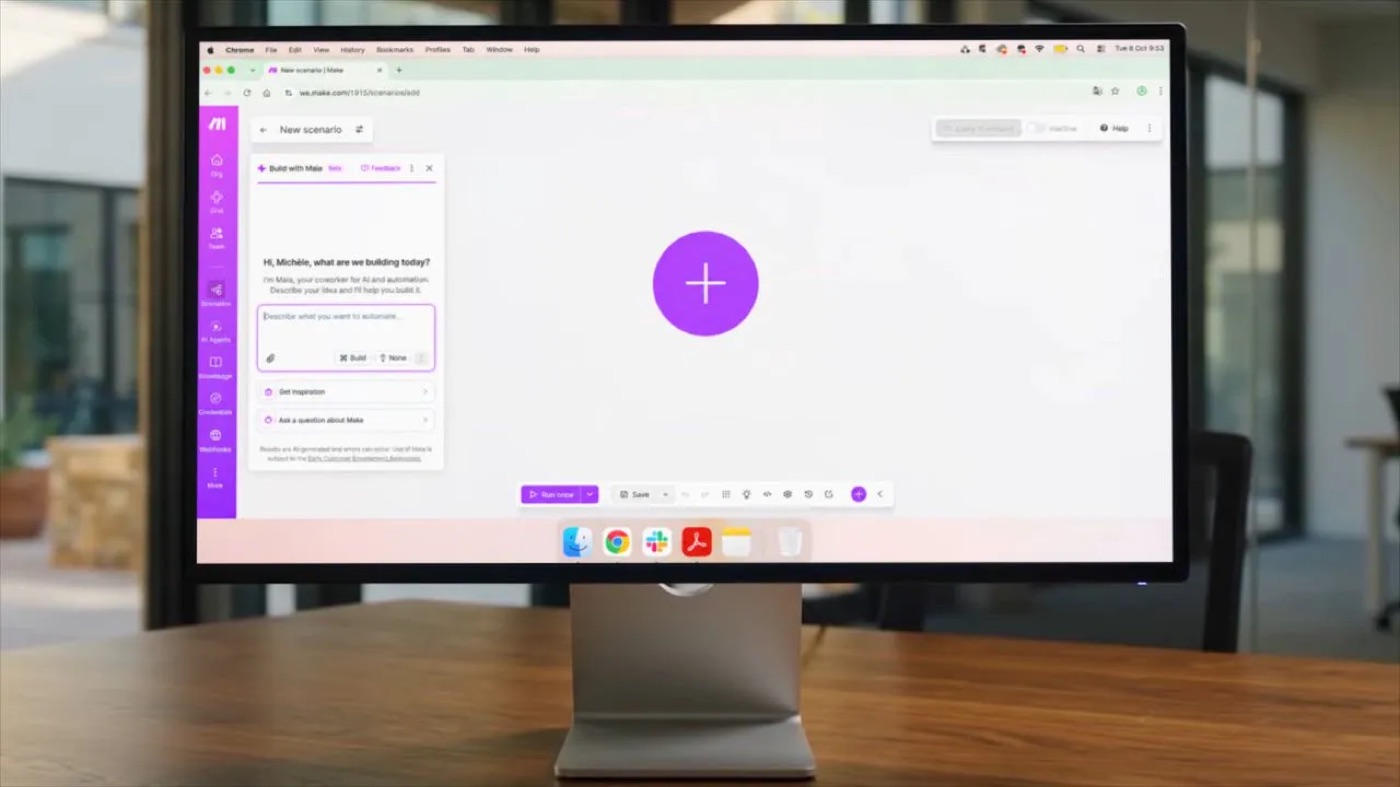
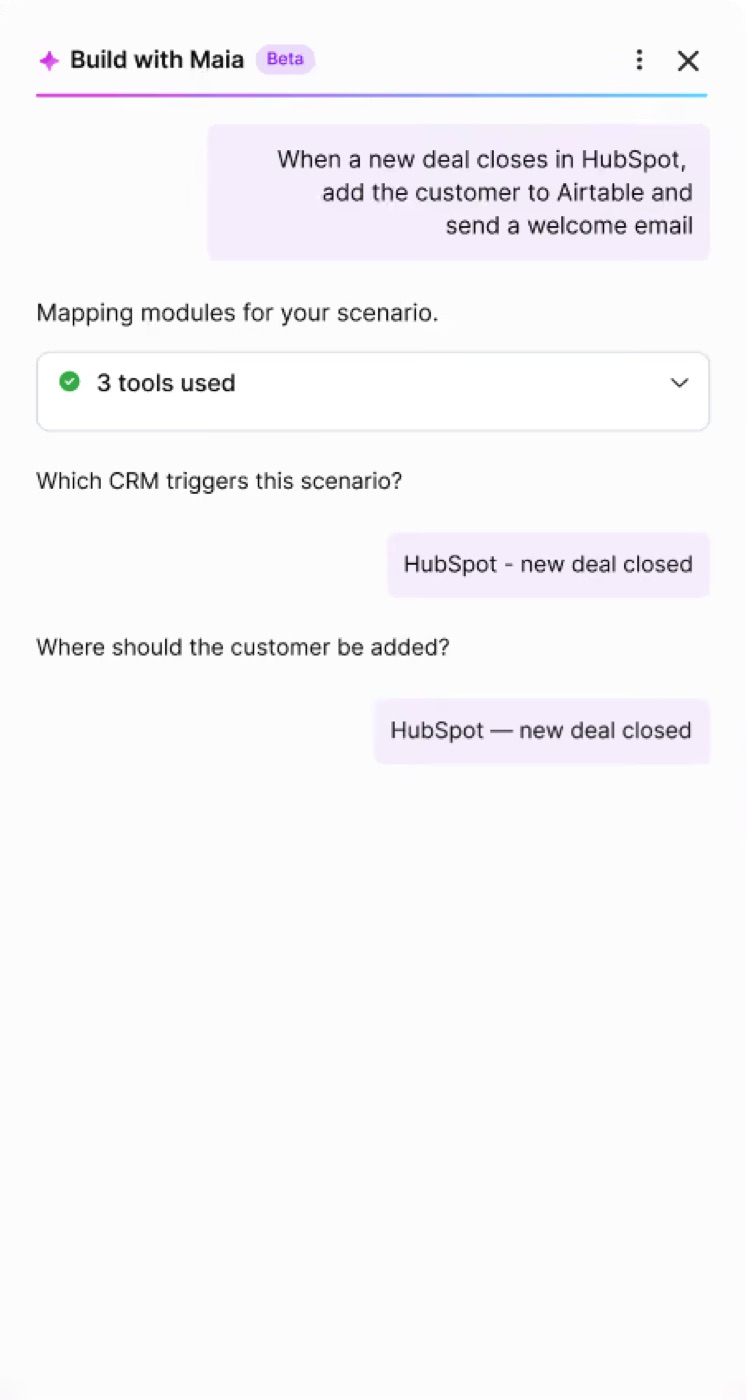
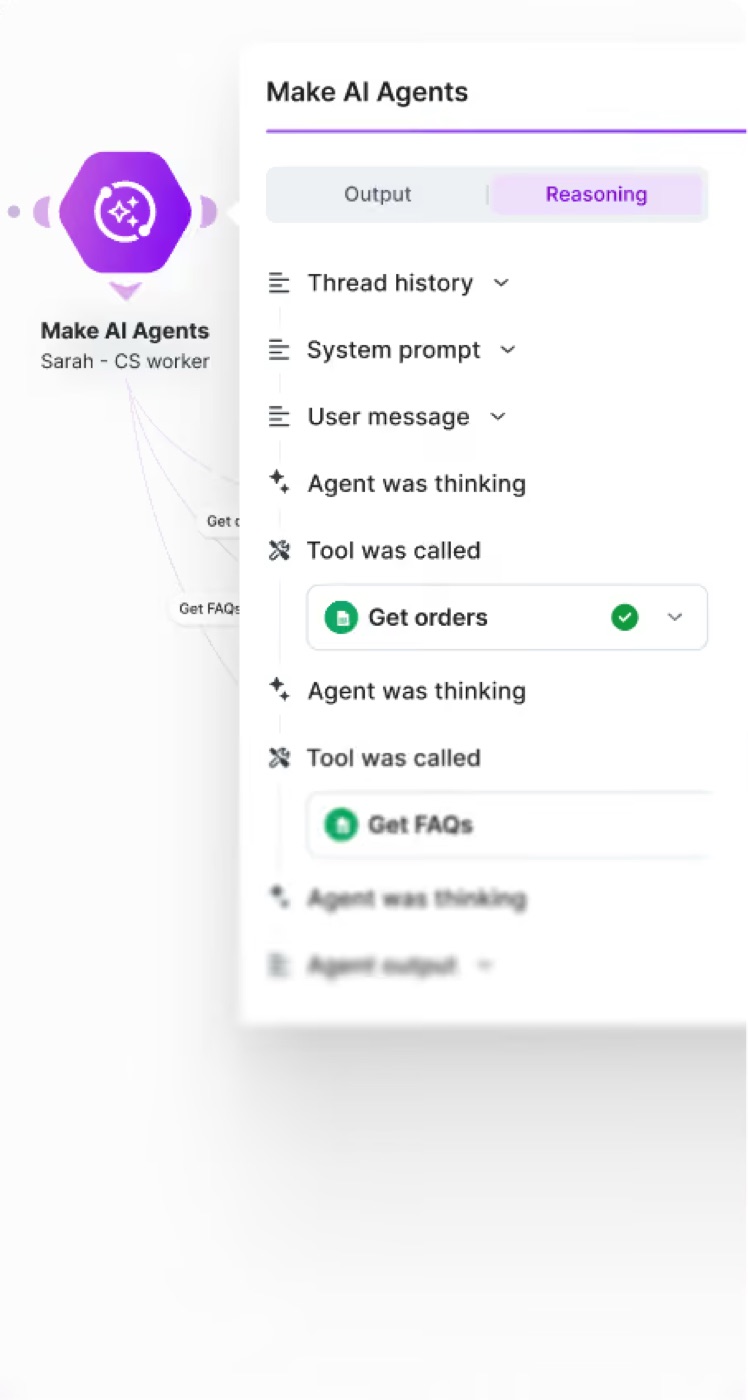
The biggest recent change is billing. Credits replaced operations as the billing unit on August 27, 2025. Most modules use 1 credit per operation, but AI features on Make's AI Provider use extra credits based on tokens, and the Make Code app uses 2 credits per second of execution. On October 1, 2026, Make removed the Cycles per run setting, so every scenario run now completes one pass. AI has also moved to the center: Make AI Agents with a reasoning panel and manual approvals, Maia, an assistant that builds and debugs scenarios from prompts (public beta), Make Grid, an auto-generated map of how scenarios, apps and agents connect, and an MCP server that lets Claude, ChatGPT or Gemini run scenarios.
Against the main rivals on this site, Make sits between Zapier and n8n. Zapier's Professional plan starts at $19.99 a month and counts each action as a task, with a simpler step-by-step editor. n8n Cloud's Starter plan is $20 a month billed annually for 2,500 full workflow executions regardless of step count, and n8n can be self-hosted. Activepieces offers a free plan with 1,000 credits a month and a flat $20 Plus plan. Microsoft Power Automate fits companies tied to Microsoft 365 at $15 per user a month paid yearly. Make's case is the lowest entry price of the group per action and the most visual editor.
The limits are documented. Credits expire at the end of each term, and on the Core plan they reset monthly even with annual billing; only Pro and Teams annual plans get a yearly pool. Extra credits cost 25% more than plan credits. When credits run out, scenarios stop until credits are added, though webhooks are queued and polling triggers catch up. Trigger modules use 1 credit per check even when they find nothing, so a scenario polling every 15 minutes uses about 2,900 credits a month before doing any work. The Make Code sandbox caps runs at 30 seconds below Enterprise, and Maia's chats use credits from the same pool as scenarios after the free trial messages.
How it scored
Make is the strongest visual builder here. Scenarios are drawn as a canvas of modules, so branching, looping over rows and merging data are visible at a glance, which suits workflows that Zapier's linear steps make awkward. Make says it connects 3,500+ apps out of the box, and anything with a public API can be added as a custom app. Billing moved to credits in August: most actions use one credit, router and error handler modules use none, and some AI Provider features use more. The free plan includes 1,000 credits a month, and paid tiers are Core, Pro and Teams, with a Start-up Plan at 50% off Business for companies under 20 employees. Maia, Make's AI assistant, helps build scenarios, and AI agents and an MCP server are part of the product. The canvas has a steeper learning curve, and unused credits expire at the end of each term.
Who it is for
Operators building branching, high-volume scenarios on a visual canvas
Run it if
- Operations staff and solo operators who build branching workflows across several apps and want to see every route and filter on one canvas
- Small businesses that want a free plan with 1,000 credits a month and a paid entry point of $12 a month billed annually
- Freelancers and agencies connecting niche tools, since custom apps can wrap any service with a public API
- Teams experimenting with AI agents that need a reasoning log, manual approval steps and access to the same 3,500+ app modules
- Companies with EU data requirements that want their organization in the EU1 or EU2 data zone
Skip it if
- Teams running long workflows with many steps or loops over thousands of records: n8n bills one full run as one execution and can be self-hosted
- Non-technical staff who want a guided, linear builder: Zapier's step list is simpler to learn and has a free plan with 100 tasks a month
- Organizations that must self-host for security or air-gapped networks: Make is cloud only, while n8n and Activepieces offer self-hosted editions
- Companies standardized on Microsoft 365 that need Windows desktop automation: Microsoft Power Automate covers desktop flows
SpecSpec sheet
| Starting paid price | $12 a month billed annually ($144 a year) or $16 month to month, Core plan with 10,000 credits a month | src ↗ |
|---|---|---|
| Free plan | 1,000 credits a month, 1 MB data storage, 1 data store | src ↗ |
| Billing unit | Credits: 1 per module operation for non-AI apps; AI and code features can use more | src ↗ |
| Modules that use no credits | Error handlers, routers and filters, subscenario modules, Make Functions | src ↗ |
| Apps | 3,500+ listed integrations, plus custom apps for any public API | src ↗ |
| Management API | More than 300 REST API endpoints | src ↗ |
| Default schedule | Scenarios run every 15 minutes by default; minimum interval depends on plan | src ↗ |
| Usage allowance per 10,000 credits | 5 GB data transfer, 10 MB data storage, 667 queued webhooks (10,000 maximum) | src ↗ |
| Code steps | JavaScript and Python on paid plans, 2 credits per second, 30 second limit (300 seconds on Enterprise) | src ↗ |
| AI features | Make AI Agents on all plans, Maia assistant (public beta), MCP server, AI Toolkit | src ↗ |
| Data zones | US1, US2, EU1, EU2 | src ↗ |
| Hosting | Cloud only, on Amazon AWS; no self-hosted edition | src ↗ |
| Compliance | GDPR, SOC 2 Type II, SOC 3, ISO 27001 | src ↗ |
| Extra credits | Bundles of 1,000 or 10,000 at 25% above plan rate; auto-purchase in 10,000 blocks | src ↗ |
Price
Free plan with 1,000 credits a month; paid Core, Pro and Teams plans. See vendor pricing (USD check pending).
US price check pending. See the vendor pricing page.
Plans on file · 6
| Plan | Price | Includes | Checked |
|---|---|---|---|
| Free | $0Monthly credit allowance, no time limit | 1,000 credits a month; 1 MB of data storage and 1 data store; Make AI Agents through Make's AI Provider; Maia on a 30-day trial with 45 free messages; MCP server with scenario run scopes only | Checked Nov 18, 2026 |
| Core | $16 a month, or $144 a year ($12 a month)Monthly or annual; credits reset monthly on both | 10,000 credits a month at the entry tier, scaling to 300,000 credits a month ($321 monthly or $2,844 a year); Make Code app for JavaScript and Python with a 30 second limit; Custom AI provider connections, such as your own Anthropic or OpenAI key; MCP server management scopes; Extra credits and auto-purchase of 10,000 credit blocks | Checked Nov 18, 2026 |
| Pro | $28 a month, or $252 a year ($21 a month)Monthly (10,000 credits a month) or annual (120,000 credits for the year) | Annual plans get the full year's credits up front to use flexibly; Higher tiers up to millions of credits, such as 1,000,000 credits a month for $1,321 monthly; Extra credits on annual billing stay valid until the end of the year; Same Make Code, custom AI provider and MCP management access as Core | Checked Nov 18, 2026 |
| Teams | $51 a month, or $456 a year ($38 a month)Monthly (10,000 credits a month) or annual (120,000 credits for the year) | Annual package of credits like Pro, 120,000 credits for $456 at the entry tier; Extra credits on annual billing stay valid until the end of the year; Payment by card, ACH direct debit or Google Pay | Checked Nov 18, 2026 |
| Enterprise | Price not listed, contact salesCustom contract; wire transfer after invoice accepted | Custom credit volumes; Enterprise-only apps such as Workday finance modules, Coupa, ServiceNow, Greenhouse and Infor M3; Audit logs, role-based access and scenario tagging; Make Code with custom libraries and a 300 second limit; 99.5% cloud service uptime and 24/7 support with a dedicated team | Checked Nov 18, 2026 |
| Start-up Plan | 50% off BusinessApplication required | For companies with fewer than 20 employees that qualify | Checked Nov 18, 2026 |
Key features
Visual scenario canvas
Scenarios are drawn as connected modules with routers, filters, iterators and aggregators, so branches and loops are visible on one screen. Routers and filters use no credits, so adding branches does not raise the cost of a run.
Credit-based billing
Trigger and search modules use 1 credit per run, action modules use 1 credit per bundle processed, and aggregators use 1 credit per aggregation. A search returning 10 rows followed by a delete step uses 11 credits, per Make's help center example.
Make AI Agents
Agents reason over a goal, pick tools from modules, scenarios and MCP tools, and show each decision in a Reasoning panel. Builders can add manual approvals or stop points. Agents run on Make's AI Provider on all plans, with custom AI provider connections on paid plans.
Maia assistant
Maia builds, edits and debugs scenarios from plain-language prompts, in Build or Plan mode, and can read a whiteboard sketch from an uploaded image. Paid plans get 70 free messages in the first 30 days, then each reply uses credits; Make's own examples show 140 to 160 credits for a single message.
Make Grid
An auto-generated, near real-time map of how scenarios, apps, data stores and AI components connect, with error indicators and dependency tracing, useful before changing a shared data source.
MCP server
MCP clients such as Claude and ChatGPT can run active on-demand scenarios on all plans, and on paid plans can also manage scenarios, teams, connections, webhooks and data stores.
Make Code
A built-in JavaScript and Python step with an IDE, running in an isolated sandbox with 512 MB RAM and a 30 second limit on Core, Pro and Teams. It uses 2 credits per second of execution time.
Strengths and weaknesses
Plus · 7
- Lowest paid entry among the main automation tools on this site: Core is $12 a month billed annually for 10,000 credits, about $0.0012 per credit
- Free plan includes 1,000 credits a month with no time limit, more than Zapier's 100 free tasks
- Routers, filters, error handlers and subscenario calls use no credits, so complex branching costs no extra
- 3,500+ listed apps plus custom apps for any public API and more than 300 REST API endpoints for managing Make itself
- When credits run out, incoming webhooks are queued and polling triggers resume from the last successful run, so data is not lost
- Pro and Teams annual plans hand over the full year of credits up front, such as 120,000 credits for $252, which absorbs seasonal peaks
- Security credentials include SOC 2 Type II, SOC 3 and ISO 27001, with US and EU data zones
Minus · 6
- Every module action uses a credit, so a 20-step scenario run 1,000 times uses at least 20,000 credits, double Core's entry tier
- Trigger modules use 1 credit per check even when they find no data, so frequent polling burns credits on empty runs
- Unused credits expire at the end of each term, and extra credits cost 25% more than plan credits
- No self-hosted edition: Make runs only in its own AWS cloud
- AI features add token-based credit charges, and a single Maia message can cost 140 or more credits after the free messages
- Code steps are capped at 30 seconds and 512 MB RAM below Enterprise, and custom code libraries are Enterprise only
Key facts
- Free plan: Yes, 1,000 credits per month
- Paid plans: Core, Pro, Teams and Enterprise
- Apps: 3,500+
- Extra credits: Bundles of 1,000 or 10,000, or auto-purchase
- Start-up Plan: 50% off Business for companies under 20 employees
Where it ranks
Make is No. 2 in our Best AI Workflow Automation Tools verdict and No. 2 in Best Automation Tools for Small Business and No. 2 in Best n8n Alternatives and No. 1 in Best No-Code Automation Tools and No. 2 in Best Workflow Automation Software and No. 1 in Best Zapier Alternatives.
AltAlternatives to weigh
- Zapier →Easier for non-technical users, with a free plan of 100 tasks a month and Professional from $19.99 a month, but it counts each action as a task at a higher entry price.
- n8n →Bills one full workflow run as one execution, starting at $20 a month billed annually for 2,500 executions, and can be self-hosted for free under its license.
- Activepieces →A similar free plan of 1,000 credits a month and a flat $20 a month Plus plan, with an open-source edition that can be self-hosted.
- Microsoft Power Automate →The better fit for Microsoft 365 companies that need desktop automation of Windows apps, at $15 per user a month paid yearly for Premium.
Questions readers ask
- QDoes Make have a free plan?
- AYes. Make's Free plan includes 1,000 credits a month with 1 MB of data storage and one data store, and it does not expire. Free users can run AI agents through Make's AI Provider and try Maia for 30 days with 45 messages.
- QHow much does Make cost?
- ACore starts at $12 a month billed annually ($144 a year) or $16 month to month for 10,000 credits a month. Pro is $28 a month or $252 a year, and Teams is $51 a month or $456 a year, according to Make's US pricing data in November 2026. Enterprise is priced by sales.
- QWhat is a credit in Make?
- AA credit is Make's billing unit, and most module operations use 1 credit. Credits replaced operations on August 27, 2025. AI features on Make's AI Provider add credits based on token use, Make Code uses 2 credits per second, and routers, filters and error handlers use none.
- QIs Make worth it?
- AMake is worth it for branching workflows that run a moderate number of steps, because its $12 a month Core plan is the cheapest paid entry among Zapier, n8n and Activepieces on this site. For workflows with many steps per run, n8n's per-execution billing usually costs less.
- QMake vs Zapier: which is cheaper?
- AMake is cheaper to start: Core is $12 a month billed annually for 10,000 credits, while Zapier's Professional plan starts at $19.99 a month. Both charge per action, but Make does not charge for routers, filters or error handlers. Zapier's editor is simpler for non-technical users.
- QMake vs n8n: which should I choose?
- AChoose n8n if your workflows have many steps or you need self-hosting, since n8n counts a full run as one execution. Choose Make if you want a more visual editor, 3,500+ ready apps and a permanent free hosted plan of 1,000 credits a month.
- QDo unused Make credits roll over?
- ANo. Make's pricing FAQ says credits expire at the end of the term. Core credits reset monthly even on annual billing, while Pro and Teams annual plans get a yearly pool that lasts the whole year.
- QCan Make be self-hosted?
- ANo. Make runs only in its own cloud on Amazon AWS, with data zones in the US and EU. Teams that need self-hosting usually look at n8n or Activepieces.
LogSource log
- [01]Make: Pricing (plans, FAQ and US price data) · checked Nov 18, 2026
- [02]Make homepage · checked Nov 18, 2026
- [03]Make: Integrations · checked Nov 18, 2026
- [04]Make: AI Agents · checked Nov 18, 2026
- [05]Make: Maia · checked Nov 18, 2026
- [06]Make: Security · checked Nov 18, 2026
- [07]Make: Enterprise · checked Nov 18, 2026
- [08]Make Help Center: Credits · checked Nov 18, 2026
- [09]Make Help Center: How features use credits · checked Nov 18, 2026
- [10]Make Help Center: Extra credits · checked Nov 18, 2026
- [11]Make Help Center: Monthly and annual subscriptions · checked Nov 18, 2026
- [12]Make Help Center: Schedule a scenario · checked Nov 18, 2026
- [13]Make Help Center: Introduction to Maia by Make · checked Nov 18, 2026
- [14]Make Help Center: Maia by Make pricing · checked Nov 18, 2026
- [15]Make Help Center: Introduction to Make Grid · checked Nov 18, 2026
- [16]Make Help Center: Make MCP server · checked Nov 18, 2026
- [17]Make Help Center: Introduction to AI agents · checked Nov 18, 2026
- [18]Make Help Center: The Make Code app is available · checked Nov 18, 2026
- [19]Make Help Center: Cycles removal on October 1, 2026 · checked Nov 18, 2026
- [20]Make Help Center: AI providers and data zones in Make · checked Nov 18, 2026
- [21]Make Help Center: Organizations and teams · checked Nov 18, 2026
- [22]Make Help Center: Introducing credits, the new billing unit · checked Nov 18, 2026
Deep review last updated November 18, 2026. Prices and specs are rechecked against these pages.
Alternatives we scored
- Zapier8.9
- Activepieces8.7
- n8n8.7
- Gumloop8.4
Cite this page
DBotMaker. Make review. Updated November 18, 2026. https://dbotmaker.io/review/make
Visit make.com · Questions or corrections: editorial@dbotmaker.io