Review · Software & AI
 Dify review
An open-source platform for building agentic workflows, chat apps and RAG pipelines on a visual canvas, hosted or self-deployed.
By the DBotMaker research desk · Updated November 24, 2026
Short answer · output
Dify is a visual platform for building AI agents, chat apps and document-search workflows, available as a hosted cloud or as a free self-hosted Community Edition. Cloud pricing is per workspace: a free Sandbox with 200 message credits, Professional at $59 a month or $590 a year, and Team at $159 a month or $1,590 a year, as listed on Dify's pricing pages in November 2026. It suits developers and technical teams who want a drag-and-drop builder they can also run on their own servers.
- Capabilities (40%)
- 8.7
- Ease of setup (30%)
- 7.5
- Value (30%)
- 8.8
In pictures · 3 images
Verdict printout · Dify
Dify is worth choosing for a technical team that wants workflows, retrieval over its own documents and agents in one builder, with a fixed workspace price or no license fee when self-hosted. It is a poor fit for support teams that need a shared inbox and ready-made messaging channels, and for anyone who wants to run it as a multi-tenant service, because the license requires written authorization for that. The deciding fact is the billing model: Professional costs $59 a month for 3 members and 50 apps, and once its 5,000 monthly message credits run out the workspace can continue on its own model API key, so ongoing cost depends mostly on model spend.
ReadOverview
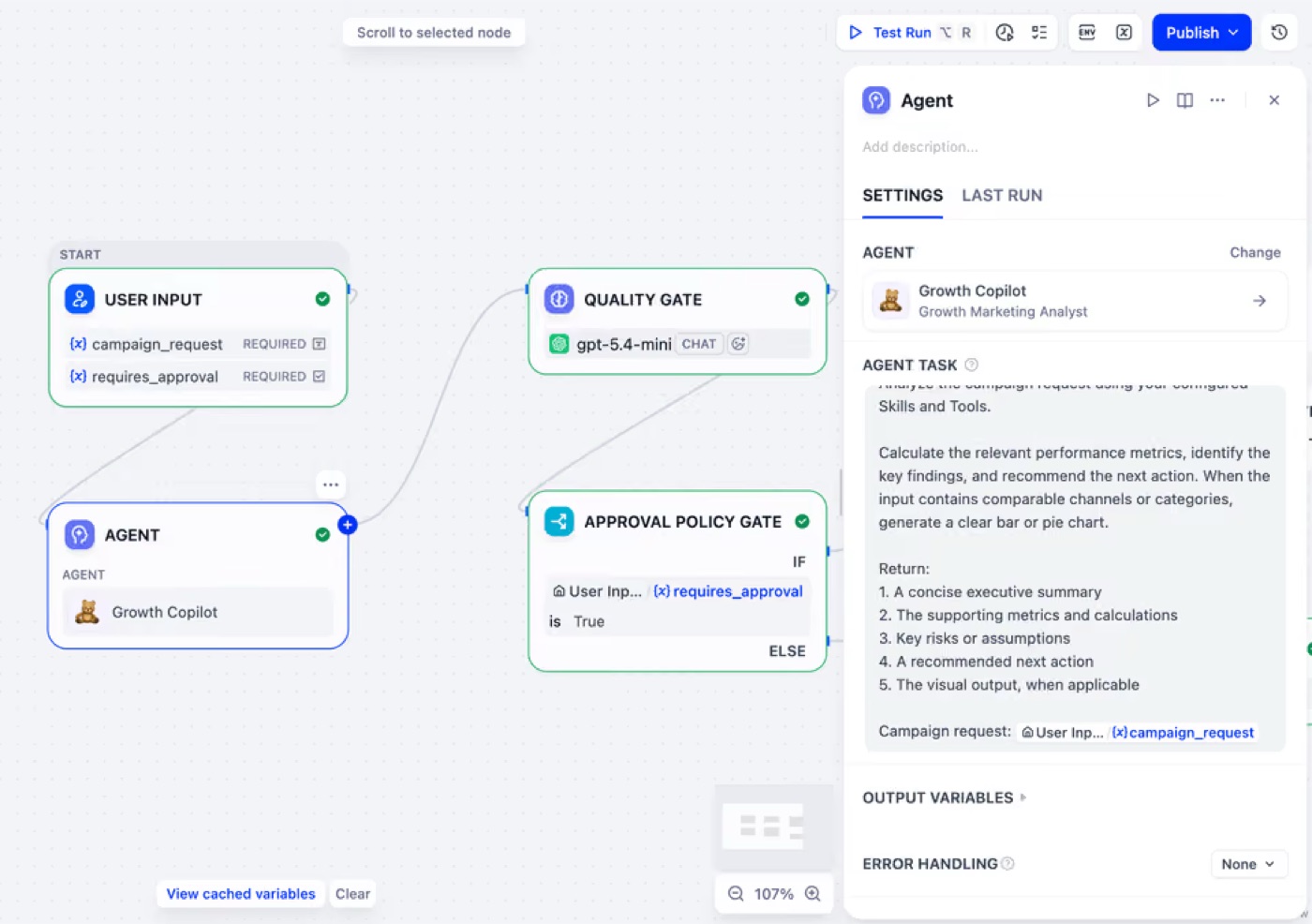
Dify is made by LangGenius, Inc., a Delaware corporation. Builders connect nodes on a canvas for model calls, knowledge retrieval, code, branching, loops, HTTP requests and human approval. A Workflow runs once from input to result and can start from a schedule, webhook or integration event. A Chatflow adds a conversation layer and always starts from a user message. Published apps become web apps and API endpoints, and they can be embedded on a website or exposed as MCP servers to tools such as Claude Desktop and Cursor. The GitHub repository showed about 161,800 stars and 25,500 forks on November 24, 2026.
The product has changed quickly in the second half of 2026. Release 1.16.0 in July introduced the new Dify Agent, which works in its own Linux sandbox, runs commands and installs programs. Release 1.18.0 in October let an agent choose the next workflow branch, and 1.20.0 on November 18, 2026 turned on a new Human Input node that sends approvals by email and through Slack, Feishu or Lark, Microsoft Teams, DingTalk or WeCom. The same release added trace export to any OpenTelemetry collector, optional malware scanning of knowledge uploads and personal access tokens. The new Agent is still labeled beta in the documentation.
Cloud plans are sold per workspace, not per seat. Professional allows 3 members, 50 apps, 500 knowledge documents and 5 GB of knowledge storage; Team allows 50 members, 200 apps, 1,000 documents and 20 GB. Credits are charged per model call and vary by model: at the listed rates, Professional's 5,000 monthly credits equal 5,000 calls to a 1-credit model such as GPT-4o mini, 500 calls to Claude Sonnet 4.6 at 10 credits, or 200 calls to GPT-5.5 at 25 credits. An app that makes several model calls per answer spends credits for each call.
Against rivals covered on this site, Dify is closest to n8n and Botpress. n8n bills by workflow execution and lists $20 a month billed annually for 2,500 executions, which fits general app-to-app automation. Botpress lists Plus at $150 a month billed annually for 250 conversations and includes its own helpdesk. Chatbase is aimed at support bots built from existing content and starts at $120 a month billed yearly for 4,000 message credits. Dify's difference is that document pipelines, prompt work, agents and publishing sit in one self-hostable product, but the messaging and handoff layer is left to plugins or custom code.
The limits are specific. Team doubles Professional's document quota to only 1,000 while costing about 2.7 times as much, and Dify's answer for buying extra vector space or seats on Professional is to upgrade. Self-hosters take on upgrades: release 1.17.1 warned that the bundled Weaviate database had to be moved through 12 minor versions in stages, and that skipping steps could permanently break vector search. The Community Edition is also limited to a single workspace, and the license forbids removing the Dify logo from the console or apps when its frontend is used.
How it scored
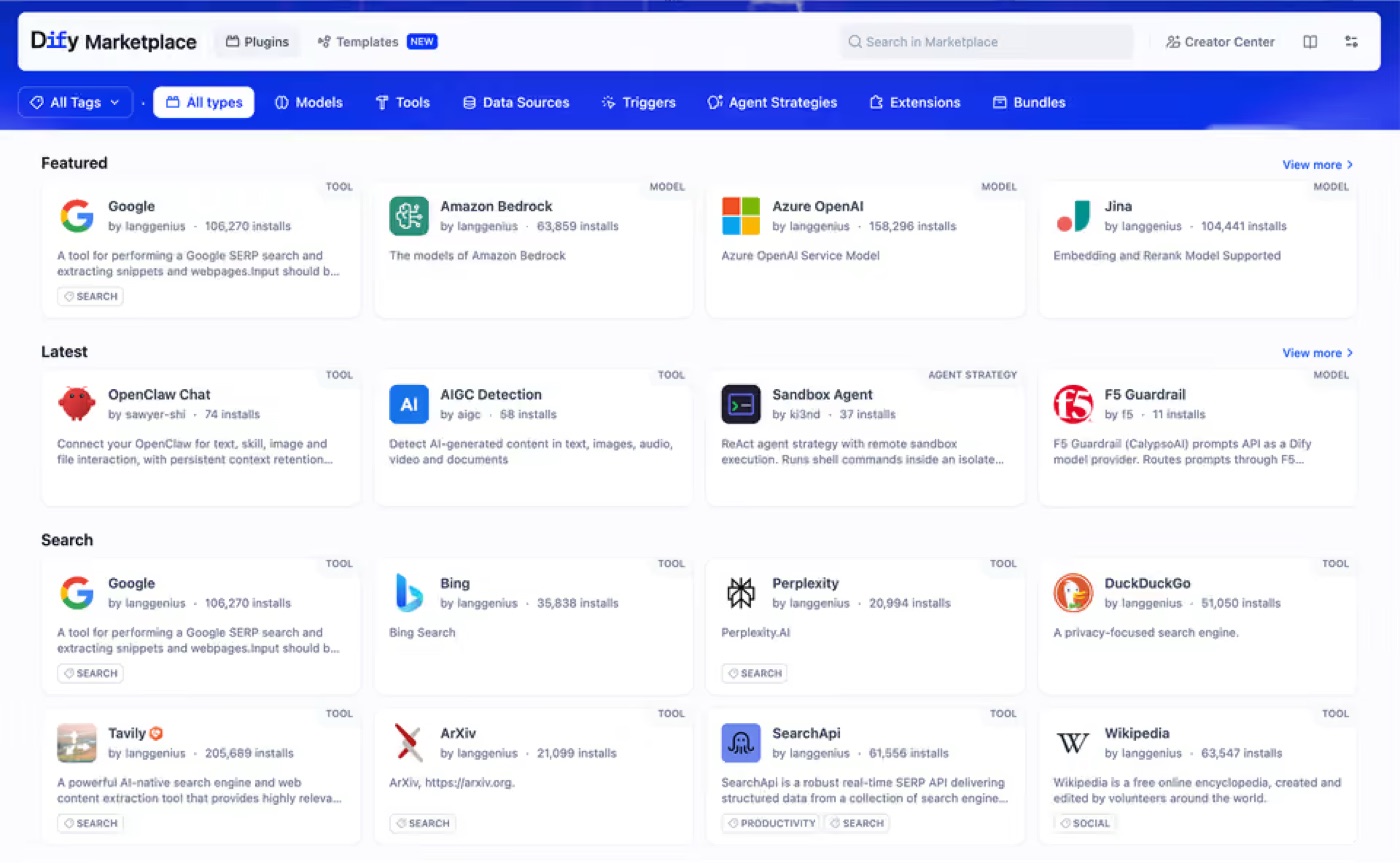
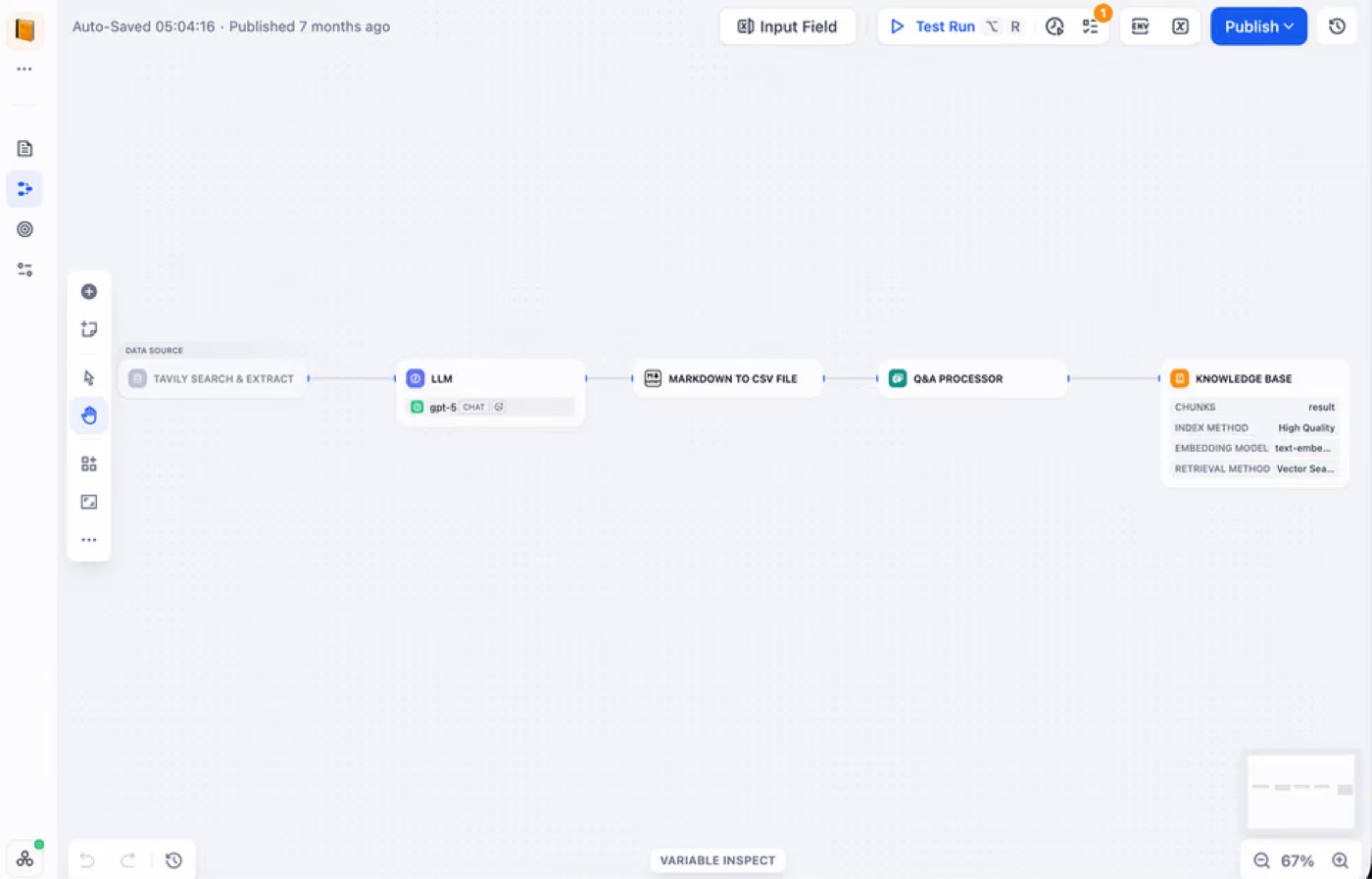
Dify suits Botpress users who want the visual canvas but also want the option to own the stack. The Community Edition is free to self-deploy with Docker, and the same platform runs as Dify Cloud or inside a private VPC. Workflow Studio is the visual builder for agentic workflows, Knowledge Pipeline prepares documents for retrieval, and a marketplace adds tools, models and plugins. Workflows can start from plugins, schedules or webhooks, which makes Dify useful for back-office agents as well as chat. On the cloud, Professional costs $590 per workspace a year with 5,000 message credits a month across OpenAI, Anthropic, Gemini and other providers, then you can switch to your own API key. Team is $1,590 a year for up to 50 members. The tradeoff is that Dify is a builder for AI apps rather than a messaging platform, so WhatsApp or helpdesk handoff needs plugins or your own code.
Who it is for
Developers and small teams who want a visual builder they can self-host for free or run on a flat cloud plan.
Run it if
- Developers building an internal assistant over company documents with vector, full-text or hybrid search and an API
- Organizations that need to keep data on their own servers and can run Docker Compose on a machine with at least 2 CPU cores and 4 GiB of RAM
- Small product teams of up to 3 people who want a fixed $59 a month workspace and their own model API keys
- Teams of 4 to 50 builders, where Team at $159 a month is a flat price rather than a per-seat bill
- Students, teachers and educational staff, who can apply for the yearly Professional plan free of charge
Skip it if
- Support teams that need a helpdesk with human agents in the same product: Botpress, which includes Botpress Desk, is the closer match
- Business users whose work is mostly moving data between SaaS apps: n8n or Activepieces bill per run and focus on app automation
- Owners who want a website answer bot without designing a workflow: Chatbase is simpler
- Companies that want to host Dify for many customers in separate workspaces without a commercial license: Activepieces has an MIT-licensed core and sells an Embed edition from $36k a year
SpecSpec sheet
| Starting paid price | $59 per workspace a month, or $590 a year (Professional) | src ↗ |
|---|---|---|
| Free options | Sandbox cloud plan with 200 message credits; self-hosted Community Edition | src ↗ |
| Billing unit | Per workspace, with message credits charged per model call | src ↗ |
| Included credits | 200 on Sandbox, 5,000 a month on Professional, 10,000 a month on Team | src ↗ |
| Credit cost examples | 1 for GPT-4o mini, 5 for Claude Haiku 4.5, 10 for Claude Sonnet 4.6, 25 for GPT-5.5 | src ↗ |
| Members | 1 on Sandbox, 3 on Professional, 50 on Team | src ↗ |
| Apps | 5 on Sandbox, 50 on Professional, 200 on Team | src ↗ |
| Knowledge quota | 50 documents and 50 MB; 500 documents and 5 GB; 1,000 documents and 20 GB | src ↗ |
| Upload limits (cloud) | Sandbox 1 file of up to 15 MB at a time; paid plans 50 files of up to 50 MB each | src ↗ |
| Knowledge request limit | 10, 100 or 1,000 a minute on Sandbox, Professional and Team | src ↗ |
| Trigger events | 3,000 on Sandbox, 20,000 a month on Professional, unlimited on Team | src ↗ |
| Dify API limit | 5,000 a month on Sandbox; no Dify API rate limit on paid plans | src ↗ |
| Publishing | Web app, API, website embed, MCP server | src ↗ |
| Self-host minimum | 2 CPU cores, 4 GiB RAM, Docker Compose 2.35.0 or later | src ↗ |
| License | Modified Apache 2.0 with multi-tenant and logo conditions | src ↗ |
| Latest release checked | 1.20.0, November 18, 2026 | src ↗ |
Price
Free Sandbox and Community Edition; Professional $590 per workspace a year with 5,000 message credits a month; Team $1,590 a year.
$590 per workspace / year
Quoted from the vendor pricing page on November 9, 2026.
Plans on file · 6
| Plan | Price | Includes | Checked |
|---|---|---|---|
| Sandbox | $0Free cloud plan | 200 message credits; 1 member and 5 apps; 50 knowledge documents and 50 MB of storage; 3,000 trigger events, up to 2 triggers per workflow; 30 days of log history; 5,000 API calls a month | Checked Nov 24, 2026 |
| Professional | $59 a monthPer workspace monthly; $590 billed annually, before tax | 5,000 message credits a month; 3 members and 50 apps; 500 knowledge documents and 5 GB of storage; 100 knowledge requests a minute; 20,000 trigger events a month; No Dify API rate limit | Checked Nov 24, 2026 |
| Team | $159 a monthPer workspace monthly; $1,590 billed annually, before tax | 10,000 message credits a month; 50 members and 200 apps; 1,000 knowledge documents and 20 GB of storage; 1,000 knowledge requests a minute; Unlimited trigger events; Priority workflow execution | Checked Nov 24, 2026 |
| Community Edition | $0 license feeSelf-hosted; you pay for servers and model usage | Core features in the public repository; Single workspace; Local model support; GitHub community support | Checked Nov 24, 2026 |
| Dify Premium on AWS | Price not listed in the Dify docsAWS Marketplace subscription, running in your own AWS account | AMI deployed to your VPC as an EC2 instance; Custom branding, including removal of Powered by Dify | Checked Nov 24, 2026 |
| Enterprise | Custom, price not listedContact sales | Commercial license; Multiple workspaces; SSO through SAML, OIDC and OAuth2; Negotiated SLAs; Professional technical support | Checked Nov 24, 2026 |
Key features
Workflow and Chatflow canvas
Both app types share one node system with model, retrieval, question classifier, if-else, iteration, loop, Python or JavaScript code and HTTP request nodes. Triggers work in Workflows only: schedule, webhook or integration event. Chatflows always begin with a user message.
Knowledge bases and retrieval
High Quality indexing uses embeddings and supports vector, full-text and hybrid search. Economical indexing uses 10 keywords per chunk, consumes no tokens and gives up retrieval accuracy. A knowledge base created as High Quality cannot be switched to Economical later.
Sandboxed Agent (beta)
The new Agent runs commands, installs programs and reads and writes files in its own sandbox. It can be published as a chat app or placed in a workflow as a node. Dify warns that the Community Edition runtime is not a hardened security boundary between mutually untrusted users.
Model choice and own keys
Cloud credits cover selected OpenAI, Anthropic, Gemini, xAI and Tongyi models. A workspace can add its own provider keys and set credits to be used first. Community and Enterprise editions also list local model support.
MCP in both directions
Dify apps can call tools from external MCP servers, and an app can be exposed as an MCP server for Claude Desktop or Cursor. The server setting is off by default, and the generated URL contains credentials, so it needs the same care as an API key.
Human approval
The new Human Input node pauses a workflow and sends a form by email; workspace members can also get it in Slack, Feishu or Lark, Microsoft Teams, DingTalk or WeCom. The first response from any recipient decides the outcome and closes the request.
Logs and tracing
Conversation logs show token spend, latency and feedback, while workflow logs show a node-by-node trace. Traces can go to Langfuse, LangSmith, Opik, Phoenix and others, and release 1.20.0 added export to any OpenTelemetry collector.
Strengths and weaknesses
Plus · 7
- Flat workspace pricing: Team is $159 a month for up to 50 members, about $3.18 per member when every place is used
- Community Edition has no license fee and starts on a machine with 2 CPU cores and 4 GiB of RAM
- Own API keys can take over when credits run out, so a paid workspace is not capped at 5,000 or 10,000 credits
- One published app is available as a web app, an API, a website embed and an MCP server
- High Quality knowledge bases offer vector, full-text and hybrid search, with files of up to 50 MB on paid cloud plans
- Active development: stable releases 1.18.0, 1.19.0 and 1.20.0 arrived between October 23 and November 18, 2026
- Verified students and educational staff can get the $590 yearly Professional plan free, with 200 one-time AI credits
Minus · 6
- Professional stops at 3 members and 500 documents; Dify's pricing FAQ recommends upgrading to the $159 Team plan rather than selling extra seats or vector space
- Premium models drain credits: at 25 credits a call, 5,000 credits cover 200 GPT-5.5 calls
- The license bars multi-tenant use without written authorization and bars removing the Dify logo when the frontend is used
- Self-hosted upgrades can need care: 1.17.1 required a staged Weaviate move from 1.27.0 to 1.39.2, with a warning that skipping steps could permanently break vector search
- Knowledge retrieval inside a loop counts each pass toward the per-minute limit, and refused requests count too
- Fees are generally non-refundable under the terms, and SSO is listed as an Enterprise feature with no public price
Key facts
- Plans: Sandbox free, Professional $590 and Team $1,590 per workspace a year
- Professional limits: 3 members, 50 apps, 500 knowledge documents, 5GB storage
- Open source: Community Edition under the Dify Open Source License
- GitHub: About 161k stars on langgenius/dify
Where it ranks
Dify is No. 1 in our Best Botpress Alternatives verdict.
AltAlternatives to weigh
- n8n →Better for general automation between business apps; cloud Starter is $20 a month billed annually for 2,500 executions and all plans allow unlimited users.
- Botpress →Better for customer support agents with a built-in helpdesk; the free plan covers 100 conversations a month and Plus is $150 a month billed annually.
- Activepieces →A lower-cost open-source automation tool with an MIT-licensed core; the free plan has 1,000 credits a month and Plus is $20 flat.
- Gumloop →A hosted choice for operations and sales teams; Pro is $37 a month with 20,000 credits and unlimited seats, but there is no self-hosted edition.
- Chatbase →Simpler for a website support bot trained on existing content; Basic is $120 a month billed yearly with 4,000 message credits and a helpdesk inbox.
Questions readers ask
- QIs Dify worth it?
- ADify is worth it for technical teams that need document search, workflows and agents in one builder, at $59 a month per workspace or no license fee when self-hosted. It is less useful for a team that needs a live support inbox, since Dify is an app builder rather than a helpdesk.
- QIs Dify free?
- ADify has two free options: the cloud Sandbox plan and the self-hosted Community Edition. Sandbox includes 200 message credits, 1 member, 5 apps and 50 documents; self-hosting has no license fee, but servers and model usage are extra.
- QHow much does Dify cost?
- ADify Professional costs $59 per workspace a month or $590 a year, and Team costs $159 a month or $1,590 a year, before taxes. Enterprise pricing is not listed. These prices were checked in November 2026.
- QIs Dify open source?
- ADify calls itself open source, but its license is a modified Apache 2.0 with extra conditions. Running a multi-tenant service needs written authorization, and the logo and copyright notices cannot be removed when Dify's frontend is used.
- QCan Dify be used commercially?
- AYes, the Dify license permits commercial use, including as a backend service for other applications or as an internal development platform. A commercial license is required for multi-tenant operation or for removing the logo, unless the use avoids the Dify frontend in the logo case.
- QDify vs n8n: which is better?
- ADify is better for AI apps built around documents and chat, while n8n is better for general automation across business apps. Dify charges $59 per workspace a month for Professional; n8n Starter is $20 a month billed annually for 2,500 executions.
- QWhat happens when Dify message credits run out?
- AThe workspace can continue on its own model provider API key once its message credits are used up. Credits are deducted per model call, from 1 for small models such as GPT-4o mini to 25 for GPT-5.5.
- QWhat are the requirements to self-host Dify?
- ADify requires at least 2 CPU cores, 4 GiB of RAM and Docker Compose 2.35.0 or later. On macOS, the docs recommend giving the Docker Desktop virtual machine 8 GiB of memory. The default setup includes PostgreSQL and Weaviate.
LogSource log
- [01]Dify pricing overview · checked Nov 24, 2026
- [02]Dify Cloud plan comparison and credit rates · checked Nov 24, 2026
- [03]Dify Community and Enterprise comparison · checked Nov 24, 2026
- [04]Dify Terms of Service · checked Nov 24, 2026
- [05]Dify license · checked Nov 24, 2026
- [06]Dify GitHub repository · checked Nov 24, 2026
- [07]Dify release 1.20.0 · checked Nov 24, 2026
- [08]Dify release 1.19.0 · checked Nov 24, 2026
- [09]Dify release 1.18.0 · checked Nov 24, 2026
- [10]Dify release 1.17.1 · checked Nov 24, 2026
- [11]Dify release 1.16.0 · checked Nov 24, 2026
- [12]Dify docs: Docker Compose deployment · checked Nov 24, 2026
- [13]Dify docs: Dify Premium on AWS · checked Nov 24, 2026
- [14]Dify docs: Billing and education plan · checked Nov 24, 2026
- [15]Dify docs: Model providers · checked Nov 24, 2026
- [16]Dify docs: Manage members · checked Nov 24, 2026
- [17]Dify docs: Upload local files · checked Nov 24, 2026
- [18]Dify docs: Knowledge request rate limit · checked Nov 24, 2026
- [19]Dify docs: Logs · checked Nov 24, 2026
- [20]Dify docs: Agent · checked Nov 24, 2026
- [21]Dify docs: Human Input · checked Nov 24, 2026
- [22]Dify docs: MCP server · checked Nov 24, 2026
- [23]Dify docs: Tools · checked Nov 24, 2026
- [24]Dify docs: Publishing overview · checked Nov 24, 2026
- [25]Dify docs: Workflow and Chatflow · checked Nov 24, 2026
- [26]Dify docs: Index methods and retrieval · checked Nov 24, 2026
- [27]Dify docs index · checked Nov 24, 2026
- [28]n8n pricing · checked Nov 18, 2026
- [29]Botpress pricing · checked Nov 24, 2026
- [30]Activepieces pricing · checked Nov 24, 2026
- [31]Gumloop pricing · checked Nov 24, 2026
- [32]Gumloop docs: Credits · checked Nov 24, 2026
- [33]Activepieces license · checked Nov 24, 2026
- [34]Chatbase pricing · checked Nov 24, 2026
Deep review last updated November 24, 2026. Prices and specs are rechecked against these pages.
Alternatives we scored
- Voiceflow8.4
- Microsoft Copilot Studio8.1
- Rasa8.0
- Typebot8.0
Cite this page
DBotMaker. Dify review. Updated November 24, 2026. https://dbotmaker.io/review/dify
Visit dify.ai · Questions or corrections: editorial@dbotmaker.io