Review · Software & AI
 Google Dialogflow CX review
Google Cloud's conversational agent service with intent-based flows and generative playbooks for chat and voice.
By the DBotMaker research desk · Updated November 24, 2026
Short answer · output
Google Dialogflow CX is Google Cloud's service for building chat and voice agents, now sold as the Flows edition of Conversational Agents, with generative Playbooks alongside it. Checked in November 2026, it costs $0.007 per chat request and $0.001 per second of voice audio on Flows, or $0.012 per request and $0.002 per second on Playbooks, with no monthly fee and $600 plus $1,000 in trial credits for new users. It suits engineering teams on Google Cloud building high-volume phone or chat agents that need deterministic, auditable conversation paths.
- Capabilities (40%)
- 8.6
- Ease of setup (30%)
- 6.8
- Value (30%)
- 7.8
In pictures · 3 images
Verdict printout · Google Dialogflow CX
Pick Dialogflow CX if you have developers, a Google Cloud project and a contact center or high-volume chat use case where conversations must follow designed paths, such as authentication, payments or order status, and you want to pay only per request or per second of audio. Skip it if you want a no-code support bot trained on your help center by a non-technical team, where Intercom Fin or Botpress get you live faster, or if you are already on AWS, where Amazon Lex charges $0.00075 per text request. The deciding fact is the billing model: 1,000 chat requests cost $7.00 on Flows and $12.00 on Playbooks, but if a Playbook calls a Flow, every turn in that conversation is billed at the Playbooks rate.
ReadOverview
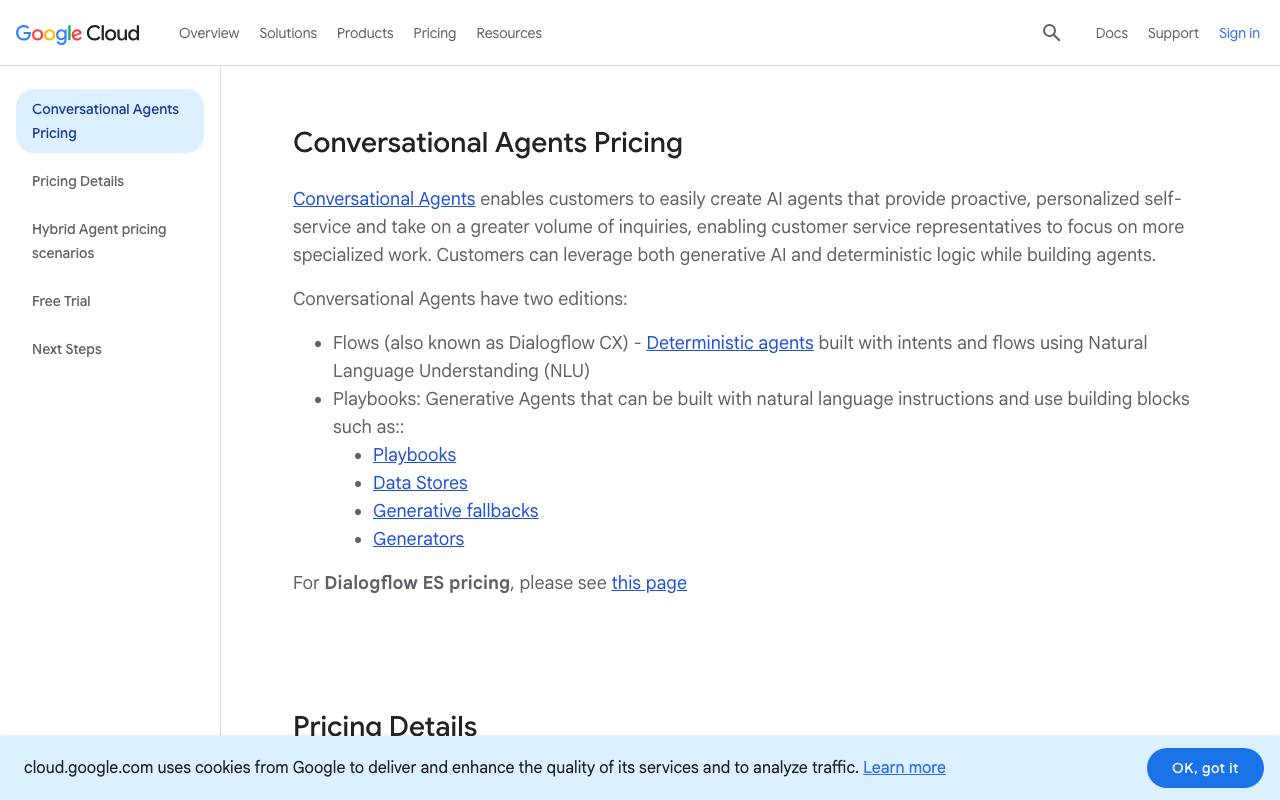
Dialogflow CX is the advanced agent type in Google's Dialogflow family. Google's editions page describes it as suitable for large or complex applications, with a graph structure of flows and pages and a state machine model where pages act as nodes and state handlers control the path. The older Dialogflow ES type uses a flat list of intents and contexts and is aimed at small to medium applications. On the current pricing page Google files Dialogflow CX under Conversational Agents, which has two editions: Flows (also known as Dialogflow CX), for deterministic agents built with intents and natural language understanding, and Playbooks, for generative agents built from natural language instructions with data stores, generators and generative fallbacks.
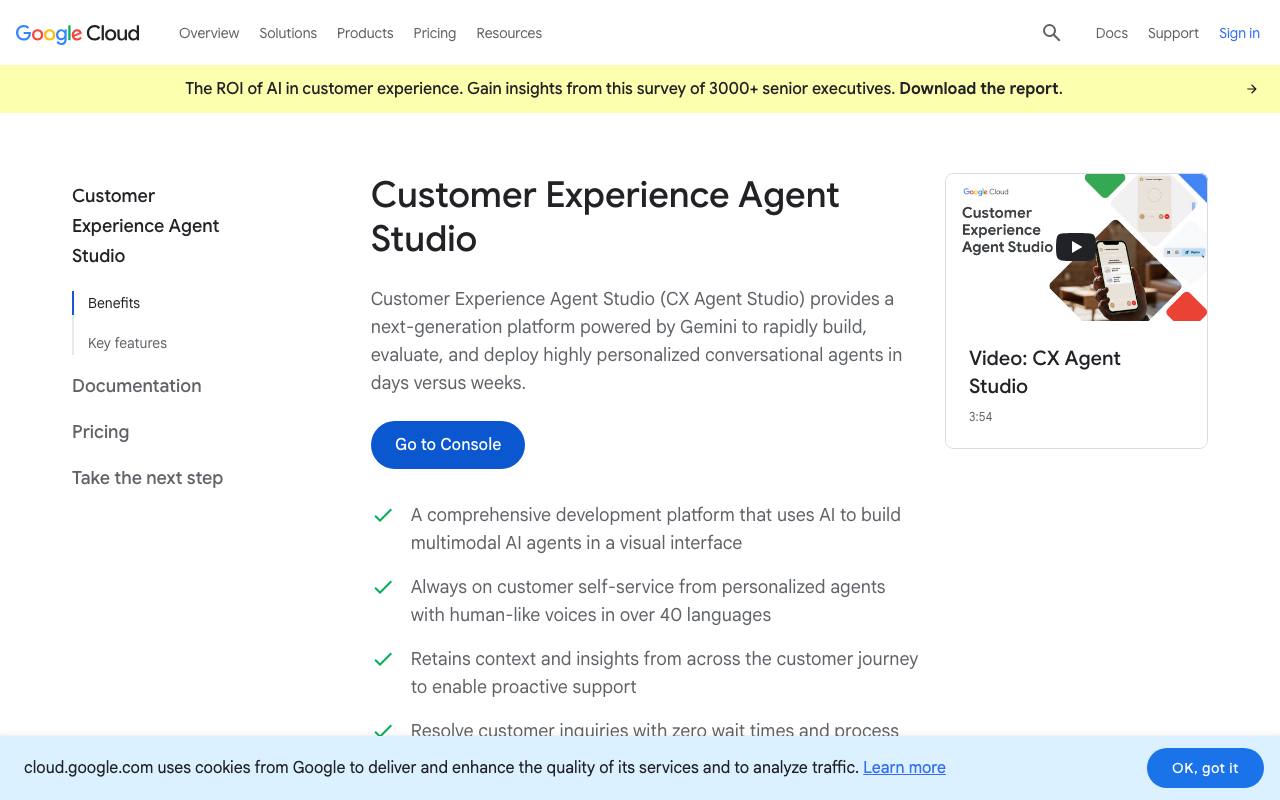
The product line-up changed in 2026. Google's documentation now points builders to the Conversational Agents console, described as the new interface replacing the Dialogflow CX console, and lists the old Dialogflow CX console as deprecated. Separately, the cloud.google.com/dialogflow product page now leads with Customer Experience Agent Studio (CX Agent Studio), a Gemini-based builder with 35 prebuilt agent templates and voices in over 40 languages, priced at $0.50 per session for chat or voice. Dialogflow CX agents keep their own per-request pricing, so teams evaluating Google should price both options against their expected session length.
Pricing is pure usage. Chat agents are billed per request, voice agents per second of audio, where billed time is the seconds the agent listens plus the full length of its spoken reply, rounded up per turn, even if the caller interrupts it. Design-time requests in the visual builder are free. Data store index storage has a free quota of 10 GiB a month, then $5.00 per GiB. New users get $600 in Flows credits and $1,000 in Playbooks credits that expire after 12 months. Hybrid agents need care: when a Flow calls a Playbook, only the generative turns cost the higher rate, but when a Playbook calls a Flow, the whole conversation is billed as Playbooks.
Compared with the other enterprise platforms ranked on this site, Dialogflow CX has unusually transparent public pricing. Amazon Lex is cheaper per text request at $0.00075 and fits teams on AWS and Amazon Connect. Microsoft Copilot Studio sells capacity in $200 monthly packs of 25,000 Copilot Credits and fits Microsoft 365 organizations. Kore.ai and NiCE Cognigy target the same contact center buyers, but their USD list prices could not be confirmed on their own pages. Dialogflow CX's strengths are its telephony options (its own Phone Gateway plus AudioCodes, Avaya, Twilio and Voximplant partner integrations), 34 prebuilt flow components for banking, retail and telecom tasks, and a 99.9% monthly uptime SLA.
The limits are real. Google's quotas page caps each agent at 50 flows, 250 pages per flow, 10,000 intents and 100 webhooks, and the default text quota is 1,200 requests per minute per project, with generative features limited to 600,000 tokens per minute by default. The Phone Gateway only works with agents in the global region and is limited to US phone numbers. Playbooks are excluded from the Dialogflow CX SLA and do not accept DTMF keypad input from phone systems. Building well also assumes Google Cloud skills: a project, billing, IAM permissions and usually a webhook service for anything that touches back-end data.
How it scored
Dialogflow CX is the cloud-native alternative for teams that want to pay per request and run on Google Cloud. Agents come in two styles. Flows are deterministic, built from intents, entities, pages and state handlers on a visual graph, and Playbooks are generative agents defined by instructions, tools and data stores. Both can be mixed in one agent. Prebuilt flow components handle authentication, payments, order status and other common tasks. Voice is a strength: the Phone Gateway, Twilio, Avaya, AudioCodes, Voximplant and SIP trunks connect agents to phone lines, and Dialogflow Messenger embeds a web widget. Flows cost $0.007 per chat request or $0.001 per second of audio, and Playbooks cost $0.012 per chat request. That beats Botpress's conversation packs at low volume, but you need a Google Cloud project, IAM and webhook code to get far.
Who it is for
Developers on Google Cloud building high-volume chat or phone agents with pay-per-request billing.
Run it if
- Contact centers building IVR or phone agents that need Google-hosted numbers or SIP and partner telephony through AudioCodes, Avaya, Twilio or Voximplant, billed at $0.001 per second of audio on Flows
- Engineering teams already on Google Cloud that want deterministic, testable conversation paths with up to 50 flows and 2,000 test cases per agent
- Banks, retailers and telecom operators that can start from Google's prebuilt components for authentication, payments, card locking, order status and returns
- Teams in regulated industries that need a chosen data region, customer-managed encryption keys and a 99.9% uptime SLA
- High-volume chat projects where per-request pricing ($7.00 per 1,000 Flows requests) is easier to forecast than seat or resolution pricing
Skip it if
- Small businesses that want a support bot trained on their website without developers: Botpress, with a free plan and Plus at $150 a month billed annually, or Intercom Fin are faster to set up
- Teams running on AWS and Amazon Connect: Amazon Lex charges $0.00075 per text request and $0.004 per speech request and avoids a second cloud
- Microsoft 365 organizations that want agents inside Teams and SharePoint: Microsoft Copilot Studio fits that stack better
- Projects that need phone numbers outside the US through the built-in gateway: Phone Gateway support is limited to US numbers, so a partner integration such as Twilio or a SIP setup is needed instead
SpecSpec sheet
| Pricing model | Pay as you go per request (chat) or per second of audio (voice); no monthly fee | src ↗ |
|---|---|---|
| Flows (Dialogflow CX) price | $0.007 per chat request, $0.001 per second of voice | src ↗ |
| Playbooks price | $0.012 per chat request, $0.002 per second of voice | src ↗ |
| Free trial credits | $600 for Flows and $1,000 for Playbooks, expire after 12 months | src ↗ |
| Data store storage | 10 GiB a month free, then $5.00 per GiB of raw data | src ↗ |
| Agent structure | Graph of flows and pages, state machine model with state handlers | src ↗ |
| Playbook models | gemini-2.5-flash, gemini-2.5-flash-lite, gemini-3.1-flash-lite, gemini-3.5-flash-lite (all GA) | src ↗ |
| Built-in channels | Phone Gateway, Dialogflow CX Messenger, Messenger from Meta, Workplace from Meta, LINE, Slack, Google Chat | src ↗ |
| Partner telephony | AudioCodes, Avaya, Twilio, Voximplant (supported by the partners, not Google) | src ↗ |
| Phone Gateway limits | Global region agents only, US phone numbers only, 100 total phone minutes per minute | src ↗ |
| Default request quotas | 1,200 text requests and 600 audio requests per minute; 600,000 generative tokens per minute | src ↗ |
| Agent size limits | 50 flows per agent, 250 pages per flow, 10,000 intents, 100 webhooks, 20 environments | src ↗ |
| Uptime SLA | 99.9% monthly uptime, 10% to 50% service credits below it; Playbooks excluded | src ↗ |
| Data residency | Agent region chosen at creation, data at rest kept in that region; location cannot be changed later | src ↗ |
Price
Flows chat $0.007 per request and voice $0.001 per second; Playbooks chat $0.012 per request.
Chat $0.007 / 1 count $0.012 / 1 count
Quoted from the vendor pricing page on November 9, 2026.
Plans on file · 3
| Plan | Price | Includes | Checked |
|---|---|---|---|
| Conversational Agents (Flows), also known as Dialogflow CX | $0.007 per chat request; $0.001 per second of voice audiopay as you go, monthly Google Cloud bill | Deterministic agents built with intents, flows and pages; Design-time requests in the visual builder free of charge; Voice billed on input plus output seconds per turn, rounded up; $600 in free trial credits for new users, valid 12 months | Checked Nov 24, 2026 |
| Conversational Agents (Playbooks) | $0.012 per chat request; $0.002 per second of voice audiopay as you go, monthly Google Cloud bill | Generative agents built from natural language instructions; Data stores, generators and generative fallbacks billed as one request when used together; Data store index storage: 10 GiB a month free, then $5.00 per GiB; $1,000 in free trial credits for new users, valid 12 months | Checked Nov 24, 2026 |
| Custom quote | price not listedcontract through Google Cloud sales | Google Cloud's pricing page offers a custom quote through its sales team | Checked Nov 24, 2026 |
Key features
Flows, pages and state handlers
Conversations are designed as a visual graph. Each flow holds pages, each page collects parameters and uses routes and event handlers to decide the next step, so designers control exactly where a conversation can go. Intents are decoupled from fulfillment and can be reused across flows, and webhook errors trigger explicit error events rather than failing quietly as they can in Dialogflow ES.
Generative Playbooks
Playbooks are the building blocks of generative agents: each one has instructions and examples for a task, can call external services, and can hand a sub-task to a flow or another playbook. Builders can pick from four Gemini models listed as GA, including gemini-2.5-flash and gemini-3.5-flash-lite, at the agent level or per request. Playbooks run in 17 listed regions, including global, us, eu and several Asian locations.
Prebuilt components
Google ships 13 building block flows, such as address, date of birth, credit card number and ZIP code collection, and 21 use case flows, including authentication, make a payment, lock card, lost and stolen card, order status, return and refund, and telecommunications steering. They come with intents and entities ready to use; anything that touches a back end needs its webhook configured.
Telephony
The Dialogflow CX Phone Gateway assigns a Google-hosted phone number to an agent for conversational IVR, with a default quota of 100 total phone minutes per minute. Calls can also arrive through partner integrations from AudioCodes, Avaya, Twilio and Voximplant, which the partners support rather than Google. The gateway uses the phone_call speech model by default and supports every language that has both speech-to-text and text-to-speech.
Chat channels and open source connectors
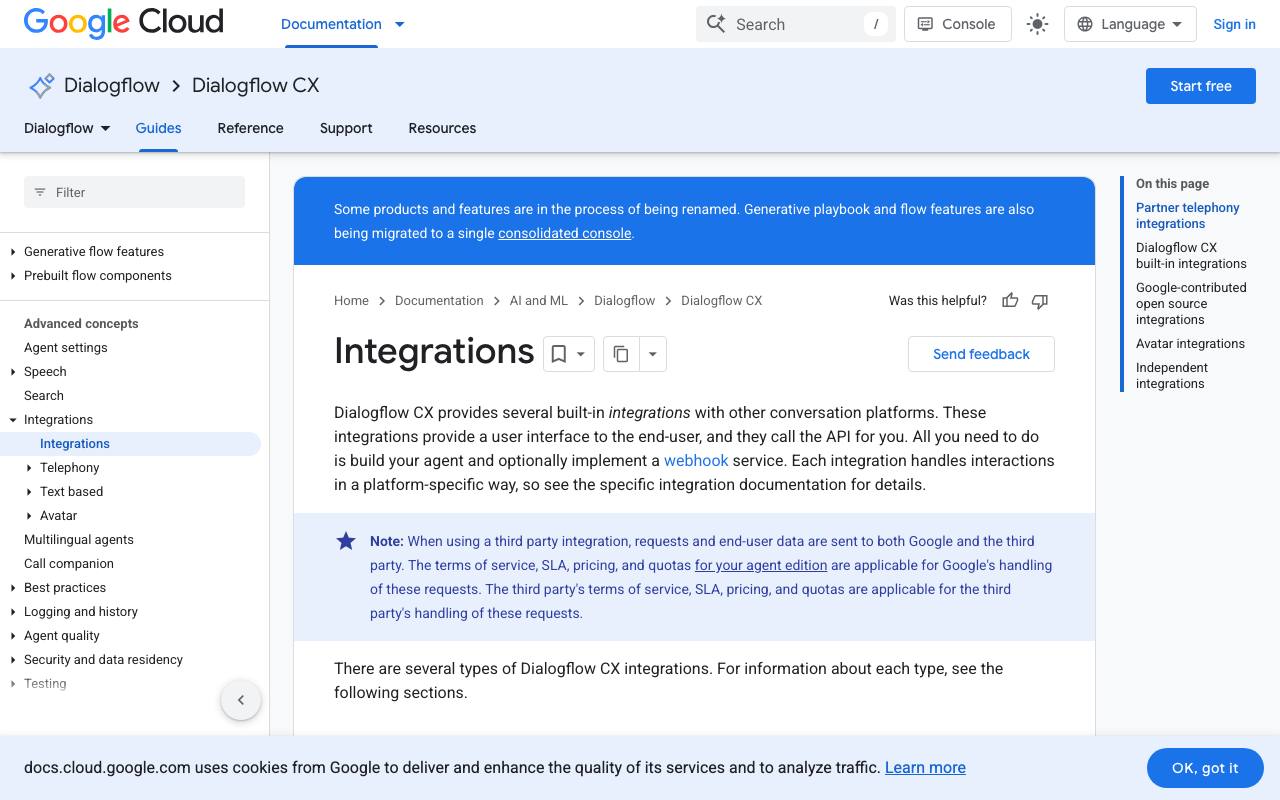
Built-in integrations cover the Dialogflow CX Messenger web widget, Messenger from Meta, Workplace from Meta, LINE, Slack and Google Chat. Google has also published open source integrations for Microsoft Teams through Azure Bot Service, Discord, ServiceNow, Telegram, Twilio, Viber and others that teams can fork and host themselves.
Regions and encryption
Each agent is pinned to a region at creation, and Dialogflow CX keeps data at rest inside that region; regions include Iowa, South Carolina, Oregon, Montreal, Belgium, London, Frankfurt and the Netherlands. Customer-managed encryption keys can be set in location settings. Moving an agent to another region requires export and restore into a new agent.
Strengths and weaknesses
Plus · 7
- Public, per-use pricing: 1,000 chat requests cost $7.00 on Flows, and a 3-minute voice call costs $0.18 on Flows or $0.36 on Playbooks, with no platform fee
- Large trial allowance for new users: $600 in Flows credits and $1,000 in Playbooks credits, valid for 12 months
- Design-time requests in the builder are free, so building and browsing an agent does not add to the bill
- 34 prebuilt flow components for banking, retail and telecom tasks such as authentication, payments, lost cards and returns
- Deep telephony support: a Google-hosted Phone Gateway plus four partner telephony integrations and DTMF in flows
- 99.9% monthly uptime SLA with service credits of 10%, 25% or 50% of the monthly bill when Google misses it
- Generous agent capacity: up to 10,000 intents, 50 flows and 2,000 test cases per agent, and 1,000 agents per project
Minus · 6
- Hybrid billing trap: if a Playbook calls a Flow at any point, every turn in the conversation is billed at the Playbooks rate of $0.012 per request or $0.002 per second
- The Phone Gateway works only with agents in the global region and only with US phone numbers
- Playbooks are excluded from the Dialogflow CX SLA and do not accept DTMF keypad input
- Text requests cost about nine times more than Amazon Lex text requests ($0.007 versus $0.00075)
- Requires a Google Cloud project, billing, IAM setup and usually a webhook service, so non-technical teams will need developer help
- Product naming is in flux: Dialogflow CX, Conversational Agents and CX Agent Studio ($0.50 per session) appear side by side, and the old CX console is deprecated
Key facts
- Flows pricing: Chat $0.007 per request, voice $0.001 per second
- Playbooks pricing: Chat $0.012 per request, voice $0.002 per second
- Editions: Flows (intent-based) and Playbooks (generative)
- Security: CMEK, VPC Service Controls and regional settings
Where it ranks
Google Dialogflow CX is No. 7 in our Best Botpress Alternatives verdict and No. 3 in Best Conversational AI Platforms and No. 3 in Best Voiceflow Alternatives.
AltAlternatives to weigh
- Amazon Lex →The closest like-for-like engine for teams on AWS: $0.00075 per text request and $0.004 per speech request, with native Amazon Connect integration.
- Microsoft Copilot Studio →Fits Microsoft 365 organizations that want agents in Teams and SharePoint, priced at $200 a month per pack of 25,000 Copilot Credits or pay as you go.
- Botpress →A hosted visual builder with a permanent free plan and a built-in helpdesk, easier for smaller support teams than a Google Cloud project.
- RasaFor teams that want to self-host their conversational AI: a free Developer Edition covers one bot and up to 1,000 external conversations a month.
Questions readers ask
- QHow much does Dialogflow CX cost?
- ADialogflow CX (the Flows edition) costs $0.007 per chat request and $0.001 per second of voice audio, according to Google's pricing page in November 2026. Generative Playbooks cost $0.012 per request and $0.002 per second. There is no monthly platform fee, and design-time requests in the builder are free.
- QDoes Dialogflow CX have a free plan?
- ANo, Dialogflow CX has no permanent free tier, but new users get $600 in Flows credits and $1,000 in Playbooks credits that activate automatically and expire after 12 months. At $0.007 per request, $600 covers about 85,700 Flows chat requests. Data store index storage also includes 10 GiB a month free.
- QWhat is the difference between Dialogflow CX and Dialogflow ES?
- ADialogflow CX uses a graph of flows and pages with a state machine model, while Dialogflow ES uses a flat list of intents with contexts to steer the conversation. Google positions CX for large or complex applications and ES for small to medium ones. CX also supports generative Playbooks, and ES is priced separately.
- QIs Dialogflow CX being replaced by CX Agent Studio?
- AGoogle now markets Customer Experience Agent Studio on its Dialogflow product page at $0.50 per session, while Dialogflow CX remains on sale as the Flows edition of Conversational Agents with per-request pricing. The Conversational Agents console has replaced the Dialogflow CX console, which Google lists as deprecated. The pricing page bills Flows and Playbooks separately from CX Agent Studio sessions.
- QDialogflow CX vs Amazon Lex: which is cheaper?
- AAmazon Lex is cheaper per text request at $0.00075, compared with $0.007 for a Dialogflow CX Flows request. For voice, Lex charges $0.004 per speech request while Dialogflow CX bills $0.001 per second of audio, so the cheaper option depends on how long each turn lasts. The bigger factor is usually which cloud the rest of the stack already runs on.
- QCan Dialogflow CX answer phone calls?
- AYes, the Dialogflow CX Phone Gateway connects a Google-hosted phone number to an agent, but it is limited to US numbers and agents in the global region. Calls can also come through partner integrations with AudioCodes, Avaya, Twilio and Voximplant. Voice is billed at $0.001 per second on Flows.
- QWhich AI models do Dialogflow CX Playbooks use?
- APlaybooks use Google Gemini models: the documentation lists gemini-2.5-flash, gemini-2.5-flash-lite, gemini-3.1-flash-lite and gemini-3.5-flash-lite as generally available. The model can be set for the whole agent or overridden per request. Generative features have a default quota of 600,000 tokens per minute.
- QIs Dialogflow CX worth it?
- ADialogflow CX is worth it for developer-led teams on Google Cloud that need designed, testable conversation paths for chat or phone at volume, at $7.00 per 1,000 Flows chat requests. It is a poor fit for small teams without developers, which will reach a working support bot faster with a no-code tool such as Botpress or Intercom Fin.
LogSource log
- [01]Conversational Agents pricing, Google Cloud · checked Nov 24, 2026
- [02]Customer Experience Agent Studio, Google Cloud · checked Nov 24, 2026
- [03]Editions, Dialogflow documentation · checked Nov 24, 2026
- [04]Playbooks, Dialogflow CX documentation · checked Nov 24, 2026
- [05]Integrations, Dialogflow CX documentation · checked Nov 24, 2026
- [06]Dialogflow CX Phone Gateway, Dialogflow CX documentation · checked Nov 24, 2026
- [07]Prebuilt components overview, Dialogflow CX documentation · checked Nov 24, 2026
- [08]Regionalization and location settings, Dialogflow CX documentation · checked Nov 24, 2026
- [09]Quotas and limits, Dialogflow documentation · checked Nov 24, 2026
- [10]Dialogflow Service Level Agreement · checked Nov 24, 2026
- [11]Language reference, Dialogflow CX documentation · checked Nov 24, 2026
Deep review last updated November 24, 2026. Prices and specs are rechecked against these pages.
Alternatives we scored
- Dify8.4
- Voiceflow8.4
- Microsoft Copilot Studio8.1
- Rasa8.0
Cite this page
DBotMaker. Google Dialogflow CX review. Updated November 24, 2026. https://dbotmaker.io/review/google-dialogflow-cx
Visit cloud.google.com · Questions or corrections: editorial@dbotmaker.io