Operator manual · General
Single Agent vs Multi Agent: How to Choose
In short
Compare single agent vs multi agent with a 2026 decision rule, benchmark swings from big losses to big gains, and published run costs.
DBotMaker research desk · Updated November 22, 2026 · 12 min read
Keep one agent unless the work splits into independent parallel subtasks. Multi-agent systems can improve results, but adding agents does not guarantee a better outcome.
The popular advice to add specialists as workloads become more complicated skips the important question: can those specialists finish useful work without repeatedly consulting each other? Complexity alone doesn't justify distributed execution. A difficult task can still need one continuous chain of decisions.
Treat agent count as operational risk, not a capability upgrade. Additional agents must earn their place through better completed outcomes after accounting for messaging, checking, latency, and recovery costs.
Table of Contents
- The Default Pick Is One Agent
- Task Shape Decides the Design
- How Planning, Memory, and Messages Differ
- Token Cost Latency and Dollar Spend
- Workflows That Fit Each Design
- Keep One Agent Until the Matched Test Pays
The Default Pick Is One Agent
A single agent is the starting design for sequential work, shared memory, and workflows already running on a capable model. It can plan, call tools, inspect results, and revise its next action without passing ownership elsewhere. Several agents become defensible when separate investigations can proceed independently and an aggregator can verify their outputs.
The average result in the opening isn't a promise that every architecture performs equally. The distribution matters more than the average. Large gains and large losses can coexist, which makes a blanket recommendation to add agents a poor buying rule.
Decision rule: An additional agent needs a specific job, a verifiable output, and a measurable advantage over keeping that job inside the existing execution loop.
A team should classify its workflow before choosing an orchestrator:
- Sequential: Each action changes what the next action should be. Repository edits and account changes belong here.
- Independently parallel: Separate investigations can finish without waiting for another investigator's intermediate decisions.
- Mixed: Routine requests follow a short path, while exceptional requests need specialist help.
Start with the dependency map
The useful diagram isn't a collection of agent personas. It's a map of which actions depend on which facts. A researcher and a reviewer may sound like different roles, but role labels don't establish independence.
Teams should draw the task as actions and dependencies, then identify where a result can be checked against an external source, test, or authoritative record. If every branch reconnects before useful work can continue, splitting the task probably creates handoffs rather than parallelism.
The architectural choice should follow those dependencies. A specialist is justified by a separable responsibility, not a more elaborate prompt.
Task Shape Decides the Design
Default to one agent. Add specialists only when independent subtasks deliver a measurable gain after coordination costs.
| Workflow shape | Start with | Evidence anchor | Flip the call if |
|---|---|---|---|
| Sequential planning or shared state | Single agent | The 2026 controlled evaluation found 0.0 percent average improvement for multi-agent systems, with a 95 percent confidence interval from minus 58.7 percent to plus 77.2 percent | Subtasks become independent and an aggregator can check their results |
| Independent parallel research | Multi-agent candidate | The same evaluation found no average improvement across its tested configurations | Agents must repeatedly negotiate the same facts |
| Static planning | Single agent | REALM-Bench reported 85 to 95 percent success for single-agent static planning versus 45 to 70 percent for multi-agent dynamic cases. These were not matched task conditions. | The environment becomes dynamic and separable responsibilities justify retesting |
| Strong coding baseline | Single agent | The 2026 controlled evaluation's SWE-bench Verified results showed changes from minus 13 to minus 1 percent across tested multi-agent architectures | A specialist needs a tool the base agent cannot call |
| Mixed easy work plus rare hard cases | Hybrid candidate | Selective collaboration has published accuracy and deployment-cost benefits | Escalations become the normal path rather than the exception |
| Diagram math with a strong single model | Single agent | The 2026 EACL paper reported Gemini 2.0 Flash at 85.19 percent versus 83.86 percent on Geometry3K | A measured gain justifies additional tokens |
| Newer decomposable math set | Multi-agent only after a cost test | The same EACL evaluation reported We-Math gains of 2.66 and 4.64 percentage points for Qwen-2.5-VL 7B and 32B, respectively | The accuracy improvement doesn't justify added latency |
The 2026 Nature Machine Intelligence controlled evaluation covered 260 configurations, six benchmarks, five agent architectures, and three large-language-model families. Its average result was 0.0 percent improvement, with a 95 percent confidence interval from minus 58.7 percent to plus 77.2 percent and a 37.5 percent standard deviation (the evaluation's results). Decentralized WorkBench execution improved performance 5.6 percent, from 0.629 to 0.664. Centralized and hybrid designs each underperformed the single-agent baseline by 1.2 percent.
These findings do not support a blanket ranking of one design over another. Coordination choices can change outcomes, even within a benchmark. A successful decentralized configuration does not establish that a manager-and-specialists design will work for the same task.
Shared state overrides attractive role labels
Use a single agent when participants would need to agree on changing authoritative state. Calling them planner, executor, and reviewer does not remove that dependency. It can make each participant reconstruct information the previous one already had.
A multi-agent branch makes sense when it receives a stable input, uses its own tools, and returns a result that can be checked independently. If it must wait for another branch's updates before making progress, the split may add handoffs without useful parallel work.
Treat the static-planning results carefully. Their success ranges describe different conditions, not a matched comparison showing that one agent caused the difference. They support caution about coordination under disruption, not a forecast for a live deployment.
The math results also resist simple rules. Similar subject matter can favor different execution structures. Choose based on the task's dependencies and measured outcomes, not because a demonstration covers the same field.
Separate coordination gains from extra computation
Under equalized total reasoning-token budgets, the 2026 multi-hop reasoning study found that single agents matched or outperformed multi-agent systems across Qwen3, DeepSeek-R1-Distill-Llama, and Gemini 2.5. The study attributed apparent multi-agent advantages to added computation or expanded context rather than an inherent coordination benefit.
A fair comparison aligns reasoning limits, tool access, and response-time requirements. Otherwise, the multi-agent design may get more chances to solve the task.
Keep two questions separate:
- Architecture efficiency: Which design produces better outcomes with comparable resources?
- Deployment value: Which complete configuration meets the actual budget and deadline?
A slower, more expensive design can still be worth deploying. Count its added resources as part of the decision.
A weak baseline needs sensible prompts, reliable tools, and the information required to finish the task. Adding agents does not fix those gaps.
For mixed workloads, test selective escalation. If nearly every request needs specialist intervention, the primary path is no longer lightweight. It is distributed execution with an added routing stage.
How Planning, Memory, and Messages Differ
A single agent centralizes planning, memory, tool use, and execution. A multi-agent system distributes those responsibilities across specialized or autonomous participants operating in a shared environment.
The distinction predates language-model applications. The Distributed Artificial Intelligence survey traces early work to U.S. workshops in the 1980s, distinguishing Distributed Problem Solving, which coordinates components pursuing a common goal, from Multiagent Systems, which manages behavior among independent agents.
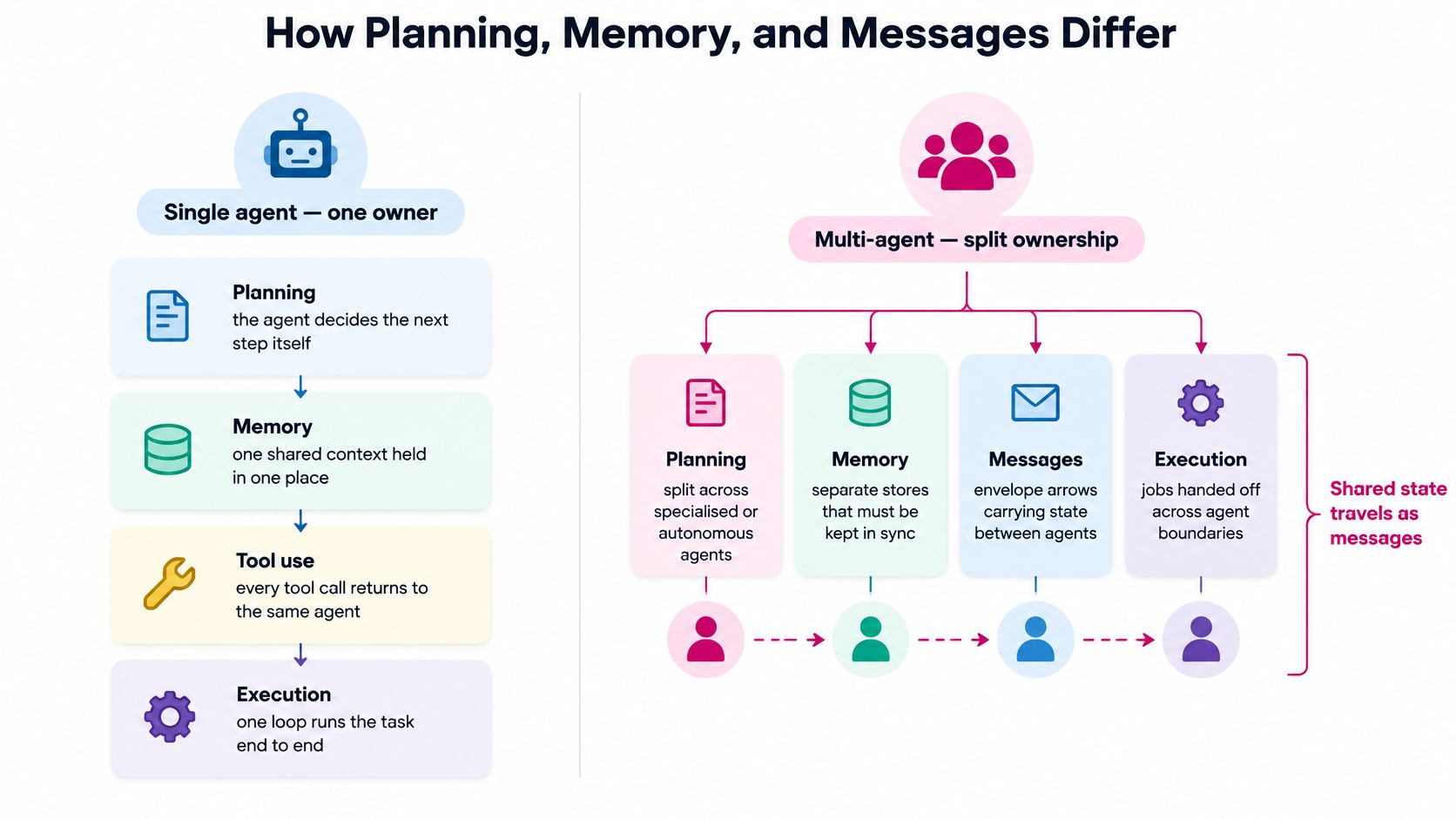
Coordination consumes execution
The historical trade-off remains practical: parallel work requires communication, synchronization, negotiation, and conflict resolution. A message isn't just transport. Its recipient must interpret it, reconcile it with existing state, and decide whether to act.
Extra reasoning turns by coordination style
The 2026 Nature Machine Intelligence overhead analysis reported the following increases against a single-agent baseline under matched per-system token-budget ceilings.
| Coordination style | Extra reasoning turns | About how many times the turns | What overhead means |
|---|---|---|---|
| Independent multi-agent | 58 percent more | About 1.6 times | Messages still required per task |
| Decentralized | 263 percent more | About 3.6 times | Agents coordinate without one controller |
| Centralized | 285 percent more | About 3.9 times | A controller adds its own turns |
| Hybrid | 515 percent more | About 6.2 times | Routing plus specialist turns |
Communication overhead measures inter-agent message exchanges per task. Extra reasoning turns aren't identical to extra tokens or elapsed time, so these multiples shouldn't be used as a billing calculator.
Assign ownership before adding participants
An agent orchestration design needs explicit rules for state, permissions, and verification. A shared database alone doesn't establish who may change a record or how another agent learns that the record changed.
A practical ownership inventory should cover:
- Authoritative state: Name the record that settles disagreements, such as a repository commit, ticket state, or approved dataset.
- Speaking rights: Specify which agents can request work, publish findings, or initiate another action.
- Verification: Assign a checker that can inspect evidence rather than merely approve a summary.
- Failed handoffs: Define whether an interrupted task resumes, retries, or goes to a human.
Ambiguous roles, organizational breakdowns, inter-agent conflict, and weak verification are failure categories worth checking during design. A trace should preserve the input, output, state version, and acceptance decision at each boundary.
Agent count is a cost that must earn its messages. A longer roster isn't evidence of a more dependable system.
Token Cost Latency and Dollar Spend
Default to one agent unless a multi-agent workflow lowers the cost of an accepted result enough to justify its extra time and coordination. Benchmark run costs are not product prices, and the comparisons below do not isolate agent count from model choice.
The 2025 ACM MLAgentBench study reported average multi-agent costs of $0.054 per run with a no-cost model version and $0.120 per run with a low-cost version. The GPT-4 single-agent baseline cost $0.931 per task. Average success was 32.95 percent for the multi-agent runs and 22.72 percent for the baseline, with reported cost reductions of 94.2 percent and 87.1 percent. The models differ, so these results do not show that multi-agent design alone caused the lower costs or higher success.
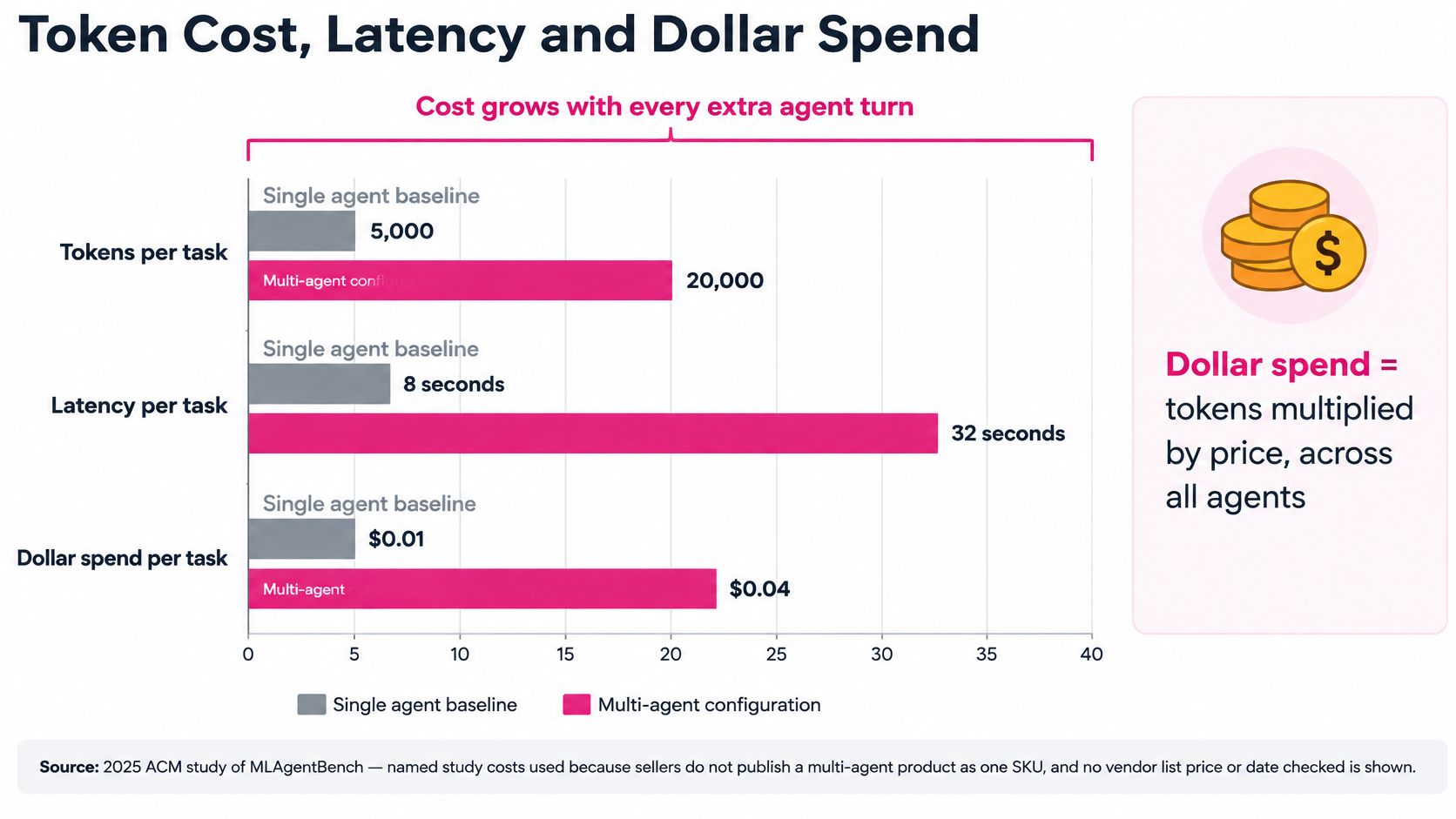
The illustration is conceptual, not a universal ordering of measured costs. The ACM comparison shows why: a multi-agent configuration can cost less when model choice and pricing differ.
Read the bill at the workflow level
Published run cost versus a single-agent baseline
| Setup and source | Reported cost or time | Success | Limit |
|---|---|---|---|
| Gemini-Pro multi-agent, no-cost model version, ACM 2025 MLAgentBench | $0.054 per run | 32.95 percent average success | Not a universal multi-agent discount |
| Gemini-Pro multi-agent, low-cost version, same study | $0.120 per run | 32.95 percent average success | Different reported pricing condition |
| GPT-4 single-agent baseline, same study | $0.931 per task | 22.72 percent | Different model, so architecture isn't isolated |
| Strongest 2026 scientific data-analysis multi-agent workflow | About 4 times single-agent inference time | Strongest evaluated configuration | Use only if the improvement pays for the wait |
| Trimmed 2026 data-analysis workflow | Under 2 times single-agent cost | Retained most of the multi-agent benefit | Prefer when maximum performance isn't necessary |
The 2026 scientific data-analysis benchmark reported that its strongest multi-agent configuration required approximately four times single-agent inference time. A more economical workflow retained most of the benefit at less than twice the single-agent cost. Time and cost are separate measures, so do not combine them into one multiplier.
Calculate successful outcomes, not cheap attempts
Cost per successful task includes spending on failed attempts and retries, divided by accepted completions. Add tool charges, orchestration services, and human recovery to the operating budget when they apply.
Latency needs a separate threshold. p50 latency is the middle response time; p95 latency shows slower requests that routine averages can hide. A support workflow may tolerate a longer investigation, but a delayed acknowledgement of a locked account can still miss the operational need.
Approve a design only when task success, cost per successful task, and latency all meet the workflow's requirements. A small accuracy gain does not justify missing the response deadline or creating unaffordable recovery work.
Workflows That Fit Each Design
Coding in a changing repository
A developer asks an agent to fix an authentication bug, update tests, and adjust the migration that caused it. Keep one agent responsible for the working tree. Each edit changes the context for the next edit, and test failures can redirect the whole plan.
An isolated reviewer can inspect a completed patch without owning concurrent edits. Giving several agents permission to modify overlapping files adds the risk of conflicting patches, stale assumptions, and duplicated fixes.
Research divided by independent sources
A market-analysis request asks for customer disclosures, competitor filings, and supplier documentation. Several source-specific investigators plus a checker fit this shape. Each investigator can return evidence without waiting for another investigator's interpretation.
The aggregator should receive source locations, extracted claims, dates, and unresolved contradictions. Agents shouldn't negotiate unsupported consensus. Adding more investigators becomes harmful when they produce overlapping summaries that the checker must untangle.
Routine account and support requests
An employee requests a password reset through Slack or Microsoft Teams. Use one agent with approved tools and a human queue. The system should establish identity, check authorization, perform the permitted action, and confirm the resulting account state.
The same pattern suits locked accounts and straightforward access lookups. These workflow automation examples should be assessed around the actual action path, not the apparent sophistication of an agent roster. Extra participants can add a slow handoff or repeat a state-changing action after an ambiguous response.
Scientific analysis with an independent check
An analyst asks for an exploratory analysis, then needs someone to challenge the method and recompute important figures. Start with a short multi-agent or hybrid workflow. Keep the dataset version fixed and give the checker access to executable analysis, not just the author's narrative.
A trimmed workflow is the sensible choice when the decision doesn't require maximum benchmark performance. Extra discussion rounds can delay delivery without resolving the methodological uncertainty that matters.
Before buying an orchestrator: The team should map its live workflow to a concrete operating scene and identify the failure that another participant would introduce.
The task grid is a starting classification, not permission to deploy without constraints. A useful architecture proposal names the input, the accepted output, the state owner, and the recovery path. If those remain vague, shopping for coordination software is premature.
Keep One Agent Until the Matched Test Pays
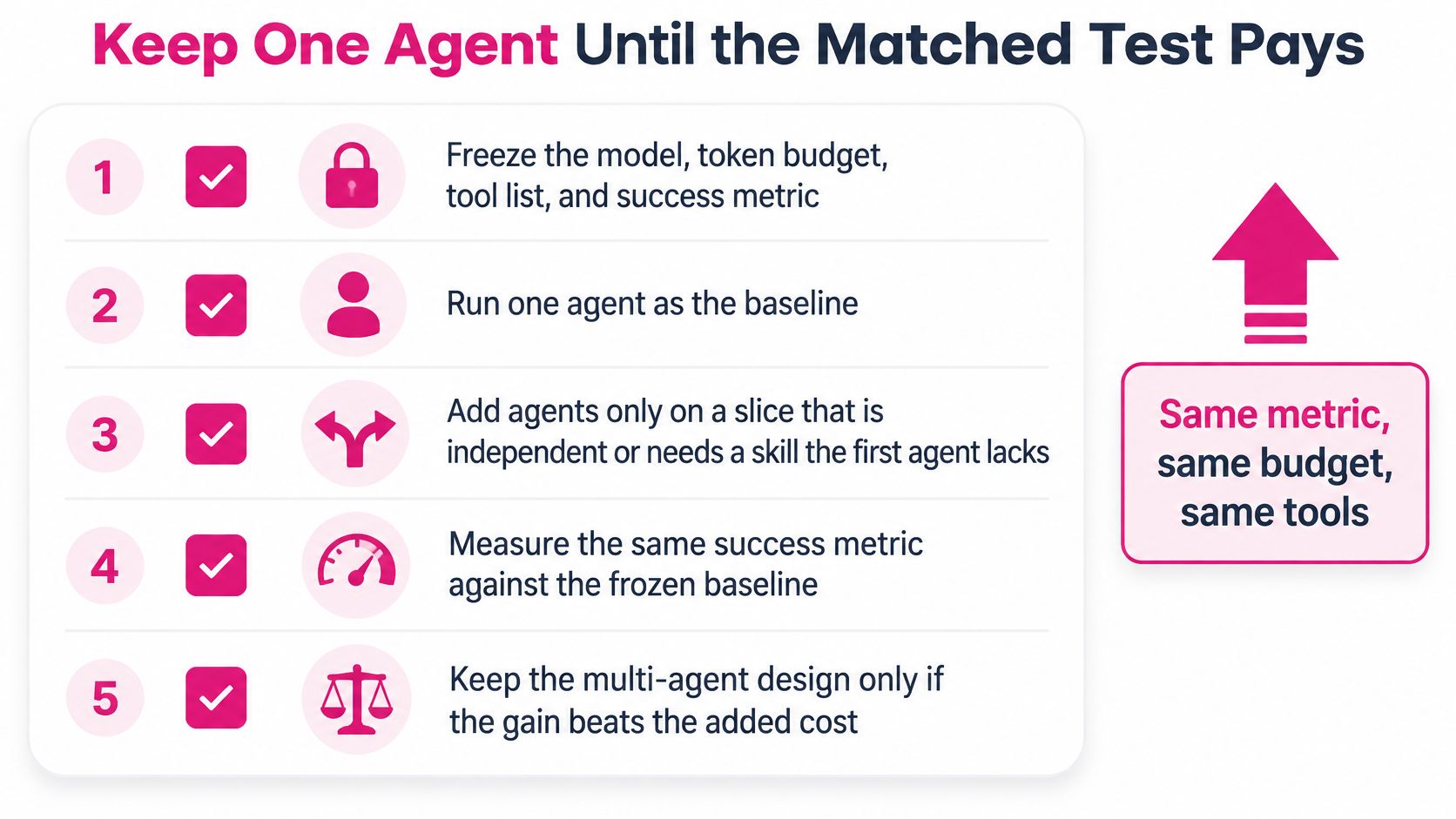
- Freeze the comparison. Fix the model, token budget, tool list, input set, and success metric. Specify what counts as an accepted result before reviewing outputs.
- Run the single-agent baseline. Preserve complete traces, including unsuccessful attempts. Repair broken tools and missing permissions before attributing failures to architecture.
- Add agents only to a justified slice. Select cases with independent branches or a specialist capability the primary agent lacks. Keep routine requests on the existing path.
- Log the complete escalation bill. Record escalation rate, added tokens, tool calls, p50 and p95 latency, and the share of escalated cases with materially better outcomes. Record retries and human intervention too.
- Apply a written keep-or-cut rule. Retain the additional agents only when the improvement meets the team's acceptance threshold without exceeding its cost and latency limits.
Selective escalation needs verification
The 2025 paper Single-agent or Multi-agent Systems? Why Not Both? reports accuracy improvements of 1.1 to 12 percent and deployment-cost reductions of up to 20 percent for hybrid designs; its discussion also describes distributed-information testing with 30.1 percent multi-agent accuracy versus 80.7 percent for a single agent with complete information. Those information conditions aren't equivalent, but the contrast exposes a practical danger: participants can miss facts that other participants know but haven't communicated.
A hybrid therefore needs a defined escalation trigger, disciplined shared state, and independent checking. The router should explain why the case needs another agent, and the receiving agent should acknowledge the evidence it received. Silence shouldn't be interpreted as complete information.
Teams preparing to deploy AI agents should write the next sprint's decision in advance: retain specialist routing only for the evaluated slice, under the agreed spending and response-time limits. Cut routes that produce more discussion without better accepted outcomes.
Choose the product after the architecture
DBotMaker's decision bot takes a question about what to pick and returns one clear answer, scored on capabilities, setup, and value. Its weighting is capabilities 40 percent, ease of setup 30 percent, and value 30 percent. DBotMaker compares documented features and published prices; it doesn't conduct hands-on testing.
For the next sprint, the team should select a representative workflow, save its single-agent baseline, and approve specialist routing only where the matched comparison earns it. Once that architecture decision is documented, DBotMaker's decision bot can help shortlist products against the required tools, setup constraints, and budget.
Spotted an error in this guide? Email editorial@dbotmaker.io