Operator manual · General
How to Deploy AI Agents Safely: Steps and Controls
In short
Learn how to deploy AI agents in 2026: pick an architecture, scope permissions, test the full system and monitor cost, errors and escalations.
DBotMaker research desk · Updated November 15, 2026 · 12 min read
More than 80% of respondents whose organizations used generative AI said they hadn't seen a tangible enterprise-level EBIT impact, according to McKinsey's 2025 global survey. The DBotMaker research desk's call is straightforward: start with a bounded workflow, not a broadly capable assistant. Deployment readiness depends on the agent's identity, permissions and rollback controls, not how convincing its demonstration looks.
For teams deciding how to deploy AI agents, the central question isn't whether the model can finish the task. It's whether the organization can contain the consequences when it chooses the wrong action. A useful deployment makes that boundary enforceable outside the model.
Table of Contents
- The Eight Steps to Deploy an AI Agent
- Pick an Architecture That Fits the Task
- Give the Agent Its Own Identity and Limits
- Test the Whole Agent System Before Launch
- Monitor Cost, Errors and Escalations After Launch
The Eight Steps to Deploy an AI Agent
The initial deployment should be one bounded workflow, a single agent with a short tool list, and human approval before any write action. That combination limits troubleshooting to a manageable process and keeps operational decisions with an accountable owner.
In Gartner's 2025 survey of 360 IT application leaders across North America, Europe and Asia-Pacific, 75% said they were piloting, deploying or had already deployed some form of AI agent, while 15% were considering, piloting or deploying fully autonomous agents. Those categories don't establish deployment success, but they make an important distinction: adopting an agent doesn't require granting full autonomy.
The deployment sequence keeps process decisions ahead of implementation decisions.
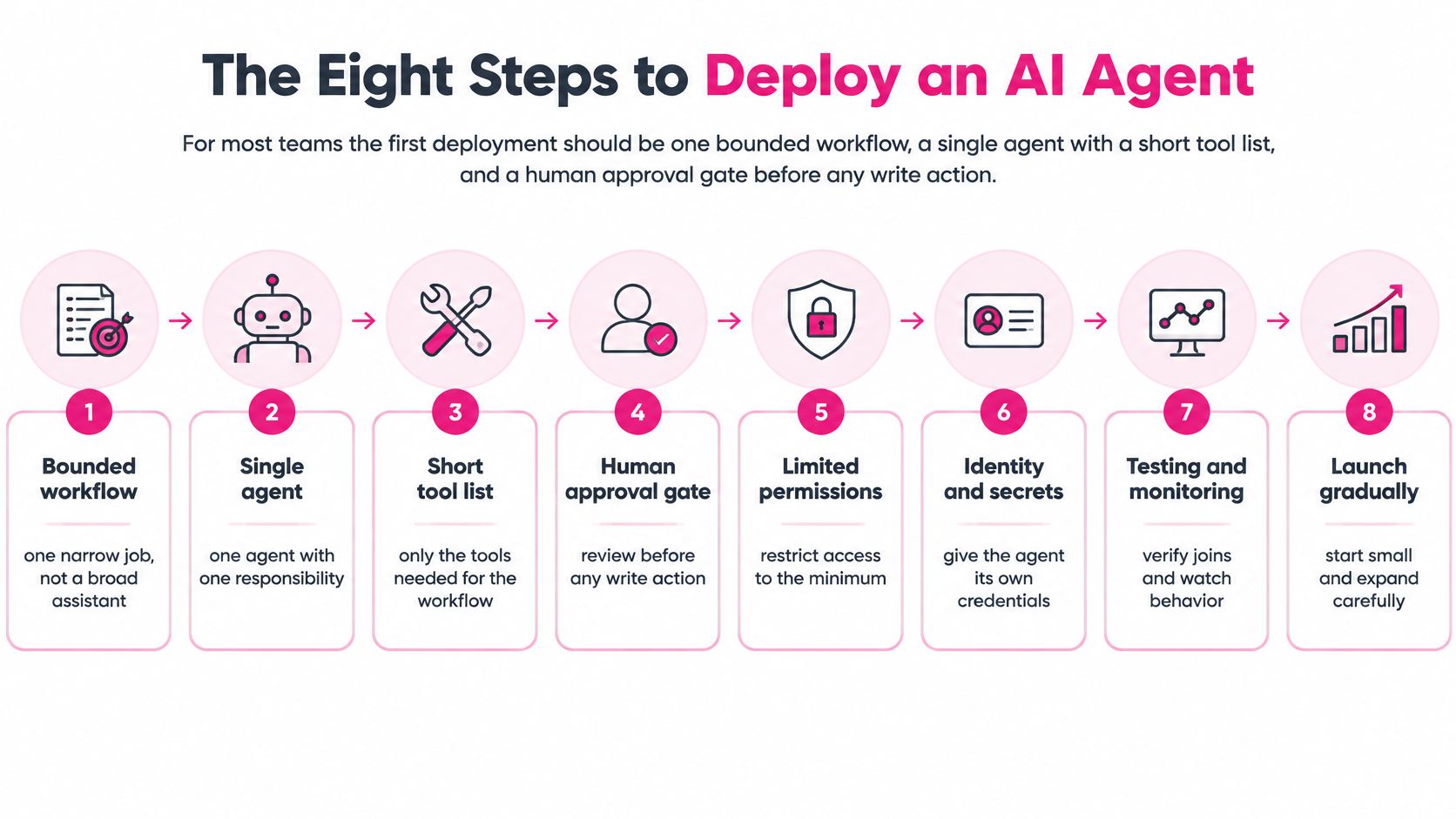
Define the job before choosing the stack
Write the job and its success measure in a sentence. A suitable scope might be classifying incoming support tickets and proposing the correct queue, judged against labels approved by support leads. Answering customer questions is too broad unless the team specifies which questions, which knowledge sources and which exceptions belong with people.
Map the existing workflow. Record the trigger, required inputs, systems touched, decision points and completion condition. Mark judgment and approval steps explicitly, including what happens when an account identifier is missing or a customer disputes the underlying record. These opening steps matter because a vague job makes permission design, testing and cost estimates guesswork.
Choose the architecture that matches that map. A repeatable retrieval task rarely needs a group of collaborating agents. A process with fixed stages belongs in an explicit workflow, with agent reasoning confined to the stages that need it. Hosting should follow the operational requirement, not dictate the workflow.
Create a distinct agent identity. Associate the deployment with a named owner and a documented access policy before connecting production systems. A successful login isn't evidence that the granted permissions are appropriate.
Establish the release boundary
Set staged autonomy. Begin with observation and proposals, then require approval for consequential actions. The release plan should state which capabilities remain unavailable, rather than relying on a prompt that tells the agent to behave cautiously.
Test the complete system. Exercise the model, tool adapters, retrieval, memory, authorization and human handoff together. Include unsuccessful cases and unavailable dependencies, not just examples selected because the agent handles them well.
Launch into a restricted queue. Select a clearly identifiable category of real work and keep the normal human process available. The operator needs a tested stop control, an owner who can use it and a way to identify every case the agent touched.
Review results on a fixed schedule. Expand access only after the release criteria hold, with exceptions resolved and the access owner's approval recorded. A new tool or destination system should count as a scope change, not routine maintenance.
Deployment decision: A pilot should prove that the organization can supervise the agent, not merely that the agent can produce useful output.
DBotMaker's decision bot takes a question about what to pick and returns a clear answer, scored on capabilities, setup and value. Deployment choices need the same decisiveness, but security controls remain a release condition rather than a feature that a high capability score can offset.
This week's action is a single-page pilot charter: the workflow, success measure, owner and expansion rule. A recommended policy is to require the agreed task-success threshold and no unauthorized actions to hold for four weeks, with no unresolved incidents, before widening scope. That's a proposed operating rule, not a published industry benchmark, and the person approving access should sign it before the pilot begins.
Pick an Architecture That Fits the Task
A single agent with a short tool list is the default. Ticket triage, report retrieval and drafting an account summary don't justify a distributed agent system just because a framework supports one.
The architecture decision turns on the systems touched, whether actions can be reversed and the length of the task. Fixed stages favor a workflow with agent steps; independent tasks may justify parallel agents. The distinction matters because deterministic code should control a prescribed sequence rather than asking a model to rediscover it during every run.
Compare the operational trade-offs
Agent architecture patterns and where to put approvals
| Pattern | Best for | Main risk | Approval point |
|---|---|---|---|
| Single agent with a short tool list | One repeatable task such as ticket triage or report pulls | Tool misuse as the tool list grows | Before any write action to a system |
| Workflow with agent steps | Multi-stage process with a fixed order | Logic hidden outside the agent, hard to audit | At each stage handoff that changes data |
| Multi-agent system | Parallel tasks across separate systems | Cascading failures and unsafe agent-to-agent messages | At every handoff that changes records or sends messages |
| Agent with human approval on every action | High-cost or irreversible actions such as payments or production changes | Slower throughput and reviewer fatigue | Before every action |
A workflow is easier to inspect when its transitions, conditions and approvals are visible in version-controlled configuration. Hidden branches scattered across scripts and automation builders remove that advantage. The practical purpose of agent orchestration is to make execution order and handoffs explicit, not to add more agents.
Multi-agent systems deserve a stricter justification. Each participant needs a separate responsibility, permission boundary and failure outcome; otherwise, the team has added coordination work without separating risk.
Budget for the execution path
Routine steps should run on a capable small model, with escalation to a larger model reserved for difficult cases. Stanford's 2025 AI Index reported that the cost of querying a model matching GPT-3.5's MMLU score fell more than 280 times between November 2022 and October 2024, using Gemini-1.5-Flash-8B as the comparison point. That historical comparison isn't a current seller quote or evidence that a small model can handle every workflow.
Each added agent introduces model calls, context transfer and potential retries. The budget must therefore cover the execution graph, tool charges, hosting, logging and human review, not just inference.
Architecture checkpoint: As a conservative design rule, a workflow needing more than three tools or writing to two systems should require approval before reaching the second system.
The architecture record should name the chosen pattern, every connected system and the exact sign-off step. If the team can't explain why parallel agents improve the task, the simpler design should win.
Give the Agent Its Own Identity and Limits
The blast radius of credentials matters more than task completion. An agent that drafts excellent answers but inherits an administrator's session isn't ready for production.
NIST's 2026 agentic-security presentation describes goal manipulation, legitimate-tool misuse, privilege escalation through weak scoping, poisoned retrieval or memory, and tampered inter-agent communications. These paths can lead to data exfiltration and unsafe operations, not merely incorrect text. Authorization must therefore remain effective even when the agent follows a malicious instruction.
The security boundary should surround the agent's actions, not depend on its interpretation of a warning.
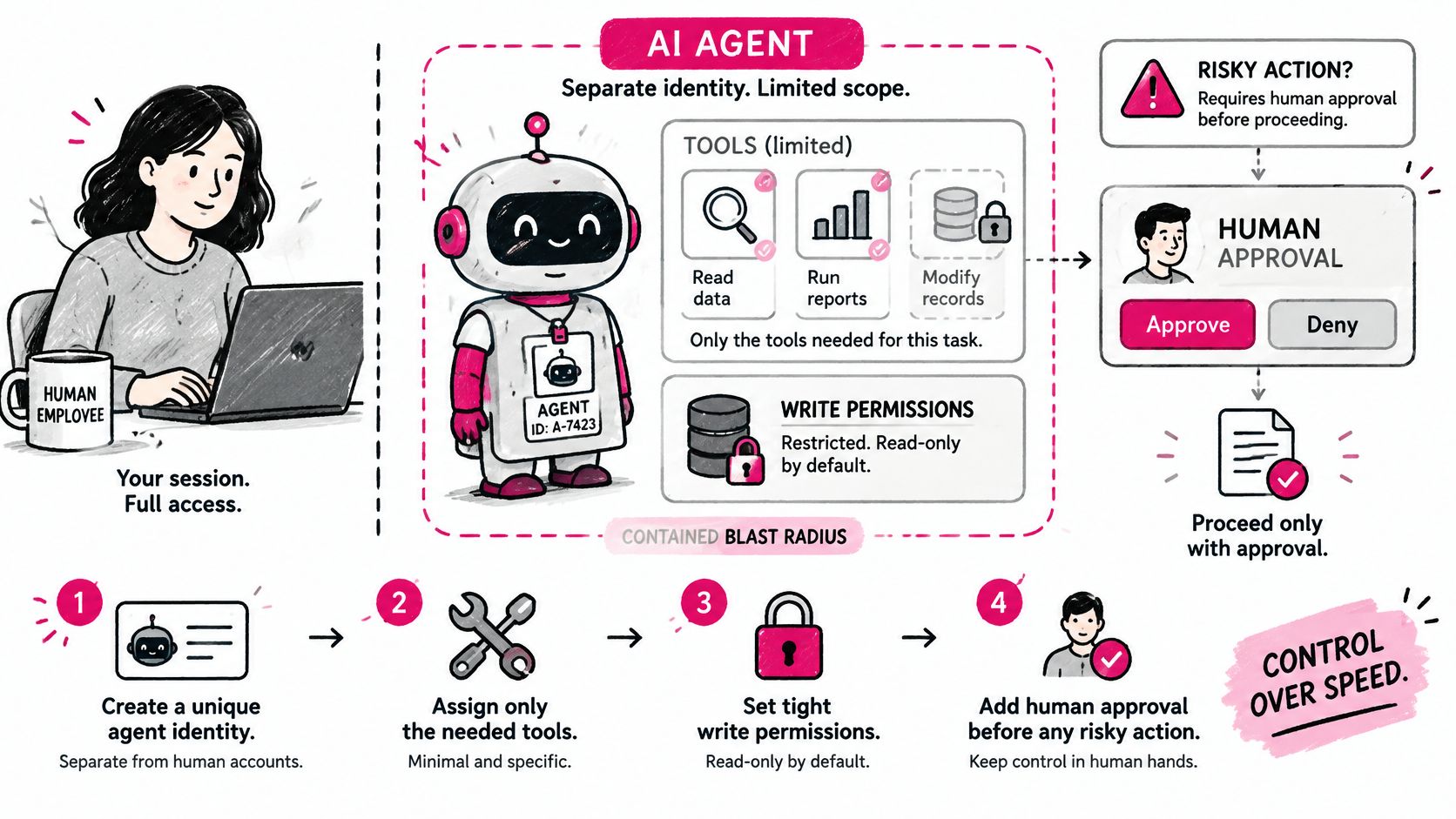
Apply controls at the execution boundary
Assign a unique identity. Use a dedicated service principal or workload identity instead of an employee session or shared API key. The identity should identify the deployment and its accountable owner, making revocation possible without disabling unrelated work.
Prefer short-lived access. Issue tokens for the required destination and establish credential rotation through the secrets-management system. Renewal failures should stop protected actions rather than trigger a fallback to a broader credential.
Enforce least privilege per tool. Grant access only to the required operations, records and tenant, with an explicit tool allowlist. A search function shouldn't expose export, deletion or administrative endpoints through the same credential.
Classify tools by impact. Mark each operation as read, write or irreversible, then validate arguments and responses against an enforced schema. Reading private payroll records still carries confidentiality risk, even though it doesn't change data.
Keep approvals and evidence outside the prompt
Gate consequential changes. Require approval before irreversible actions and writes to a system of record. Bind that approval to the exact operation, destination and arguments so the agent can't substitute a different action after review.
Keep secrets out of model context. Credentials belong in a secrets manager or tool gateway, not prompts, retrieved documents or messages. Generated code needs isolation from host credentials and unrelated files; comparisons of AI agent sandboxes should prioritize those boundaries over convenience.
Record tool-level evidence. Log each call's identity, initiating user, validated input, output, authorization decision and approval reference. Redact sensitive fields and keep audit storage outside the agent's write permissions.
Make shutdown operational. Provide a tested control that disables execution and revokes the agent's active access together. The response also needs to account for queued jobs and pending approvals, which shouldn't execute after a pause.
During the initial weeks, the agent should observe and draft. Write access can then be granted tool by tool, with a separate review of each new permission rather than a blanket promotion to autonomous operation.
For example, a support agent could draft refund recommendations while payment release remains with a person. A business-defined amount can trigger additional approval, but that threshold shouldn't authorize smaller payments during the initial deployment.
The access owner's next deliverable is a complete tool inventory with impact classes, including the identity, scope and approval requirement for every callable operation.
Test the Whole Agent System Before Launch
A model benchmark doesn't validate an agent deployment. The production system includes tool adapters, memory, retrieved content, permissions, prompts, retry logic and escalation. A strong answer from the model can still become an incorrect API request or a duplicate transaction.
The 2025 AI Agent Index found that 25 of 30 surveyed agents disclosed no internal safety results and 23 of 30 disclosed no third-party testing information, while few evaluations tested the agentic setup itself. Missing disclosures aren't proof of unsafe behavior, but they're no basis for assuming that a vendor's evaluation covers a customer's configured system.
Build tests around failure conditions
The staging checklist should cover the joins between components as well as the completed workflow.
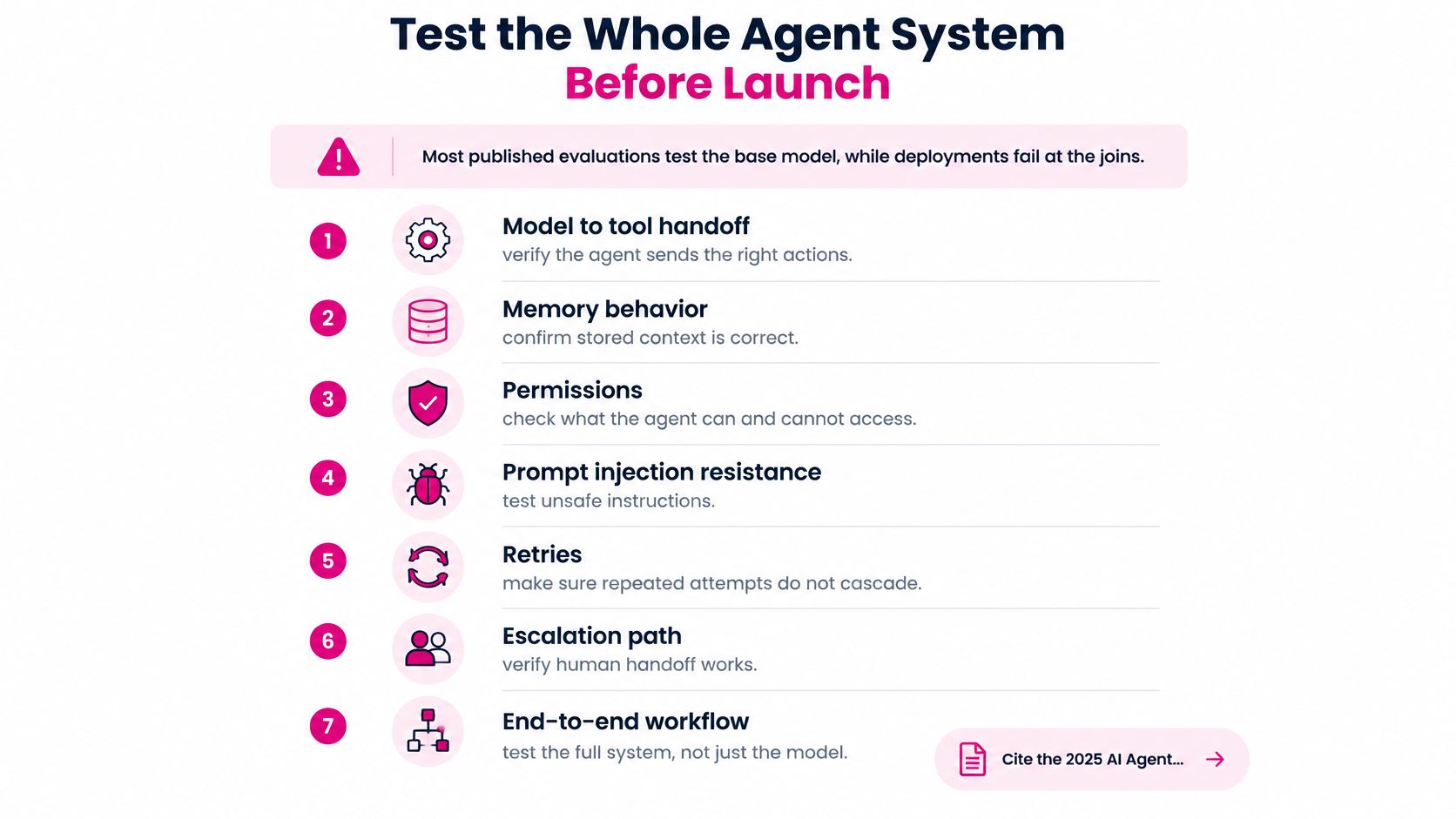
- Replay real cases. Build a test set from appropriately redacted historical requests, including missing fields, conflicting instructions, ambiguous requests and tasks that should be refused. Label the expected outcome, permitted tools and escalation reason before executing the tests.
- Exercise authorization boundaries. Attempt access to unrelated customer records, unavailable tools and operations beyond the assigned scope. The expected result is a denied operation with usable evidence, not merely an apologetic response.
- Inject dependency failures. Expire a token, delay an API, return malformed output and configure a tool to fail on every call. Confirm that the agent observes a fixed retry limit, stops rather than inventing a result and hands the case to a person with a clear summary.
- Test duplicate execution. Interrupt a run after a tool accepts a request but before the agent receives confirmation. Verify that resuming the job doesn't repeat a payment, message or record change.
- Attack through retrieved content. Place instructions in staging documents or emails that attempt to redirect the agent, reveal secrets or invoke another tool. The application should treat those instructions as untrusted content rather than new authority.
Make the release decision binary
An irreversible action that bypasses approval is a failed release, even when every other test succeeds.
The go/no-go rule should require every irreversible action to pass its approval gate in every test. Averages don't excuse a bypass, and a prompt revision alone doesn't close an authorization defect.
Human handoff also needs acceptance criteria. The receiving person should get the original request, completed actions, unresolved uncertainty and the reason execution stopped, without reconstructing the run from model narration.
Store the test set with the prompt, tool schemas, policy configuration and application version. Before the first live request, the team should write the failure list, execute it in staging and retain the results that support the release decision.
Monitor Cost, Errors and Escalations After Launch
Any unauthorized action should pause the agent that day. A rise in useful completions doesn't compensate for an action outside the granted scope. The team should establish the pause mechanism and incident owner before live work arrives.
The operating dashboard needs outcomes and control failures, not just request volume. The metrics below define what gets measured; the review schedule determines who acts when a result changes.
Track outcomes rather than activity
Post-launch metrics, how to measure each and what to review
| Metric | What it shows | How to measure it |
|---|---|---|
| Task success rate | Share of runs that reach the goal | Weekly sample of labelled runs |
| Unauthorized action rate | Actions outside granted scope | Audit log checked against the tool allowlist |
| Hallucinated tool calls | Calls to tools or fields that do not exist | Tool call logs compared with the schema |
| Tool failure recovery | Whether retries and fallbacks work | Injected faults in staging and live error logs |
| Cost per completed task | Real spend per outcome | Token and tool billing divided by completed tasks |
| Escalation rate | Share of cases handed to people | Handoff events in the review queue |
| Latency per task | Time from request to finished action | Trace timings for each run |
| Performance drift | Quality change over time | Monthly rerun of the same test set |
As an operating policy, review task success, unauthorized actions and escalations weekly during the first month, then monthly once results remain within the agreed limits. Incident alerts should remain immediate; scheduled reviews aren't a reason to leave a known control failure running.
Cost per completed task should include failed attempts and retries in the spending numerator. Otherwise, an agent that repeatedly fails can appear inexpensive because its wasted work disappears from the calculation. Comparisons of LLM API providers should therefore consider routing, context use and retry behavior alongside published rates.
Revert behavior before expanding troubleshooting
Define a sharp-rise threshold for hallucinated tool calls against the accepted baseline before launch. Crossing it should return the agent to draft-only mode while the team checks schema changes, prompts and tool adapters.
The rollback path should switch execution to drafts, revoke tokens when necessary, route the pending queue to people and record the failing step. A software rollback alone won't reverse messages already sent or records already changed.
Consider a hypothetical inbox-triage agent whose escalation rate doubles after a vendor changes an API field. A monthly replay can expose the changed behavior before customers report it, while live alerts may catch it sooner. The team should rerun the same test set monthly and after model, tool or policy updates, even when application code hasn't changed.
Before launch day, the operational owner should put review dates, pause thresholds and rollback responsibility on the deployment calendar.
The next move is to write the pilot charter and tool-access inventory, then take both to the person authorized to approve production access. The deployment should remain draft-only until its approval gates, failure tests and shutdown path pass. Any subsequent DBotMaker comparison of builders, orchestration tools or API providers should start with that control checklist, not a demonstration score.
Spotted an error in this guide? Email editorial@dbotmaker.io