Guide · General
What Is Agent Orchestration and How Does It Work
What Is Agent Orchestration? Learn how orchestrators route tasks, share context and enforce controls across AI agents, with patterns and examples.
By the DBotMaker research desk · Updated November 12, 2026 · 14 min read
Agent orchestration is the control layer that splits a goal into subtasks, routes each one to a suitable agent or tool, keeps shared state intact across dependent steps, and combines the results into one finished outcome. Treat it as an accountability layer too. Security, permissioning and cost control all become live questions the moment a single model provider sits at the center of the system.
The path into this problem looks the same most times. One agent gets wired to a knowledge base and a scheduling API, handles a narrow job well, and then a second request arrives that needs a policy lookup, an approval from a person, and a record of what happened. The agent starts improvising across steps, and afterward nobody can reconstruct why it chose what it chose.
Spend is the quieter version of the same risk. VentureBeat reports that one in five enterprises cannot stop a runaway AI agent's spending in real time. Before committing to an orchestration layer, a buyer needs answers to two tests: who is accountable when an agent makes a mistake, and whether the bill can be halted mid-task.
Table of Contents
- What Agent Orchestration Is and When You Need It
- The Core Components of an Orchestration Layer
- How an Orchestrator Runs a Multi-Step Task
- Orchestration Patterns and When Each One Fits
- Where Organizations Use Agent Orchestration
- Why Orchestration Fails and What to Measure
- Accountability When an Agent Makes a Mistake
- Decision Rule and First Pilot
What Agent Orchestration Is and When You Need It
An orchestra's musicians can each play their part alone. What they lack without a conductor is timing: who enters when, which section carries the melody at which moment. Agent orchestration is that conducting role for software. It plays none of the notes itself. It decides which agent or tool takes each subtask, in what order, and how the outputs fit together into one result.
The contrast that clears up most confusion is with a single prompt. A single prompt gets one answer from one model in one pass. An orchestrated system plans, acts, checks the result against an expectation, and continues over many steps until the work is finished.
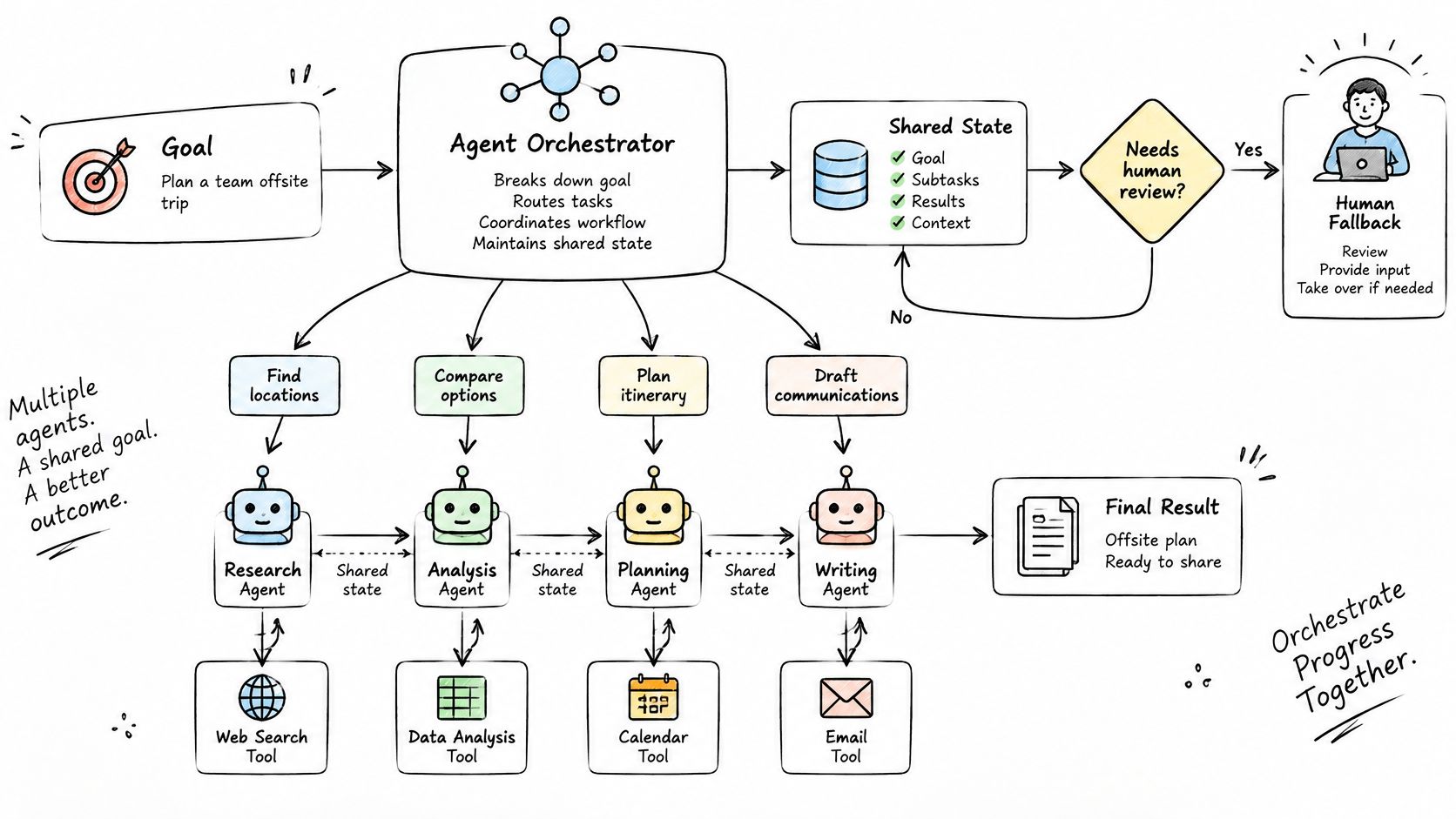
The call, made early: use a single capable agent when the task is short, one-shot and needs one tool. Use a fixed, deterministic workflow when every step is known in advance and the order never varies. Reach for orchestration when subtasks change from case to case, when they need different tools or different permission levels, or when several can run in parallel.
Picking the third option commits you to more than extra architecture. Before rollout, two tests decide whether the system is worth running: can you trace every action back to a named decision, and can you cap what a looping or misrouted agent spends? If the answer to either is no, the orchestration layer is doing the improvising rather than the governing.
Underneath the vocabulary sit the mechanics that determine whether a setup holds up: invoking tools, enforcing permissions, exchanging information between agents and merging outputs into one workflow, as described in the ACM's survey of multi-agent systems. That foundation predates today's language models, which is why the field's own terms tend to outlast any single vendor's phrasing.
For baseline figures on how widely agents are already deployed, DBotMaker keeps a running collection of sourced numbers on its AI agent statistics page. In practical terms, orchestration is what turns isolated agents into a managed system that completes multi-step work rather than merely generating individual responses.
The Core Components of an Orchestration Layer
Strip away the vendor language and an orchestration layer is six working parts. Each exists because a specific failure appears without it.
Task decomposition splits the goal into subtasks and records dependencies. Hand a goal over whole and you get duplication in one area and a skipped step in another. The fix is an explicit task graph or state machine: which steps exist, which depend on which, which can run at once.
Routing and agent selection sends each subtask to a suited agent or tool, judged on capability first, then cost, then permissions. Skip it and the wrong worker takes the job, a billing specialist answering a security question, or a generalist handed a tool it should never touch.
Shared state and memory, scoped or shared, carries intermediate outputs forward. Lose them and later agents cannot complete dependent work regardless of how good their individual model is. This is the component teams most often under-build.
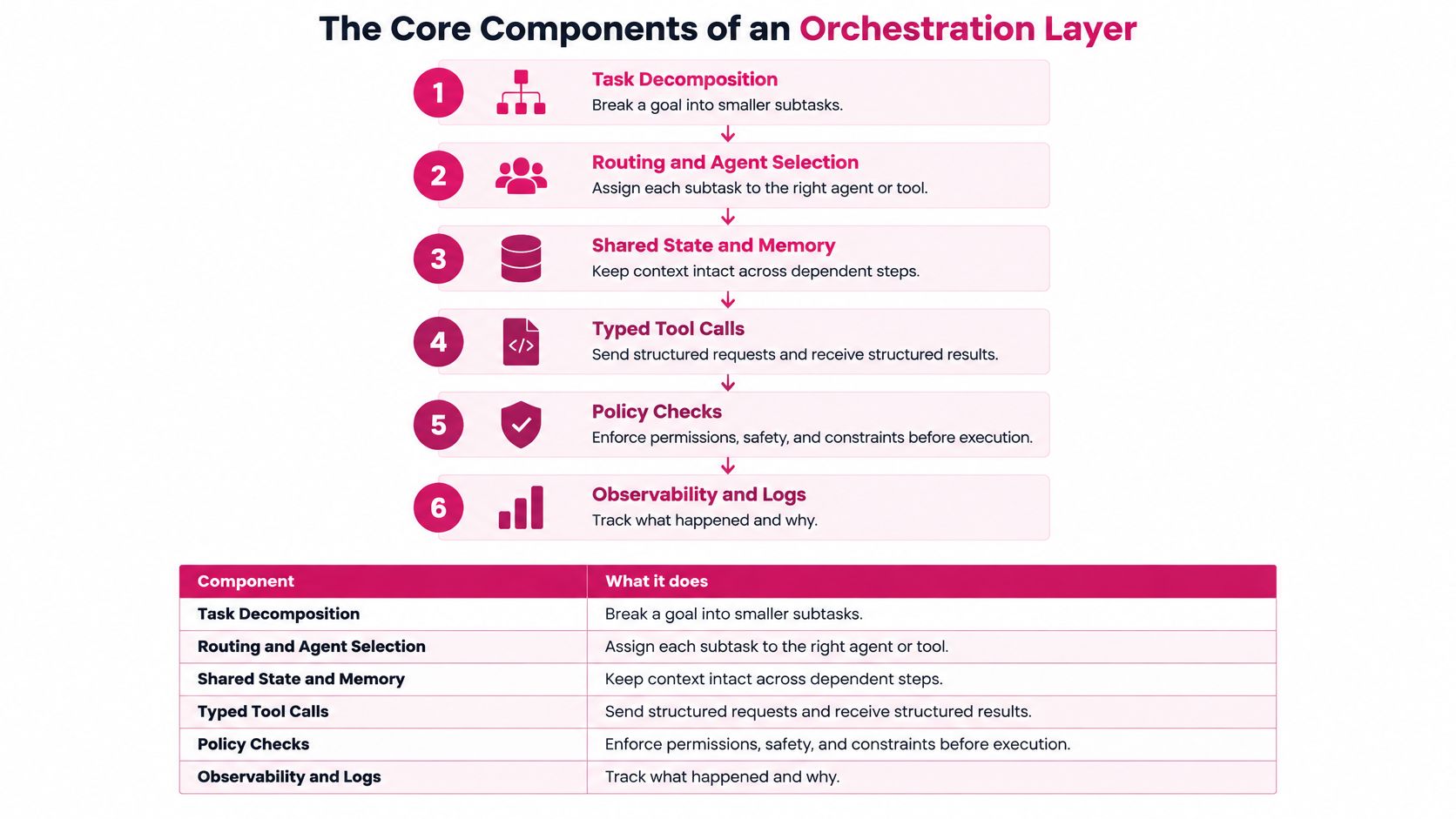
Typed tool contracts give every tool a name and an input schema, which is the machine-readable promise of what goes in and what comes back. Without that contract you get malformed calls and ambiguous results that look valid until something downstream fails.
Execution control sets timeouts, retry limits and idempotency for side effects. A retry that isn't idempotent charges the same card twice or sends the same email three times.
Permissions and audit logs limit what each agent may call and change, and record every action. Missing this produces unsafe actions with no trail behind them.
Research published in Artificial Intelligence Review identifies preservation of information across dependent tasks as more important than increasing the number of agents. That reframes the engineering priority: structured state transfer and validation beat adding more roles to the cast.
| Component | What it does | What breaks without it |
|---|---|---|
| Task decomposition | Splits the goal into subtasks with dependencies | Work is duplicated or skipped |
| Routing and agent selection | Sends each subtask to a suited agent or tool | Wrong agent handles the task |
| Shared state and memory | Carries intermediate outputs to dependent steps | Later agents cannot finish dependent work |
| Typed tool contracts | Defines input and output formats for each tool | Malformed calls and ambiguous results |
| Execution control | Sets timeouts, retry limits and idempotency | Stalled runs and repeated side effects |
| Permissions and audit logs | Limits tool access and records each action | Unsafe actions with no trail |
A test that separates real orchestration layers from prompt routers: does it hold state between steps, validate inputs against a schema, cap retries, and log each action with its arguments? If any answer is no, the layer is thinner than the marketing suggests. DBotMaker's comparison of the best AI agent frameworks weighs these capabilities plan by plan, which is where the differences show.
How an Orchestrator Runs a Multi-Step Task
The Model Context Protocol (MCP) gives the clearest published picture of the mechanics. It defines three roles, described in the MCP architecture specification: a host is the model application that starts connections and can run several clients, each client links the host to one server, and servers expose specialized context and capabilities. During initialization, both sides negotiate which features they support before the session proceeds, so nothing is assumed.
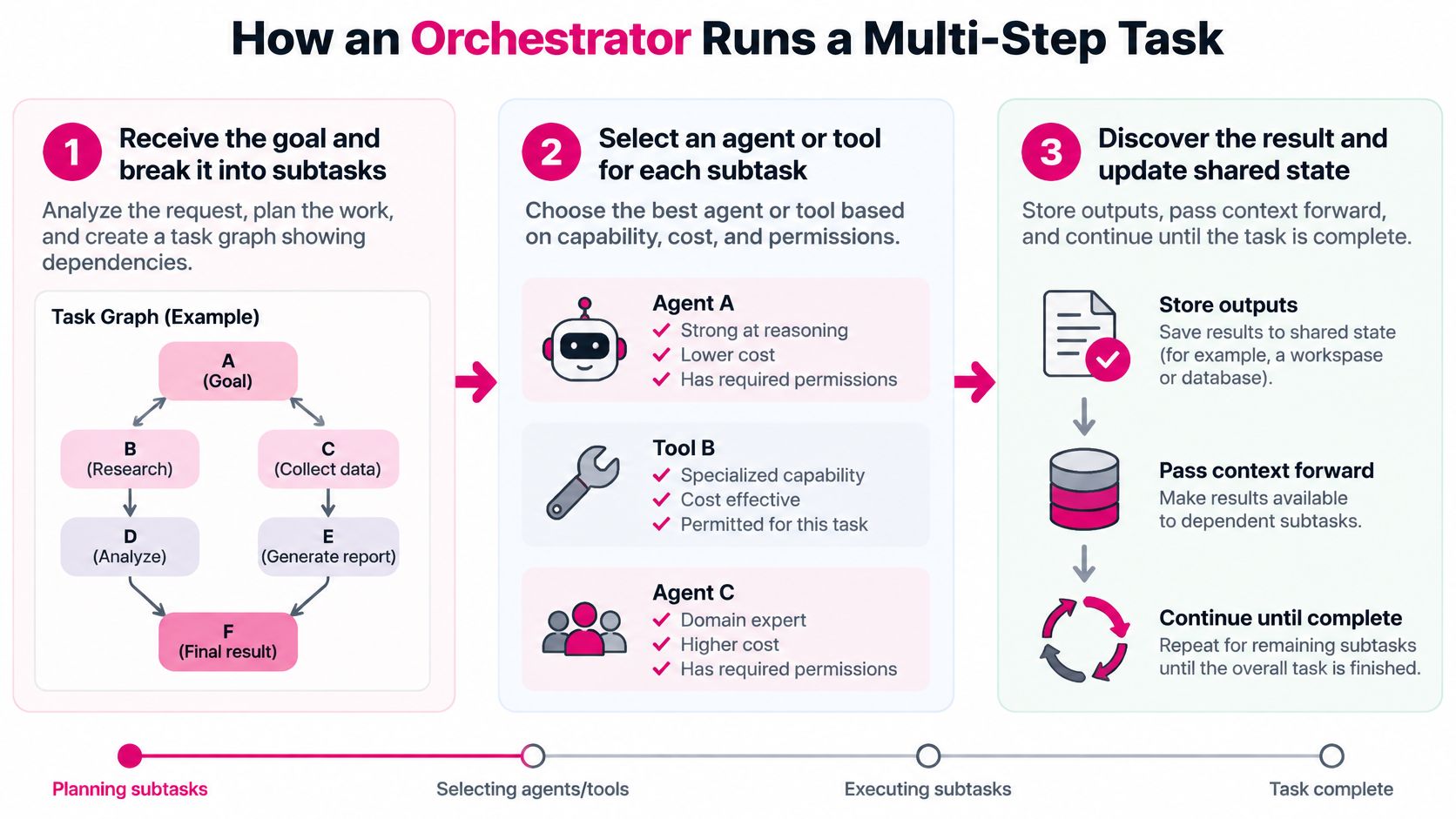
The seven steps of a run
- Break the goal into subtasks. Draw the graph: check the order, check shipping status, read the return policy, decide, act, notify. The graph records dependencies so no step runs before its inputs exist. Skipping it is how parallel agents make conflicting micro-decisions.
- Select an agent or tool per subtask. Judge on capability, then cost, then authority. A model that can read policy text may have no permission to issue a credit.
- Discover the tools on the chosen server. The client sends
tools/listand reads each tool's input schema, as set out in the MCP tools specification. Guessing parameters instead of discovering them is the most common cause of a failed first call. - Call the tool with a validated payload.
tools/callinvokes the selected function. Validation happens before the request leaves, which catches most malformed calls locally. - Check the returned result. Compare it to the expected shape. If it's malformed, retry within a set limit or escalate to a person. The usual slip is passing a plausible-looking bad result straight through to the next agent.
- Store the output in shared state and release dependent subtasks. Mark the step complete, then let the steps that depend on it become eligible. Without this, downstream agents work from stale context.
- Aggregate and log. Produce one final output plus a record of every call: arguments, result, duration and approver.
MCP messages follow JSON-RPC 2.0, and the protocol specifies lifecycle management, capability negotiation and an authorization framework for HTTP transports, per the MCP basic specification. That matters when you compare vendors: interoperability depends on protocol compliance, not on a proprietary connector format.
A finished run looks unremarkable from the outside, one answer delivered to one request. The value is underneath it, in a complete record of each discovery, call, validation and handoff.
Orchestration Patterns and When Each One Fits
Four patterns cover almost every production case, and the wrong choice is expensive to unwind later.
Sequential hands output down a chain. Research, then drafting, then review. It fits work where step two cannot start without step one, and it's the slowest option because latency adds at every handoff.
Parallel runs independent agents at once and merges their results. Pulling financial filings, news sentiment and pricing data simultaneously is the textbook case. It cuts waiting time, but the merge logic can end up harder than the work it's merging, and every agent spends tokens.
Hierarchical puts manager agents above worker teams. Large programmes with layered responsibility fit here, and so does any structure where one group's output feeds another group's brief. Coordination overhead grows with each level.
Supervisor-worker uses one coordinator that dispatches tasks to workers and inspects each return. It suits small teams with mixed tool use, where one coordinator can hold the whole picture. The risk is a coordinator that becomes the bottleneck.
| Pattern | How work flows | Best fit | Main risk |
|---|---|---|---|
| Sequential | One agent hands output to the next | Dependent steps such as research, draft, review | Slow, and one failure stalls the chain |
| Parallel | Independent agents work at once and results are merged | Separate evidence collection | Merge conflicts and duplicate token cost |
| Hierarchical | Manager agents delegate to worker teams | Large projects with layered responsibility | Coordination overhead across levels |
| Supervisor-worker | One coordinator dispatches and checks each return | Small teams and mixed tool use | Coordinator becomes a bottleneck |
Coordination can improve answers. In a multi-turn evaluation using GPQA-Diamond, IFEval and MuSR, orchestration matched or exceeded the strongest single-model baseline and consistently outperformed the other tested configurations, with the gain coming from iterative cross-agent comparison rather than parallel generation alone, according to the multi-agent evaluation on arXiv. The same work shows the benefit depends on protocol design: bounded rounds, a clear decision rule, provenance for each claim, and safeguards against correlated errors and endless consensus loops.
Use parallel agents for independent evidence collection, then a constrained synthesis or verification stage for dependent decisions. Start with the simplest pattern that matches the shape of the dependencies, not the most impressive one.
Where Organizations Use Agent Orchestration
A refund request shows the common shape. A router at the front classifies the request. Behind it sit specialists: one queries the order, one retrieves the return policy, one prepares the credit. State moves between them, and a human escalation path opens the moment the case falls outside policy, say a refund past the window or above an approver's limit.
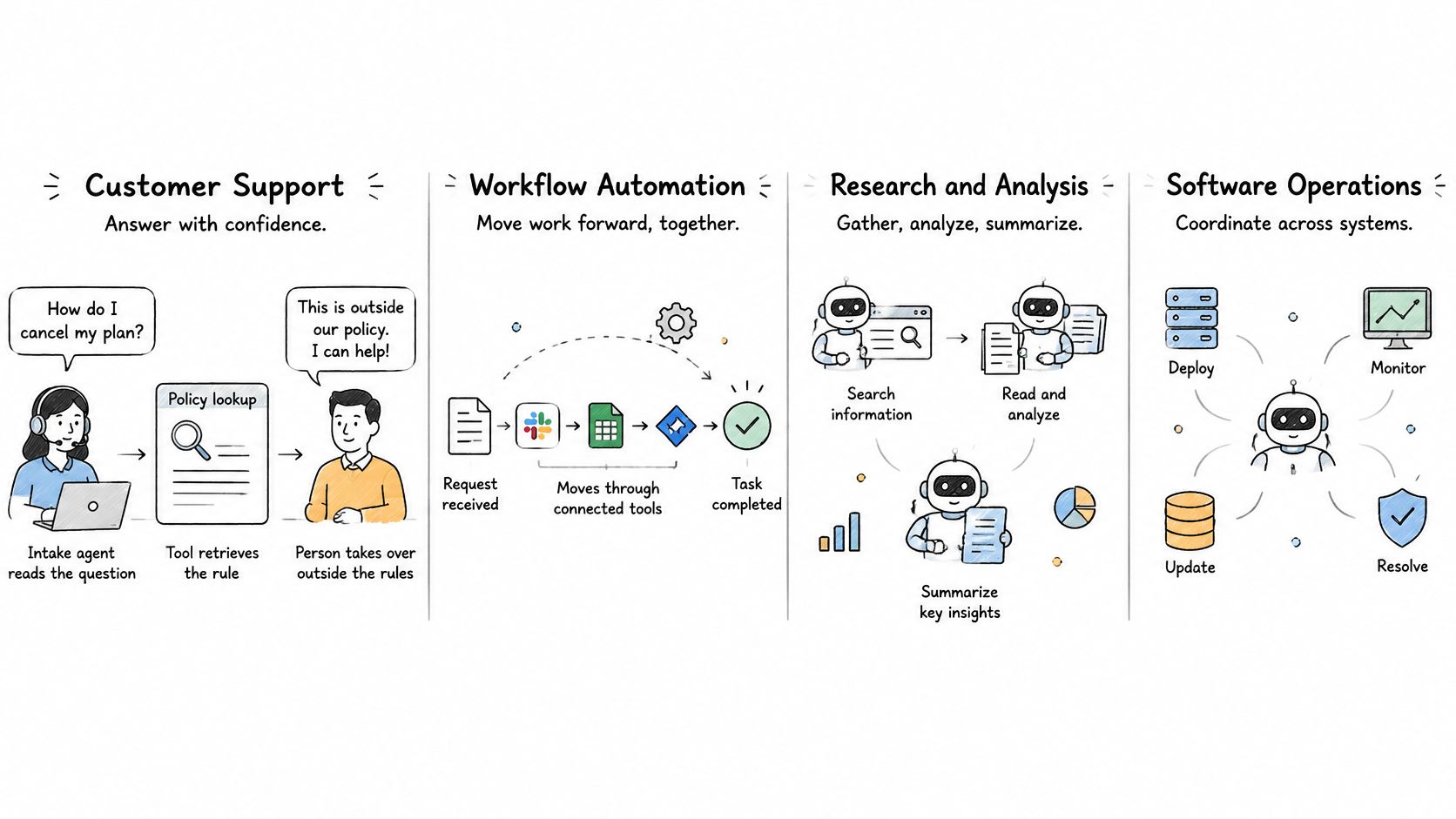
That shape repeats across four areas. In customer support, an intake agent reads the question, a policy lookup retrieves the rule, and a person takes over when the request falls outside it. That is the same handoff DBotMaker's ranking of AI customer support agents is built around, written for support leads, founders and operations managers choosing an agent that answers customer questions on its own and hands the rest to people.
In an IT service desk, the orchestrator clears password resets, locked accounts and software access requests on its own and routes sensitive changes to an approver, with requests answered in Slack or Microsoft Teams. Research and content work runs a search agent into a drafting agent with a fact-check stage behind it. Software development splits writing, testing and review across specialized agents, each with its own tool access.
The test for whether a use case needs orchestration at all: does it require more than one agent or tool, and does it carry state between steps? If both answers are yes, a single prompt will not do it. Teams wiring that layer into sales and operations workflows can see how the pieces map onto a live pipeline in DBotMaker's workflow automation and CRM guide.
Survey data shows how far along adopters already are:
| Source and year | Finding | Figure |
|---|---|---|
| Deloitte survey, published 2025 (2024 data) | Exploring autonomous-agent development, to a large extent vs. to some extent | 26% / 42% |
| PwC survey, published May 2025 | Senior executives whose teams plan to raise AI budgets over 12 months because of agentic AI (of 300 surveyed) | 88% |
Surveys of enterprise adopters also describe a pattern beyond any single figure: few organizations settle on one orchestration platform. Most run several side by side and expect a hybrid control plane, part vendor platform and part in-house routing, rather than a single vendor's stack. For a buyer, the practical consequence is that the first orchestration layer deployed is unlikely to be the only one in place a year later, so portability between tools and open interfaces matter as much as the features on launch day.
Why Orchestration Fails and What to Measure
A single successful demo works like one clean rehearsal: it shows the workflow can function under controlled conditions. The buying question is whether orchestration improves reliable performance per dollar.
An enterprise-agent evaluation framework reported in recent arXiv research on agent evaluation found that systems with similar precision could differ in cost by a factor of 50. The same research reported performance falling from 60% on a single run to 25% when consistency was tested across eight runs. Optimizing for accuracy alone made agents 4.4 to 10.8 times more expensive than cost-aware alternatives with comparable performance.
Those figures describe two separate risks. The first is inconsistency: at those rates, 100 identical requests would produce 60 completed tasks in one case and 25 in the other. The second is unreliable cost. Repeated attempts and tool calls can make each finished outcome more expensive than a one-off demo suggests.
Operational maturity lags ambition. A team can automate isolated steps and still lack the budget controls, service-level targets and repeated-run testing needed to keep a chain of agents stable. Each handoff adds delay, each tool dependency adds a failure point, and each retry adds spend.
What to measure before you scale
| Metric | What it reveals | Why it matters |
|---|---|---|
| Success rate over repeated runs | Consistency across identical tasks | A single good run can hide unreliable behavior |
| Cost per completed task | Spend for each finished outcome | Cheap steps can still produce costly failures |
| End-to-end latency | Total wait from request to result | Chained agents add delay at every handoff |
| Tool-call failure rate | How often a tool call breaks | Shows weak contracts or unreliable services |
| Recovery rate | Share of failures fixed by retry or reroute | Shows whether the system self-heals |
| Cascade radius | Downstream work hit by one failed agent | Shows how far one error spreads |
Choose three metrics before you build anything. Test them across several runs, then compare the orchestrated version against a single agent or fixed workflow on the same tasks. Commit when the result stays consistent and the cost per completed task remains predictable.
Accountability When an Agent Makes a Mistake
Most explanations stop at routing. The harder question arrives the first time an agent does something consequential: who approved it, what evidence supported it, whether a person should have stepped in, and how the system rolls back and records what happened.
The World Economic Forum treats evaluation as measuring performance in representative contexts, including limitations and operating conditions, and governance as converting those findings into safeguards and accountability mechanisms, per its 2025 report on AI agents in action. The gap is wide. Gartner reported that 74% of surveyed IT application leaders viewed AI agents as a new attack vector, while only 13% strongly agreed their organizations had appropriate governance structures, a set of findings cited in that same report.
The same research found 75% of respondents piloting, deploying or running some form of AI agent, but only 15% considering, piloting or deploying fully autonomous agents. The market is moving toward supervised orchestration, not unrestricted autonomy.
Take a credit issued above the standard limit. A reviewer should be able to trace the request as it arrived, the policy rule the lookup tool returned, the amount approved, and the name of whoever signed off. Below, the controls that make that trace possible.
- Permission boundaries: each tool has an explicit list of what an agent may call and change.
- Escalation rules: payments, account changes and anything irreversible stop for a person.
- Provenance: every claim in an answer links back to the source that supported it.
- Idempotency and rollback: each side effect has a defined undo, and a repeat call doesn't double it.
- Separation of duties: the agent that acts is never the agent that approves.
The reader's test is one question: can you reconstruct any decision from the log alone, without asking the agent what it meant?
Decision Rule and First Pilot
A good first pilot works like a driving test: one route, one examiner, and a score sheet filled in before the engine starts. Work the rule in order and stop at the first match.
- Single agent. If one capable agent handles the task in one shot with one tool, stop. Adding a second agent adds cost and a new failure mode.
- Fixed workflow. If every step is known in advance and the order never changes, build a deterministic workflow. It is cheaper to test and easier to audit.
- Orchestration. Use it when subtasks vary, need different tools or permissions, or can run in parallel.
Then pick one workflow with a clear success measure. Cost per completed task and success rate over repeated runs are the two that survive contact with a budget conversation; add a third for how often a person has to step in. Run it under human supervision, with the escalation path live from day one and a reviewer able to stop anything irreversible.
Set those metrics before building, and hold the same tasks against a single agent or fixed workflow as the control. That comparison is what turns a promising pilot into a defensible decision.
Ask four questions: does the task need more than one agent or tool, does it carry state between steps, does it need a human escalation path, and can you measure it across repeated runs? Yes to the first two, plus a yes to either of the others, means orchestration is likely justified. If you answer no to the first two, a single agent or fixed workflow is usually the better choice.
The next step is small and specific. Take the workflow you already run by hand most often, write down its subtasks and which ones depend on which, and score the two tools you are considering against those subtasks rather than against a feature list. DBotMaker publishes its rankings with a sortable spec sheet up front and prices quoted word for word from the seller with the date checked, so the shortlist takes an afternoon instead of a month. Score finalists on capabilities, setup and value, pilot the winner on the workflow you have already measured, and keep the single-agent control running until the orchestrated version is cheaper per finished task and more consistent across repeated runs.
Spotted an error in this guide? Email editorial@dbotmaker.io