Operator manual · General
Multi Agent System Examples: 8 Frameworks Ranked
In short
Multi agent system examples from LangGraph to CrewAI and Magentic-One: 8 real setups, what each one is built for, and the trade-offs to check first.
DBotMaker research desk · Updated November 27, 2026 · 14 min read
Coordination is the deciding constraint: choose LangGraph for controlled production workflows and CrewAI for faster role-based setup. CrewAI suits teams willing to trade fine-grained state control for readable agent definitions.
A 2025 collaboration-strategy study reported token-cost reductions of up to 93.0% through changes to governance, participation, interaction order and context management while maintaining or improving accuracy. That makes coordination a cost question as well as a control question: adding agents deserves less attention than deciding how they interact.
The DBotMaker research desk's call is LangGraph for control, CrewAI for speed of setup. LangGraph makes handoffs explicit in a graph, supporting inspection, checkpointing and recovery. CrewAI organizes work through roles and tasks, fitting teams that understand their business process but don't want to begin with a state machine.
Before committing, check whether operators can identify a failed step, contain its effects and resume without repeating an external action. Readable roles alone don't answer those recovery questions.
Selection rule: Add an agent only when it contributes a distinct responsibility, permission boundary or independently checkable result.
These multi agent system examples are ordered by coordination constraints, moving broadly from explicit workflow control toward autonomous delegation and conversation. Judge each by its cost in control, tokens and recovery, especially the failure it handles least well. MetaGPT and ChatDev serve as studied collaboration patterns rather than default purchase recommendations. Choose by coordination needs before comparing prices.
Table of Contents
- 1. LangGraph (LangChain)
- 2. CrewAI
- 3. AutoGen (Microsoft)
- 4. OpenAI Swarm and the OpenAI Agents SDK
- 5. MetaGPT
- 6. ChatDev
- 7. Magentic-One (Microsoft Research)
- 8. Anthropic Multi-Agent Research System
- How the eight multi-agent systems compare on coordination, open-source status and setup effort
- What to Copy From These Eight Setups
1. LangGraph (LangChain)
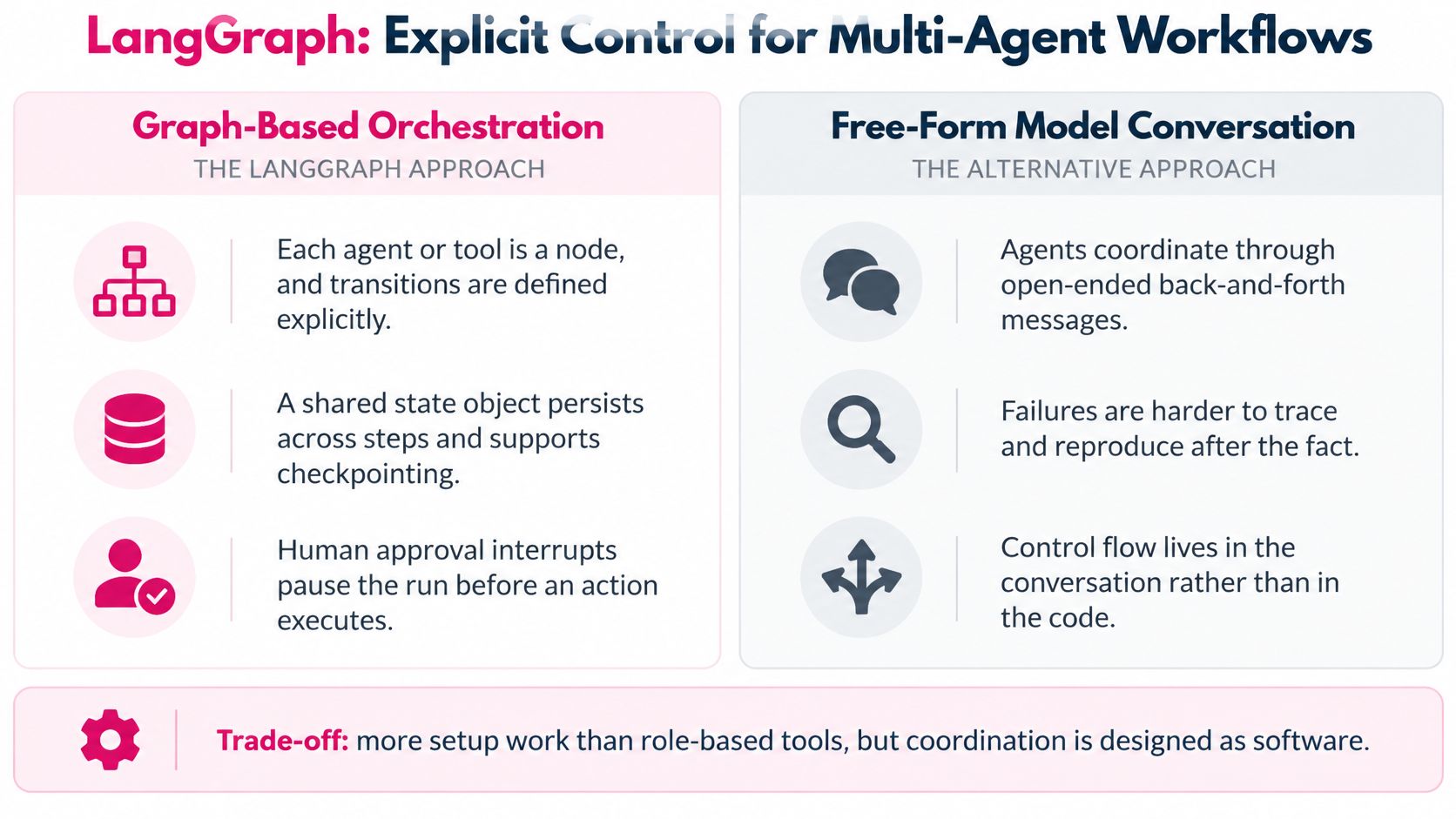
Choose LangGraph when recovery is part of the specification, not a feature to add after launch. Its graph-based approach represents work as nodes, shared state and edges that determine what happens next. Conditional routing lets a workflow distinguish successful completion, missing information, tool failure and human escalation.
Consider a customer-support pipeline. A triage agent classifies a ticket, a retrieval agent gathers policy evidence, and an escalation agent prepares a handoff when the request exceeds its permissions. A supervisor controls routing rather than allowing workers to negotiate the next speaker indefinitely.
The benefit is explicit control over transitions. The cost is engineering work: developers must define the state schema, persistence behavior, retry rules and approval boundaries rather than expressing the process entirely through role prompts.
Where recovery can still fail
Its hardest failure is an external action that succeeds before its result is recorded. A checkpoint doesn't undo a refund, retract an email or make a repeated database write safe. Developers still need idempotency keys, action receipts and reconciliation logic.
- Define state first: Separate customer facts, retrieved evidence, proposed actions and completed actions.
- Start with bounded delegation: Use a supervisor and narrowly scoped workers before introducing nested routing.
- Trace handoffs immediately: Record the route, state changes, tool result and reason for escalation.
Token costs depend on what each node receives. Passing the entire conversation into every worker defeats the economy of structured routing; pass the smallest sufficient state instead.
Commit only after a recovery test: interrupt the workflow around an external write and confirm that resuming neither loses the result nor repeats the action.
2. CrewAI
A research-and-reporting workflow is a natural CrewAI example: a researcher gathers material, an analyst organizes findings, and a reviewer checks the final claims. Developers describe agents through roles, goals and backstories, then assign tasks and expected outputs.
CrewAI fits teams that think in job responsibilities rather than state transitions. Sequential crews resemble a documented handoff process; manager-led crews introduce delegation when the next task depends on intermediate findings. That readability is its main advantage for business-oriented prototypes.
The trade-off is that understandable roles don't automatically create precise execution boundaries. A researcher and reviewer can still duplicate searches, share the same unsupported assumption or disagree without a useful stopping condition.
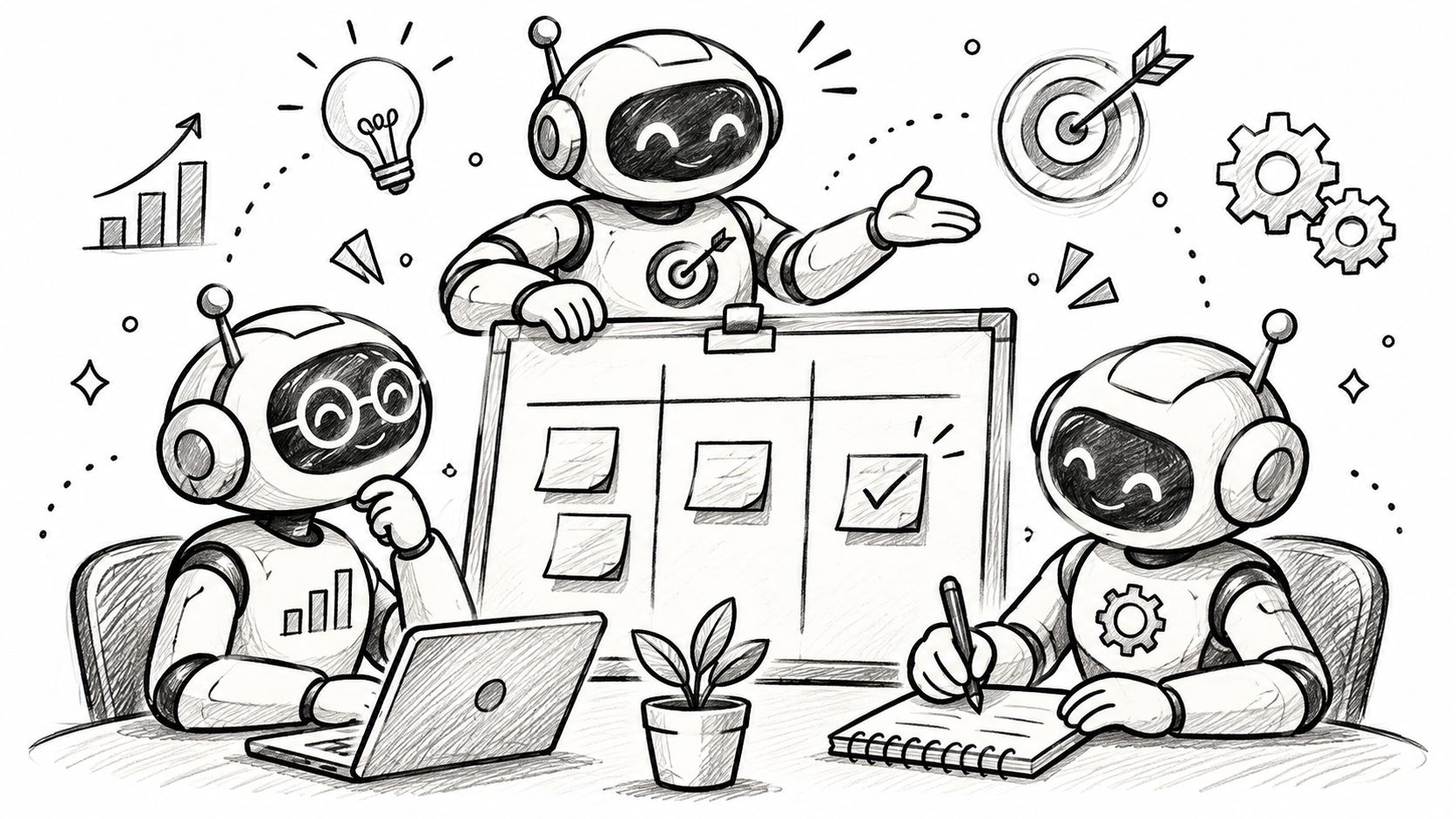
Keep roles separate from control logic
Its hardest failure is ambiguous ownership of a bad intermediate result. If an analyst receives an incomplete source pack, the workflow needs a clear rule for returning the task, requesting evidence or stopping. A persuasive backstory won't supply that rule.
Use narrow tool permissions and explicit output contracts. A research task should return claims with supporting passages and source locations, not merely a polished summary; the reviewer should evaluate those claims against the evidence.
Move deterministic validation into Flows or ordinary application code. Required fields, permission checks and file-format validation shouldn't consume another conversational round when software can check them directly.
The single-agent versus multi-agent decision guide provides the right comparison: keep the crew only if specialization improves the completed result enough to justify extra coordination.
Before committing, compare the crew against a single agent using the same tools and acceptance criteria. Measure total token spend, elapsed time and human corrections, including failed runs.
3. AutoGen (Microsoft)
AutoGen suits coding workflows where conversation itself is useful work. A coding agent proposes an implementation, an executor runs it, and a reviewer explains why the result needs revision. Optional human participation gives developers a way to intervene without replacing the conversational architecture.
Agents coordinate through messages rather than exclusively through a predetermined business-process graph. AutoGen's layered components separate runtime concerns, agent chat and extensions, so library versions and migration behavior deserve attention before an implementation becomes infrastructure.
The relevant evidence concerns role design, not an assurance that any conversational team will work. An AutoGen-based finite-element analysis study found functional complementarity more important than expanding the team, with the Coder-Executor-Critic arrangement producing physically valid and reliable results across its evaluated setup.
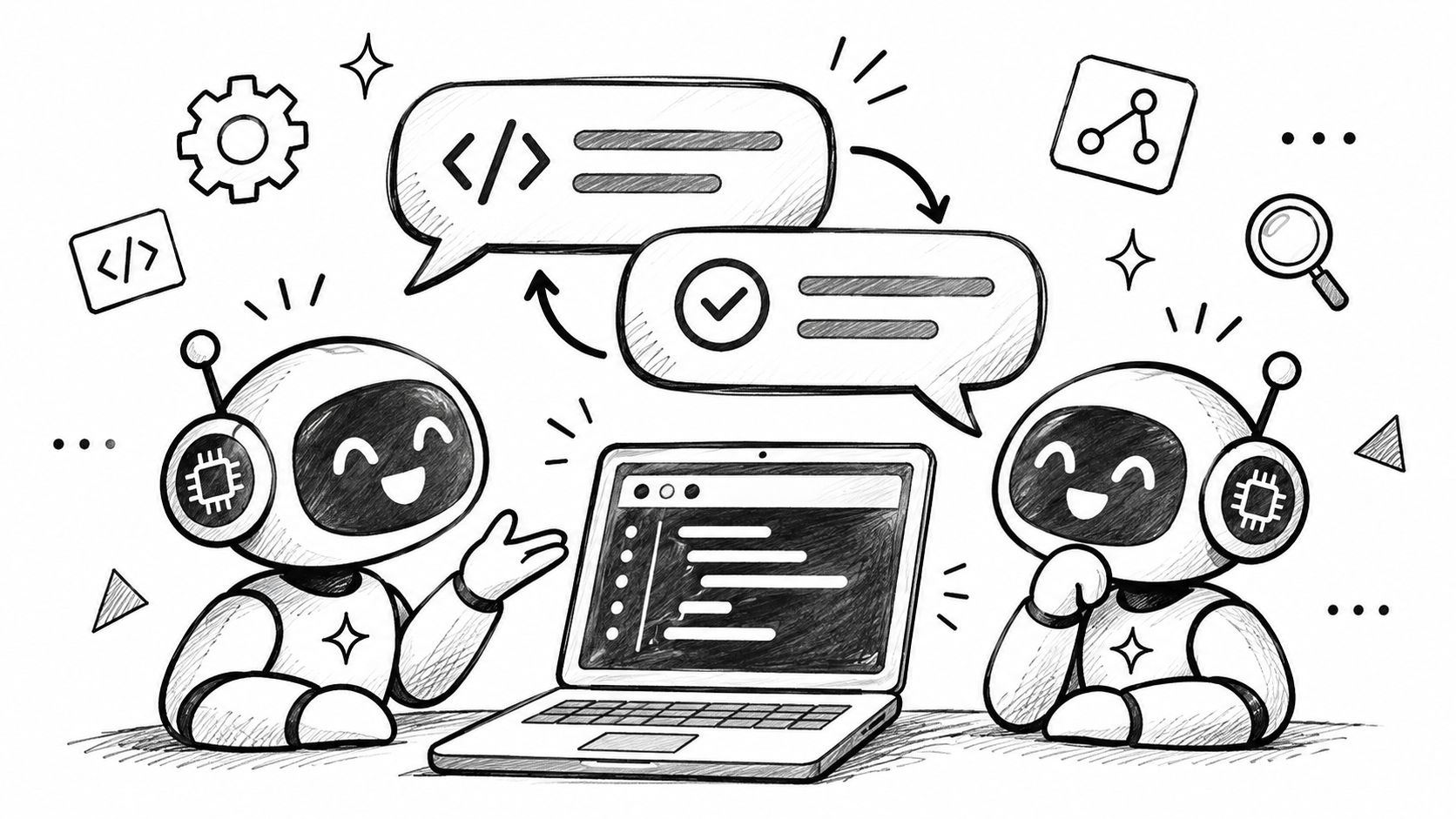
Make termination an application rule
Its hardest failure is a conversation that continues without improving the artifact. A coder can keep revising while a reviewer keeps generating plausible objections. Each exchange adds tokens, and replaying the dialogue doesn't necessarily recreate the same execution environment.
- Bound the conversation: Set turn limits, tool-call limits and explicit success or escalation conditions.
- Separate criticism from acceptance: Require executable tests or domain checks, not agreement between agents.
- Isolate execution: Run generated code in a restricted container rather than on the host machine.
- Pin dependencies: Keep the framework version, executor image and application dependencies reproducible.
Recovery should preserve the current artifact, test output and unresolved defects. Restarting with the full transcript alone leaves the next agent to infer which files and decisions are authoritative.
4. OpenAI Swarm and the OpenAI Agents SDK
A support request illustrates the handoff pattern clearly. A triage agent recognizes a booking issue and transfers control to a booking specialist; a refund request goes to a separately permissioned refund agent. The useful abstraction is transfer of responsibility, not a permanent group discussion.
Swarm presents that idea as an experimental, educational framework in which returning an agent from a function transfers control. The Agents SDK carries the handoff pattern into a production-oriented toolkit with tracing, guardrails and sessions.
Use Swarm to understand handoffs, then evaluate the Agents SDK for deployment. The distinction matters because a concise demonstration of delegation isn't equivalent to an operating model for durable customer transactions.
A handoff should transfer the task and its evidence, not silently expand the receiving agent's authority.
The risky boundary is responsibility
Its hardest failure is a valid handoff with incomplete context or inappropriate permissions. A refund agent might receive the customer's request without the policy evidence, transaction status or record of an earlier attempted refund.
Treat each handoff as a typed contract. Include the task, verified facts, unresolved questions, permitted actions and completed side effects; exclude unrelated customer data and irrelevant conversation history.
The token trade-off depends on context transfer. Sending everything wastes resources and spreads untrusted content, while sending too little forces the receiving agent to repeat tool calls or guess.
The AI agent framework comparison can support broader selection, but deployment acceptance should remain specific: trace every transfer, test incorrect routing, and require approval before irreversible actions.
Recovery belongs to the application as well as the SDK. Persist transaction status outside conversational memory so an interrupted handoff can be reconciled against what happened.
5. MetaGPT
MetaGPT fits the study of document-driven agent coordination. Its software-company roles include product manager, architect, engineer and quality assurance engineer. Instead of depending only on free-form conversation, roles exchange artifacts such as requirements, designs, code and test results.
For a small game or web-tool scenario, the product role defines behavior, the architect specifies structure, and the engineer implements against those documents. MetaGPT's published evaluation includes this kind of small-project generation, but that doesn't establish suitability for an organization's production codebase.
The editorial reason to include it is artifact-mediated coordination. A requirement document creates an inspection point that a transient conversational agreement doesn't provide.
A clean document can preserve a wrong assumption
Its hardest failure is an upstream specification error that downstream agents implement consistently. Better formatting won't rescue a misunderstood requirement. The architect, engineer and tester can all agree because they inherited the same mistake.
A separate computational-mechanics example, MechAgents, separates code generation from execution and correction, illustrating why computational verification matters more than fluent agreement. That evidence supports the verification principle, not a performance claim about MetaGPT.
- Approve requirements before implementation: Check user behavior, exclusions and acceptance conditions.
- Version intermediate artifacts: Tie each implementation and test result to the requirement revision it addresses.
- Track spend by role: Identify whether document rewriting, implementation or repeated review consumes the budget.
MetaGPT exchanges conversational flexibility for documentary structure. Token costs include producing and rereading those artifacts, especially when upstream changes invalidate downstream work.
Recovery should restart from the last approved artifact, not the latest message. A changed requirement may require design and test changes rather than another local code patch.
6. ChatDev
ChatDev is a research platform for examining a virtual software team, not the default choice for shipping an application. Its roles include executive, technical leadership, programming, review and testing responsibilities. Agents move through design, coding, testing and documentation using structured chat chains.
A simple desktop utility or text-based program is a suitable worked example. A design conversation establishes behavior, programmers create the implementation, reviewers request changes, and testers examine whether the program works.
Its distinction from MetaGPT is emphasis. ChatDev makes phased dialogue the coordination mechanism, while document-driven approaches emphasize artifacts passed between roles. Both require external acceptance criteria rather than treating a convincing conversation as proof of correctness.
Measure the phases, not the role-play
Its hardest failure is conversational agreement that escapes independent validation. Agents can complete the expected discussion while leaving a dependency problem, an untested path or an incorrect interpretation of the task.
Keep phase outputs separate so an evaluator can distinguish design errors from implementation and testing errors. Capture prompts, model settings, generated files and execution results; otherwise a changed model can alter the outcome without revealing which phase caused it.
Evaluation boundary: Completion of the simulated company's process isn't acceptance of the generated software.
Token spend comes from repeated exchanges within and between phases. Recovery costs rise when a coding defect originates in design, because the appropriate response is to revisit earlier decisions rather than continue patching.
Before running the repository, inspect dependency versions and isolate code execution. Before retaining the pattern, compare its final program against a simpler coding-and-testing workflow using identical requirements.
The useful output is a measurable collaboration experiment. The executive titles themselves don't provide accountability, software assurance or a reason to add more agents.
7. Magentic-One (Microsoft Research)
Magentic-One fits tasks that cross browser research, local files and code execution. An orchestrator directs specialized agents, including a web surfer, file surfer, coder and terminal agent. It maintains task and progress ledgers so it can revise the plan when work stalls.
A representative scenario is preparing an analysis from public web pages and local spreadsheets. The orchestrator assigns discovery, file inspection and computation, then combines the results while recording unfinished work.
This is more autonomous than a fixed pipeline, but it isn't leaderless conversation. The orchestrator owns the evolving plan, and the ledgers make replanning inspectable.
A ledger isn't a transaction log
Its hardest failure is replanning from an inaccurate account of external state. A browser action may have changed a website, a terminal command may have modified files, or an interrupted tool call may have completed despite appearing unsuccessful.
The 2025 survey of responsible LLM-based multi-agent systems treats reliability, transparency, accountability and fairness as separate evaluation dimensions. That distinction matters here: completing the task doesn't establish that the system respected permission boundaries or left a reconstructable decision trail.
- Isolate browser and terminal access: Use a restricted environment without ambient production credentials.
- Record action evidence: Preserve tool results, modified-file lists and receipts for consequential operations.
- Inspect replanning: Check whether the orchestrator changed strategy because of new evidence or merely repeated an unsuccessful approach.
Token costs include orchestration, ledger updates and repeated exploration. Recovery also requires reconciling the ledgers with actual files and external systems.
Start with narrow, read-only tasks before allowing writes. Add permissions individually, and require approval for actions that can't be safely reversed.
8. Anthropic Multi-Agent Research System
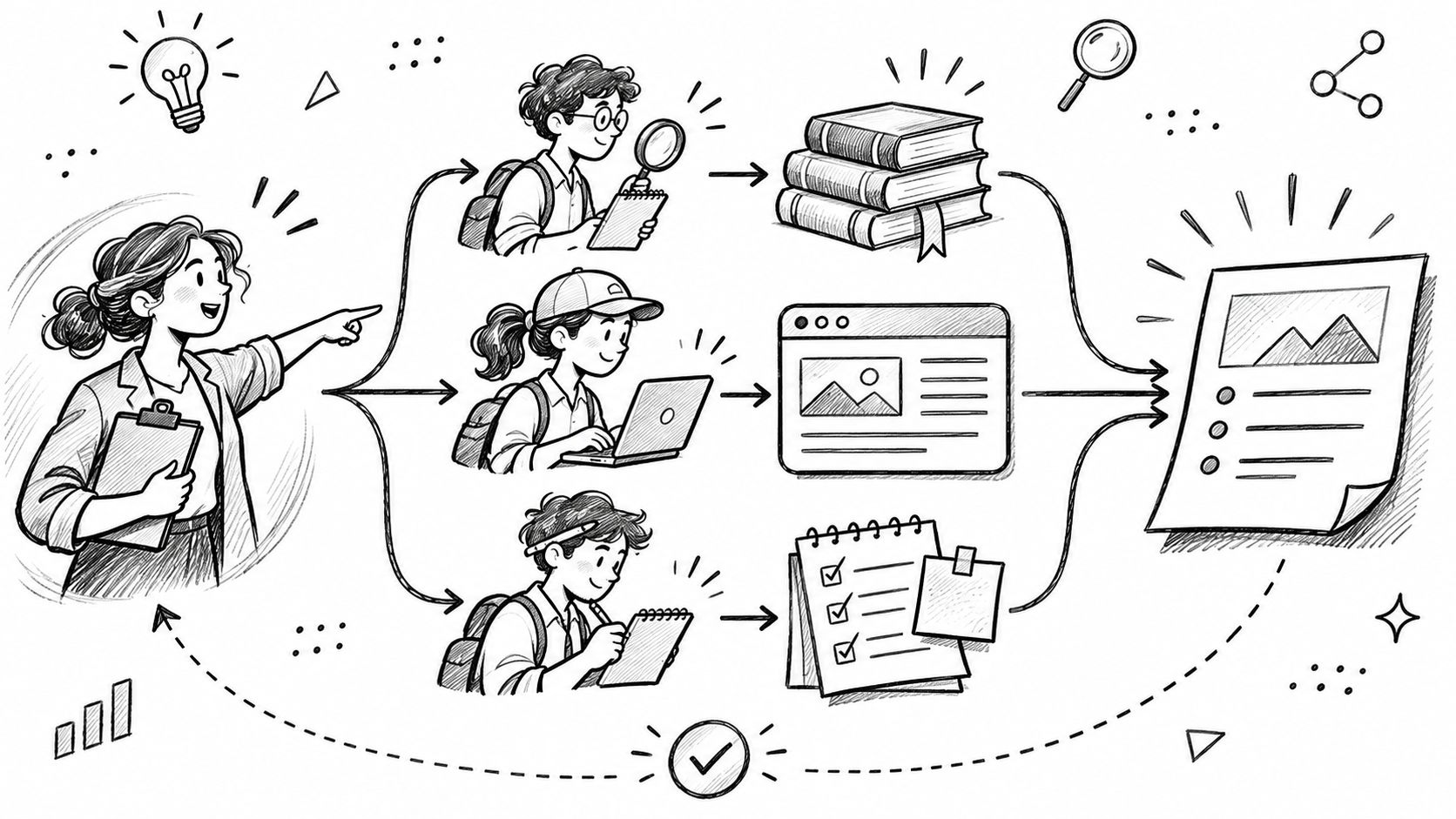
An orchestrator with parallel researchers fits broad questions with separable evidence streams. A lead agent breaks the question into assignments, delegates searches to subagents and synthesizes their findings. Anthropic's described research system makes this pattern concrete through its research feature.
For a supplier assessment, separate researchers could examine product capabilities, security documentation and contractual limitations. The lead agent then resolves conflicts and produces a sourced assessment rather than merely concatenating summaries.
The attraction is breadth. The cost is parallel context, duplicated searches and synthesis work, so the pattern needs independent branches rather than a sequential task disguised as delegation.
Keep independence without losing provenance
Its hardest failure is a confident synthesis built from overlapping or incompatible evidence. Subagents can discover the same source, interpret different publication periods as equivalent, or omit the caveat that changes the conclusion.
A Google Research evaluation of agent-system scaling supports the broader decision rule: partitionable work can benefit from coordination, while tightly sequential planning can deteriorate when the architecture adds unnecessary interaction. It doesn't establish a universal performance advantage for Anthropic's implementation.
Require each worker to return source passages, publication context, unresolved conflicts and search boundaries. Set per-worker token budgets and a total tool-call ceiling, then reserve synthesis capacity rather than spending the entire budget on discovery.
The agent orchestration guide explains the coordinating layer, but acceptance should depend on evidence quality and total cost per successful answer.
Recovery should rerun only the failed branch when its dependencies remain valid. Repeating every search after a synthesis error adds cost without necessarily adding evidence.
How the eight multi-agent systems compare on coordination, open-source status and setup effort
Pick by constraint, not by popularity. If auditable recovery is the constraint, the graph entries fit; if speed of first deployment is the constraint, the low-effort role and handoff entries fit.
| Item | Best for | Coordination pattern | Open source | Setup effort |
|---|---|---|---|---|
| LangGraph (LangChain) | Production workflows needing control and recovery | Stateful graph with explicit routing | Yes | High |
| CrewAI | Business research and content workflows | Role-based teams running sequentially or hierarchically | Yes | Low |
| AutoGen (Microsoft) | Debate, review, and coding workflows | Agents coordinate through conversations | Yes | Moderate |
| OpenAI Swarm and the OpenAI Agents SDK | Learning and building lightweight handoff workflows | Function-based handoffs between agents | Yes, Swarm | Low |
| MetaGPT | Greenfield software prototypes | Role-based software team passing structured artifacts | Yes | Moderate |
| ChatDev | Studying phased agent collaboration | Role-based chat chains across development phases | Yes | Moderate |
| Magentic-One (Microsoft Research) | Browser, file, and computer-use tasks | Orchestrator directs specialized agents and replans | Yes | High |
| Anthropic Multi-Agent Research System | Broad research that benefits from parallel searches | Orchestrator delegates to parallel workers, then synthesizes | Not released as an open-source framework | High |
The setup column is where coordination cost hides. CrewAI and Swarm start fast because their coordination is thin: sequential role execution and function-based handoffs need little configuration, but they also offer few explicit points where a failed step can be caught and rerun. LangGraph and Magentic-One invert that trade. Their high setup effort buys defined transitions and replanning logic, so a failure is an event the system handles rather than a silent corruption of everything downstream.
The open-source column carries a second, less obvious cost. Seven of the eight entries can be inspected, forked and self-hosted. The Anthropic system is documented as an architecture rather than distributed as a framework, so reproducing it means building the orchestrator, worker supervision and synthesis layer yourself. That reconstruction work, not configuration, is what puts it in the high-effort tier alongside Magentic-One, whose effort comes instead from sandboxing browser and computer-use agents.
What to Copy From These Eight Setups
Choose the coordination pattern before choosing the model. Use a graph when operators need audited recovery and explicit transitions. Use roles when setup clarity matters, conversation when critique is productive, and an orchestrator with parallel workers when the question divides into independent research branches.
Those choices allocate responsibility differently. A graph requires developers to encode transitions; a role-based crew requires precise task contracts; a conversational team requires termination and acceptance rules. An orchestrator requires evidence that its plan still matches the external environment.
More agents aren't an acceptance criterion. The relevant result is a completed task that satisfies the same quality standard as the simpler baseline, with an acceptable recovery burden.
Make failure part of the evaluation
Cap turns and tool calls before live execution. Isolate anything that touches a browser or terminal, and give each agent only the permissions its assignment requires. Human approval should precede irreversible actions, not follow an agent's announcement that the action is complete.
Evaluate successful and unsuccessful runs together. Count token spend, tool usage, elapsed time, human intervention and repeated side effects; preserve the artifacts needed to explain a failure without reconstructing it from prose.
- Test interruption: Stop execution around handoffs and external writes, then examine what resuming does.
- Test disagreement: Give workers conflicting evidence and check whether the coordinator preserves uncertainty.
- Test contamination: Place untrusted instructions in retrieved material and verify that agents treat them as content.
- Test the simpler baseline: Compare against a single agent using the same tools, evidence and acceptance conditions.
Apply the same scrutiny to buying claims
A buyer should check the named source, publication year, seller's own price page and date the price was checked. A historical framework description doesn't establish current maintenance status, and an academic benchmark doesn't establish operating cost for a different workload.
No hands-on testing underpins these entries. Quantitative research claims come from the linked publishers, while the ranking reflects coordination fit rather than a shared performance benchmark.
DBotMaker's published scoring method weights capabilities at 40%, ease of setup at 30% and value at 30%. Its research desk has scored 305 products, and the decision bot returns one clear answer to a what-to-pick question.
Start with LangGraph for recoverable production control or CrewAI for a readable role-based prototype. Build a bounded version of the actual workflow, compare it against a single-agent baseline, and deliberately interrupt it before expanding permissions. Keep the multi-agent design only when its quality advantage survives the full cost of coordination and recovery.
Cite this page
DBotMaker. Multi Agent System Examples: 8 Frameworks Ranked. Updated November 27, 2026. https://dbotmaker.io/multi-agent-system-examples
Spotted an error in this guide? Email editorial@dbotmaker.io