Review · Software & AI
 Cursor Bugbot review
Cursor's AI pull request reviewer, focused on logic bugs, with rules and an Autofix that hands findings to a cloud agent.
By the DBotMaker research desk · Updated November 25, 2026
Short answer · output
Cursor Bugbot is an AI pull request reviewer that comments on logic bugs, security issues and code quality, and it is a strong pick for teams already on Cursor that can accept a variable bill. It needs a paid plan, from Premium at $30 a month for individuals or $30 per seat for Teams, and Cursor puts the average review at $1.00 to $1.50. Prices and features were checked on Cursor's pricing page and documentation in November 2026.
- Capabilities (40%)
- 8.5
- Ease of setup (30%)
- 8.0
- Value (30%)
- 7.2
In pictures · 2 images
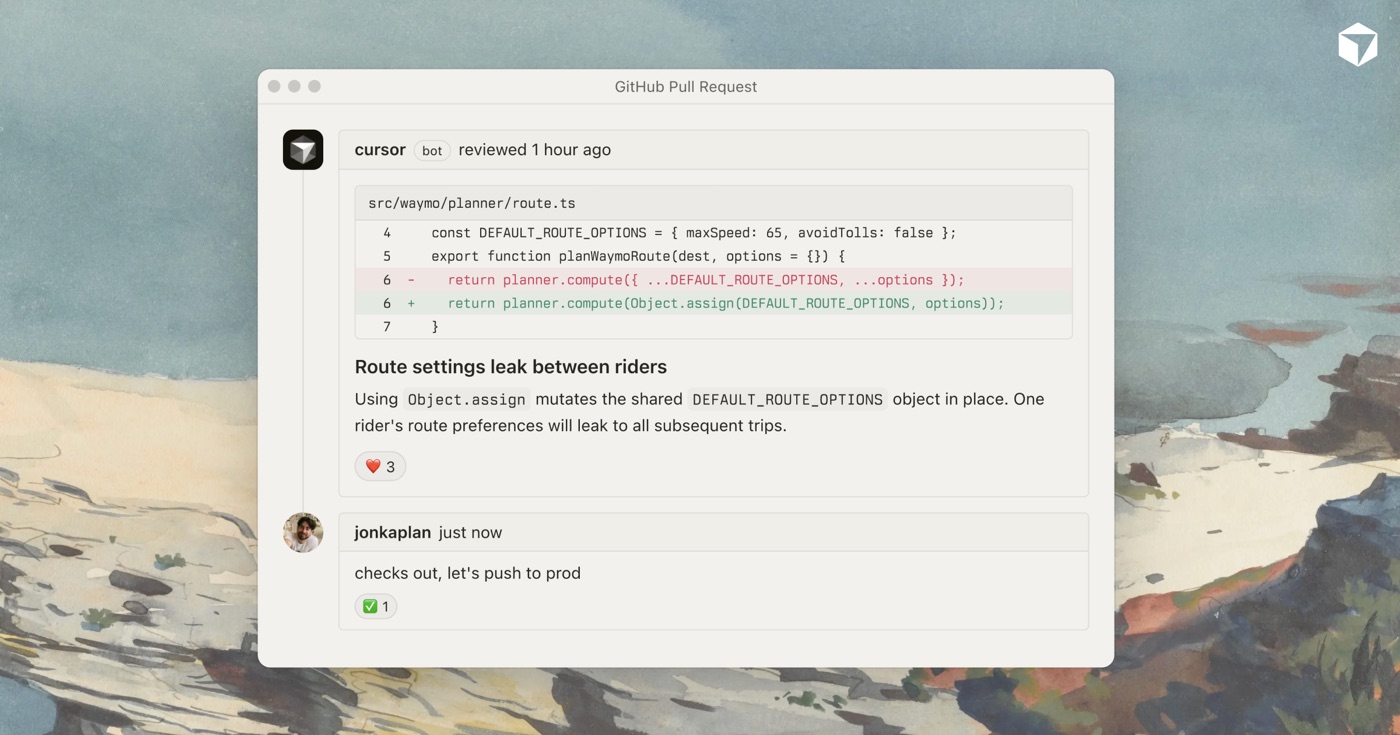
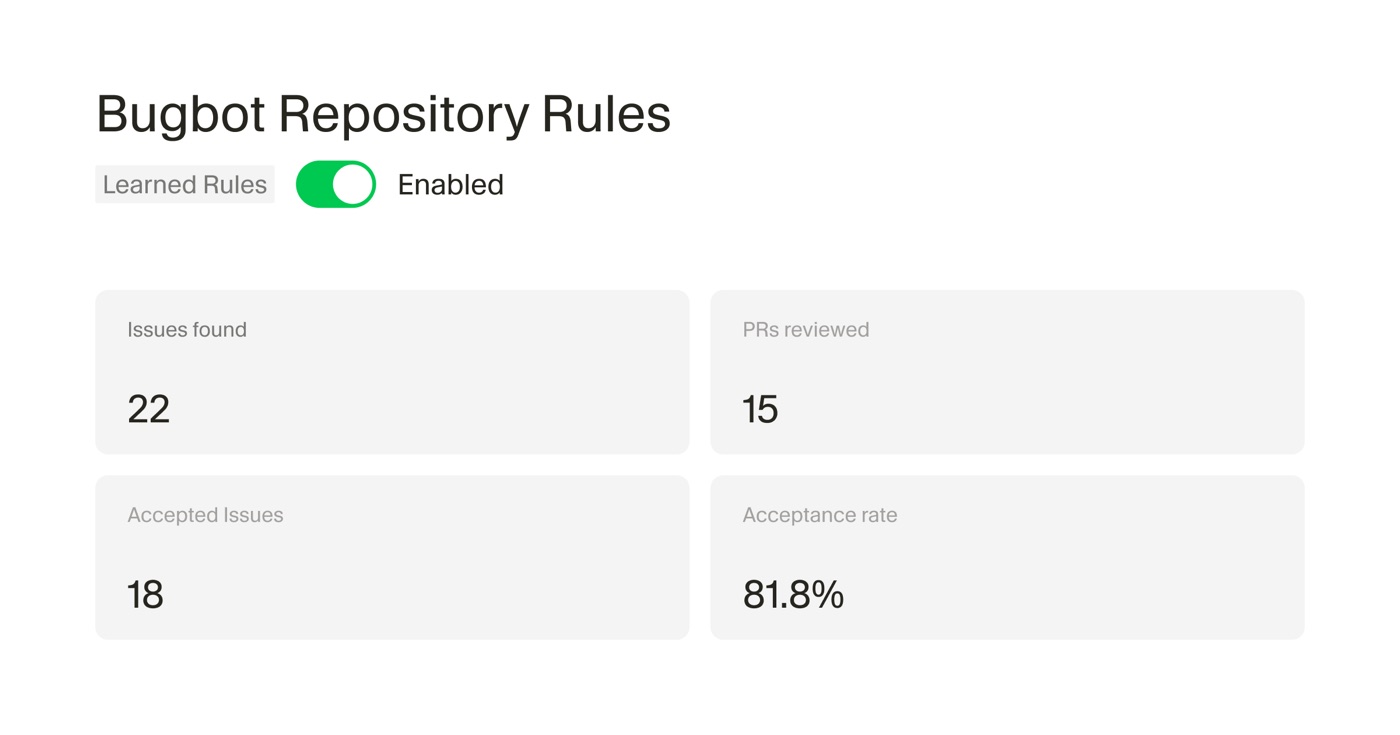
Verdict printout · Cursor Bugbot
Choose Bugbot if your team already pays for Cursor, wants a reviewer tuned to flag bugs that get fixed, and can control how often reviews run. Skip it if you need a flat price per developer, a permanent free tier, or full features on Azure DevOps or Bitbucket Data Center. The deciding fact is the meter: at Cursor's average of $1.00 to $1.50 per review, 100 reviews cost about $100 to $150, and by default every push to a pull request triggers another one.
ReadOverview
Bugbot is the code review agent in Cursor, made by Anysphere. It reads a pull request diff, uses existing comments as context and posts inline findings with fix suggestions. It runs on every pull request update, or on demand when someone comments cursor review or bugbot run. Findings can be opened in the Cursor editor or on the web, and the /review-bugbot skill runs the same kind of review on a branch before it is pushed.
Billing changed most in 2026. On May 11, Cursor announced it was dropping the $40 per seat monthly subscription for usage billing on Teams and Individual plans, with existing customers moved at their first renewal after June 8, 2026. Individual reviews now draw on included plan usage first, then prepaid credit. Teams reviews are paid from the team's prepaid credit, or from on-demand spend on a legacy Teams plan. Cursor itself is now sold as part of The X Subscription with Grok and X features, and Plus at $8 a month excludes Bugbot.
The product changed too. Autofix left beta in February 2026, learned rules arrived in April, and a June 10 release moved Bugbot to Composer 2.5. Cursor said that release was over 3x faster and 22% cheaper, found 10% more bugs per review, and finished 90% of runs in under three minutes. In October, Cursor staff wrote on the forum that the models behind Default effort had changed again over the summer, so the June figures may not describe current runs.
Accuracy evidence is encouraging but not independent. Cursor's April 2026 study of public repositories put Bugbot's resolution rate at 78.13% over 50,310 pull requests, against 63.49% for Greptile, 48.96% for CodeRabbit and 46.69% for GitHub Copilot. Its product page gives both 70%+ of flags and more than half of bugs as figures for what gets fixed. A rival, Augment Code, gave Bugbot 60% precision and 41% recall on a public benchmark, second to its own tool by F-score. DeepSource, also a vendor, notes there is no shared benchmark for AI code review and that every vendor publishing one wins its own.
Against rivals on this site's code review list, Bugbot sits at the integrated end. CodeRabbit charges $24 per developer a month billed annually, so at Bugbot's average cost the break-even is 16 to 24 reviews per developer a month. Greptile charges $1 per credit with no seat fees and one credit for a base review, plus a free Starter plan. GitHub Copilot review comes with the $10 Pro plan and averages an estimated $1.50 at Balanced effort.
Several limits affect a rollout. On an individual account Bugbot runs only on pull requests you author. Pull requests over the default size limit are skipped without a charge, and Cursor's Bugbot docs do not state the limit as a number. Learned-rule runs count as usage although they post nothing. A required Bugbot check does not block merges on findings by default, because findings return a neutral status unless fail-on-unresolved behavior is available and enabled.
How it scored
If the deciding question is catching logic bugs for a team that already codes in Cursor, Bugbot is the natural add-on. It reviews new pull requests in the background, follows team, repository and project rules, and Autofix can pass a finding to a Cursor Cloud Agent to write the fix. Two things changed since earlier versions of this list. Bugbot now connects to GitHub, GitLab, Bitbucket and Azure DevOps, including GitHub Enterprise Server, GitLab Self-Hosted and Bitbucket Data Center. And Cursor's individual plans are now sold with an X subscription: Bugbot is included from Premium at $30 a month, while Plus at $8 does not include it. Teams start at $30 per user per month. Reviews bill from usage under the May 2026 pricing, and the analytics API reports the billed cost of each review. Oversized PRs are skipped and not billed.
Who it is for
Teams already paying for Cursor
Run it if
- Teams that already pay for Cursor and want findings that open directly in the editor or go to a cloud agent
- Organizations whose contributors do not all have Cursor seats: automatic reviews cover every contributor to an enabled private repository
- Teams producing a lot of agent-written code that want a bug check before push with /review-bugbot and again on the pull request
- Companies on GitHub Enterprise Server or GitLab Self-Hosted, both of which Bugbot supports
- Teams with written standards they can encode in .cursor/BUGBOT.md files and team rules
Skip it if
- Teams that need a fixed cost per developer: CodeRabbit Essentials is $24 per developer a month billed annually, within its review rate limits
- Solo developers who want reviews at no cost: Greptile Starter is free for one developer with 50 credits a month
- Teams on GitHub that do not use Cursor: GitHub Copilot code review comes with the $10 Pro plan
- Teams on Azure DevOps or Bitbucket Data Center that want automatic fixes: Bugbot Autofix does not work on either, so CodeRabbit, which supports Azure DevOps and Bitbucket and lists one-click autofix, is worth checking first
SpecSpec sheet
| Maker | Anysphere, Inc. (Cursor) | src ↗ |
|---|---|---|
| Cheapest individual plan | Premium, $30 per month or $300 per year, before tax | src ↗ |
| Teams price | $30, $100 or $200 per seat per month | src ↗ |
| Average cost per review | $1.00 to $1.50, depending on PR size and complexity (Cursor figure) | src ↗ |
| Billing | Usage-based; legacy seats were $40 per month | src ↗ |
| Free plan | Cursor Free and Plus do not include Bugbot | src ↗ |
| Git hosts | GitHub, GitLab, Bitbucket, Azure DevOps Services (public beta) and Cursor Origin | src ↗ |
| Self-hosted Git | GitHub Enterprise Server, GitLab Self-Hosted, Bitbucket Data Center | src ↗ |
| Review triggers | Every push (default), once per PR, or only when mentioned | src ↗ |
| Effort levels | Low, Default, High and Smart, on usage-based plans | src ↗ |
| Review speed | 90% of runs under three minutes (Cursor, June 2026) | src ↗ |
| Resolution rate | 78.13% across 50,310 public PRs (Cursor study, April 2026) | src ↗ |
| Rule limits | 30,000 characters per rule, 100,000 characters combined | src ↗ |
| Config files | .cursor/BUGBOT.md for rules, .cursor/config/bugbot.yaml for settings (max 64 KB) | src ↗ |
| Review API | Enterprise teams; 30 trigger requests per minute per team | src ↗ |
| Autofix attempts | Maximum 3 per PR when committing to the existing branch | src ↗ |
Price
Included from Cursor Premium at $30 per month; Teams from $30 per user per month; reviews bill from usage.
Premium Most popular $30 /month
Quoted from the vendor pricing page on November 16, 2026.
Plans on file · 7
| Plan | Price | Includes | Checked |
|---|---|---|---|
| Free | $0 per monthno charge | Limited agent and chat requests; No Bugbot | Checked Nov 25, 2026 |
| Plus | $8 per monthmonthly, or $80 per year | Grok and Composer models only; No Bugbot, cloud agents or third-party models | Checked Nov 25, 2026 |
| Premium | $30 per monthmonthly, or $300 per year | Bugbot code review; Cloud agents and automations, used by Autofix; 4x Plus usage, refreshed weekly; Code hosting on Origin | Checked Nov 25, 2026 |
| Super | $100 per monthmonthly, or $1,000 per year | Everything in Premium, including Bugbot; 15x Plus usage; Priority model access at peak times | Checked Nov 25, 2026 |
| Ultra | $200 per monthmonthly, or $2,000 per year | Everything in Super, including Bugbot; 50x Plus usage; Earliest access to new models and products | Checked Nov 25, 2026 |
| Teams | $30, $100 or $200 per seat per monthper seat, plus Bugbot reviews from the team's prepaid credit | Bugbot with analytics, reporting and advanced rules; Seats match Premium, Super or Ultra usage and can be mixed; MCP tools in reviews; SAML/OIDC SSO and team-wide privacy settings | Checked Nov 25, 2026 |
| Enterprise | Custom, price not listedcontract | Bugbot review API and per-review analytics; Pooled usage across Grok and Cursor; SCIM, audit logs and granular spend controls; Bugbot trial available through the account team | Checked Nov 25, 2026 |
Key features
Effort levels that trade cost for depth
Low aims for quality close to Default at a lower price and longer run time. High spends more time reasoning: Cursor's internal runs found 35% more bugs with the resolution rate steady at 80%. Smart follows plain-language instructions about which pull requests get which level, reading the title, author, repository name and diff but not the description or labels.
Incremental review
By default, a new push is reviewed only against changes since the last Bugbot review. Cursor staff note that rebasing or merging main into the branch changes the base and triggers a full review, so batching pushes limits cost.
Rules at team, repository and folder level
Bugbot always loads the root .cursor/BUGBOT.md and finds nested files above the changed code. Team rules, learned rules and manual rules are merged in. Cursor's own .mdc project rules do not apply to Bugbot. Commenting bugbot run verbose=true lists each rule used and flags any that were cut.
Learned rules
Bugbot turns reactions, replies and human reviewer comments into candidate rules, promotes those that keep working and disables ones with negative signal. Cursor counted more than 110,000 repositories with learning on and 44,000 rules generated in April 2026. Each learning run bills like a review.
Autofix through cloud agents
A cloud agent can write the fix and push it to a new branch or the existing one. Cursor reported in February 2026 that over 35% of Autofix changes were merged. GitHub and Origin support both modes, GitLab and Bitbucket only commits to the existing branch, and Azure DevOps has no Autofix. It bills separately as cloud agent usage.
Review before you push
The /review-bugbot skill covers committed and uncommitted branch changes in Cursor 3.7 or later, at cursor.com/agents and in the Cursor CLI. If the pull request later has the same diff, Bugbot skips the second review and says so in a comment.
API, dry runs and cost reporting
Enterprise teams can queue reviews by URL and pull findings, resolution status and billed cost per review. A dry run stores findings without posting comments, which is useful for a pilot, but it is billed like a normal review.
Strengths and weaknesses
Plus · 8
- No Bugbot seat fee: the old $40 per seat charge is gone, and Cursor staff say one paid Team seat keeps Bugbot available across the team's enabled repositories
- Automatic reviews cover all contributors to enabled private repositories, whether or not they are team members
- Highest resolution rate in Cursor's own study at 78.13%, about 15 points ahead of Greptile at 63.49%
- Second of seven tools in a competitor's benchmark, with 60% precision against 36% for CodeRabbit and 20% for GitHub Copilot
- Cursor says 90% of runs finish in under three minutes
- Oversized pull requests are skipped with no review usage, and files marked linguist-generated do not count toward the size limit
- The settings file is read from the base branch, so a pull request cannot change how it is reviewed
- Files that look like credentials, such as .env and *.pem, are not read
Minus · 6
- Cost is variable: 200 average reviews would run about $200 to $300, and the default trigger is every push
- Bugbot starts at $30 a month; the $8 Plus plan and Free do not include it
- Recall is the weak side in Augment Code's benchmark, at 41%, so more than half of the known issues were missed
- Azure DevOps is in public beta with no Autofix, and Bitbucket Data Center gets automatic reviews only, on Teams and Enterprise
- Learned-rule runs, dry runs and Autofix all add usage beyond the visible review
- Cost complaints continue: one Ultra user reported on Cursor's forum in October 2026 that the rate rose from $0.73 to $1.72 per million tokens; staff replied that cost per review had stayed in roughly the same range
Key facts
- Cheapest individual plan with Bugbot: Premium, $30 per month
- Teams: From $30 per user per month
- Billing: Usage-based since the May 2026 pricing update
- Git hosts: GitHub, GitLab, Bitbucket, Azure DevOps
- PR size: PRs over the review-size limit are skipped and not billed
Where it ranks
Cursor Bugbot is No. 8 in our Best AI Code Review Tools verdict.
AltAlternatives to weigh
- CodeRabbit →Essentials is $24 per developer a month billed annually or $30 monthly, across four Git hosts; pick it for a predictable per-seat price.
- Greptile →Pro is $1 per credit with no seat fees, one credit per base review, and Starter is free for one developer; pick it for usage pricing with a stated unit price.
- GitHub Copilot code review →Included from Copilot Pro at $10 a month, with Balanced reviews estimated at $1.50 on average; pick it if you are on GitHub and do not use Cursor.
- Qodo →Pro Team starts at $30 a month for 2,000 pooled credits, about 14 reviews; pick it for cross-repository rules without per-user limits.
Questions readers ask
- QHow much does Cursor Bugbot cost?
- AThe average Bugbot review costs $1.00 to $1.50, according to Cursor, on top of a plan that starts at $30 a month. Individual plans use included usage first and then prepaid credit. Teams pay reviews from prepaid credit, or from on-demand spend on legacy plans. Checked in November 2026.
- QIs Cursor Bugbot worth it?
- ABugbot is worth it for teams already on Cursor that run a moderate number of reviews, since no separate seat is charged. At the average price, each developer reaches the cost of a $24 CodeRabbit seat after 16 to 24 reviews a month. Teams that push many times per pull request should set it to once per PR or use Low effort.
- QDoes Cursor Bugbot have a free plan?
- ANo, Cursor's Free and $8 Plus plans do not include Bugbot. Access starts with Premium at $30 a month, where reviews draw on included usage first. Enterprise teams can arrange a trial through their account team.
- QCursor Bugbot vs CodeRabbit: which is better?
- ACodeRabbit is easier to budget at $24 per developer a month billed annually, while Bugbot bills about $1.00 to $1.50 per review. Augment Code's benchmark gave Bugbot 60% precision and 41% recall, and CodeRabbit 36% precision and 43% recall. Augment sells a competing tool, so treat those numbers as a guide.
- QDoes Bugbot work with GitLab, Bitbucket and Azure DevOps?
- AYes, Bugbot supports GitHub, GitLab, Bitbucket, Azure DevOps Services and Cursor Origin. Azure DevOps is in public beta without Autofix, and Azure DevOps Server is not supported. Bitbucket Data Center has automatic reviews only, on Teams and Enterprise.
- QHow accurate is Cursor Bugbot?
- ACursor reported a 78.13% resolution rate across 50,310 public pull requests in April 2026. That measures how often flagged issues were addressed by merge, judged by an LLM, and it does not count bugs the tool missed. A competitor's benchmark measured recall at 41%.
- QDoes every developer need a Cursor seat to use Bugbot?
- ANo, automatic reviews run for all contributors to enabled private repositories. Cursor staff say a team needs at least one paid seat, manual comment triggers depend on team membership and access settings, and running Bugbot inside Cursor needs the user's own paid seat.
- QHow can a team lower its Bugbot bill?
- ASet reviews to once per PR or only when mentioned, and choose Low effort. Keep incremental review on and avoid rebasing until the final pass, because a base change causes a full review. Turning off Automatically Learn Rules stops the automatic learning runs, which also bill as usage.
LogSource log
- [01]Cursor Bugbot product page · checked Nov 25, 2026
- [02]Cursor pricing · checked Nov 25, 2026
- [03]Cursor docs: Bugbot · checked Nov 25, 2026
- [04]Cursor docs: Models and pricing · checked Nov 25, 2026
- [05]Cursor help: Bugbot usage-based billing · checked Nov 25, 2026
- [06]Cursor docs: Legacy Bugbot pricing · checked Nov 25, 2026
- [07]Cursor blog: Updates to Bugbot for Teams and Individuals, May 2026 · checked Nov 25, 2026
- [08]Cursor blog: Bugbot updates, June 2026 · checked Nov 25, 2026
- [09]Cursor blog: Bugbot learned rules, April 2026 · checked Nov 25, 2026
- [10]Cursor blog: Bugbot Autofix, February 2026 · checked Nov 25, 2026
- [11]Cursor docs: Security Review source control support · checked Nov 25, 2026
- [12]Cursor docs: Azure DevOps · checked Nov 25, 2026
- [13]Cursor forum: Bugbot price discussion, October 2026 · checked Nov 25, 2026
- [14]Cursor forum: Bugbot and Team seats, June 2026 · checked Nov 25, 2026
- [15]Augment Code: benchmark of 7 AI code review tools · checked Nov 25, 2026
- [16]DeepSource: AI code review benchmarks survey · checked Nov 25, 2026
- [17]CodeRabbit pricing · checked Nov 25, 2026
- [18]Greptile pricing · checked Nov 25, 2026
- [19]GitHub docs: Copilot code review · checked Nov 25, 2026
- [20]GitHub Copilot plans · checked Nov 25, 2026
- [21]Qodo pricing · checked Nov 25, 2026
Deep review last updated November 25, 2026. Prices and specs are rechecked against these pages.
Alternatives we scored
- CodeRabbit8.9
- GitHub Copilot code review8.8
- Greptile8.7
- Qodo8.4
Cite this page
DBotMaker. Cursor Bugbot review. Updated November 25, 2026. https://dbotmaker.io/review/cursor-bugbot
Visit cursor.com · Questions or corrections: editorial@dbotmaker.io