Guide · General
10 LLM API Providers Compared: The 2026 Decision Guide
Compare 10 LLM API providers by models, access, pricing and limits. See which provider fits your workload before you write a line of code.
By the DBotMaker research desk · Updated November 13, 2026 · 18 min read
The cheapest way to buy an LLM API in 2026 isn't the provider with the lowest price per million tokens. It's the one whose retry rate, rate-limit ceiling and cache behaviour don't undo the headline rate. Start with the pick, then the evidence.
The call, by situation. Teams already running on AWS should start with Amazon Bedrock, because model access, billing and IAM arrive inside infrastructure they already operate. Teams that want models plus built-in tools under one roof should start with OpenAI, which publishes per-model and per-feature pricing rather than hiding it behind a sales call. Teams standardising on a single frontier model family should look at Anthropic. Teams that want open-weight models, fine-tuning or dedicated GPUs should compare Together AI and Fireworks AI. Teams that want one key and many models for experiments should start with OpenRouter, accepting a platform fee for the convenience. Vendors that quote only on request are marked pending here, not guessed at.
How this ranking was built. Every figure below comes from the seller's own public pricing, documentation or rate-limit pages, with the date checked recorded next to the price. Where a published survey or academic paper is the only source for a market number, it's named with its year. DBotMaker's research desk does no hands-on testing and claims none; the scores rest on documented capabilities, setup effort and published value.
Before you commit: re-check the pricing page on the day you sign. Cache-write rates, residency premiums and per-model output rates change more often than procurement cycles.
What to verify before signing: the model version you plan to call, the enforced rate-limit dimensions, whether caching counts against your token ceiling, how long abuse-monitoring logs are kept, and the total cost of one completed task rather than one token.
Table of Contents
- 1. OpenAI
- 2. Anthropic
- 3. Google Gemini API
- 4. Amazon Bedrock
- 5. Mistral AI
- 6. Cohere
- 7. Together AI
- 8. Fireworks AI
- 9. Groq
- 10. OpenRouter
- 10 LLM API providers compared by access, pricing and billing
- How to Make Your Pick and Check the Price
1. OpenAI
OpenAI is the default starting point for many teams, and the reason is less about model quality than about documentation depth. Pricing is published per model and per feature, rate limits are documented dimension by dimension, and caching and retention policies are written down rather than inferred from a sales deck.
OpenAI's published pricing, checked November 13, 2026, lists GPT-6.1 Terra at $2.00 per 1 million uncached input tokens, $10.00 per 1 million output tokens and $0.10 per 1 million cached input tokens, according to the OpenAI API pricing page. The same page lists a 30-minute cache-write price of $2.50 per million tokens and a 12-hour cache-write price of $5.00, plus a 10% premium for regional-processing and FedRAMP endpoints on models released on or after March 5, 2026.
That structure rewards a specific workload shape: long, stable system prompts and schemas reused across many calls. It punishes another: fresh context on every request, where cache writes add cost rather than remove it.
The rate-limit trap nobody models
Rate limits are not one requests-per-minute figure. OpenAI's rate-limit documentation, checked November 6, 2026, identifies requests per minute, requests per day, tokens per minute, tokens per day, images per minute and audio minutes per minute for applicable streaming-audio models. Limits apply at organisation and project level, not user level, and can include a separate long-context limit for models such as GPT-5.5.
Caching doesn't buy you headroom. OpenAI's prompt-caching documentation, checked November 1, 2026, states that cached input tokens still count toward tokens-per-minute limits and that caching does not change how rate limits are calculated. Cache writes cost 1.25 times the ordinary input rate on the default 30-minute lifetime, or 2.5 times for a 12-hour minimum in the Responses API, with reads at 0.1 times on most listed models and 0.05 times on GPT-6.1 Sol and GPT-6.1 Terra.
Practical rule: size the spend model and the throughput model separately. A cache-heavy workload can cut its bill in half and still hit the same TPM wall.
On retention, OpenAI's data-controls documentation, checked November 11, 2026, says abuse-monitoring logs are generated by default and retained for up to 30 days, unless a longer period is legally required. That's a logging baseline, not a claim that every prompt is stored for 30 days.
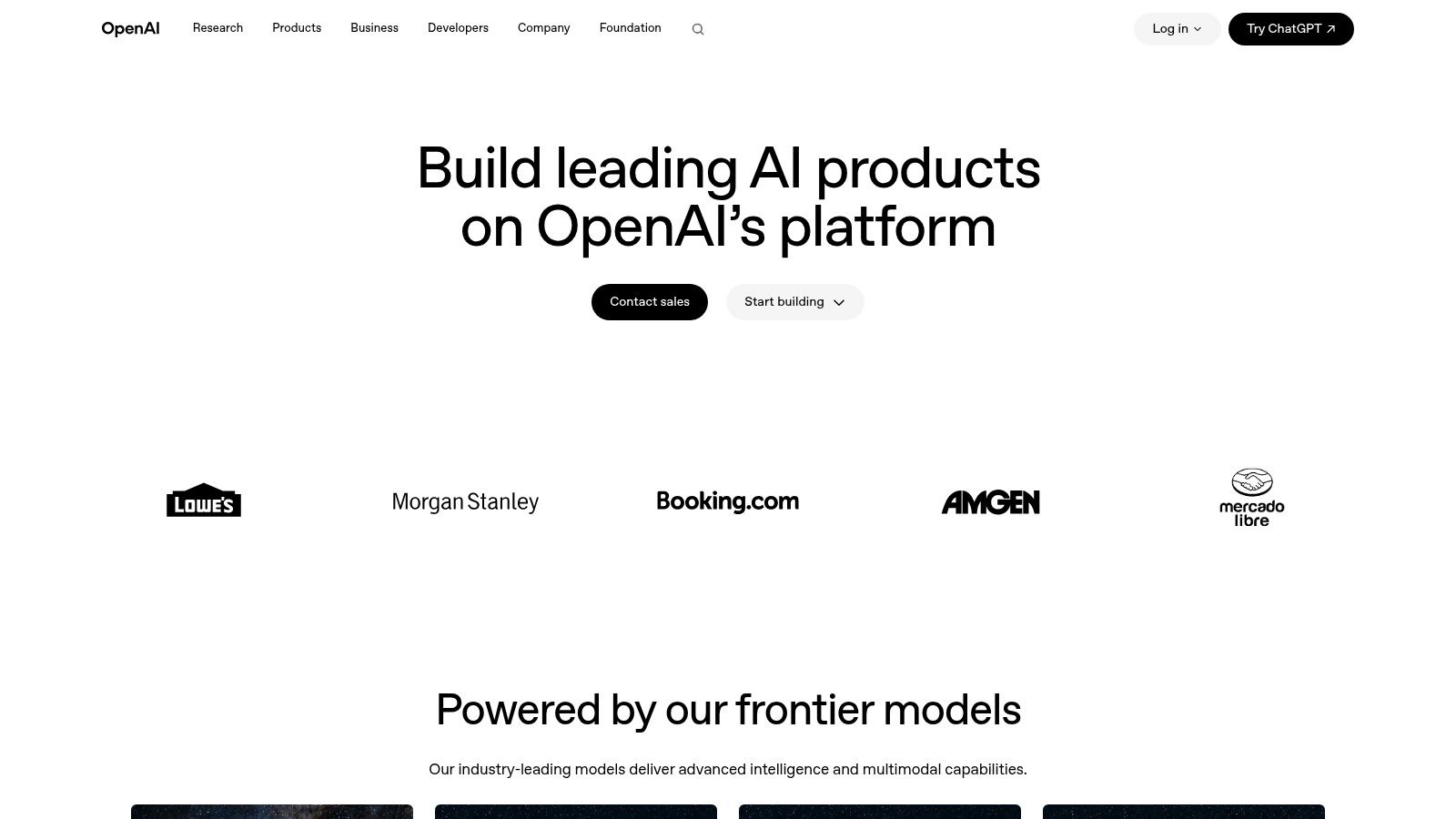
Features: general-purpose language models and API tools, published per-model pricing, caching, batch and residency options.
Pros: the deepest published documentation of any provider here; a large ecosystem; familiar API patterns that most third-party tools integrate with first.
Cons: some built-in features add charges beyond token usage; behaviour and availability vary by model; provider-specific APIs make switching real work.
Website: OpenAI API
2. Anthropic
Anthropic's enterprise position isn't a marketing claim. Menlo Ventures' 2025 survey of 495 U.S. enterprise AI decision-makers, reported in The State of Generative AI in the Enterprise, estimated provider shares by production API spending at Anthropic 40%, OpenAI 27% and Google 21%, together 88% of enterprise LLM API usage. Anthropic's share rose from 12% in 2023 to 40% in 2025, while OpenAI's fell from 50% to 27% and Google's rose from 7% to 21%.
Those figures combine survey responses, a bottoms-up market model, workload weighting and public financial triangulation, so treat them as directional. The useful lesson isn't "Anthropic is better." It's that enterprise spend concentrates on workloads where one model family performs well, and coding and agentic tool use are the obvious candidates.
What the share shift actually tells a buyer
A high enterprise share can reflect procurement relationships, deployment fit, or a specific benchmark advantage. It does not transfer automatically to your prompts. Test the Claude models you'd call against your own extraction, support, and coding tasks, and record the model version next to the result. Model choice within the family affects cost significantly, so a family-level comparison is not a decision.
Consumer Claude subscriptions don't include API usage. Budget for API billing as a separate line, with its own keys, limits and spend controls.
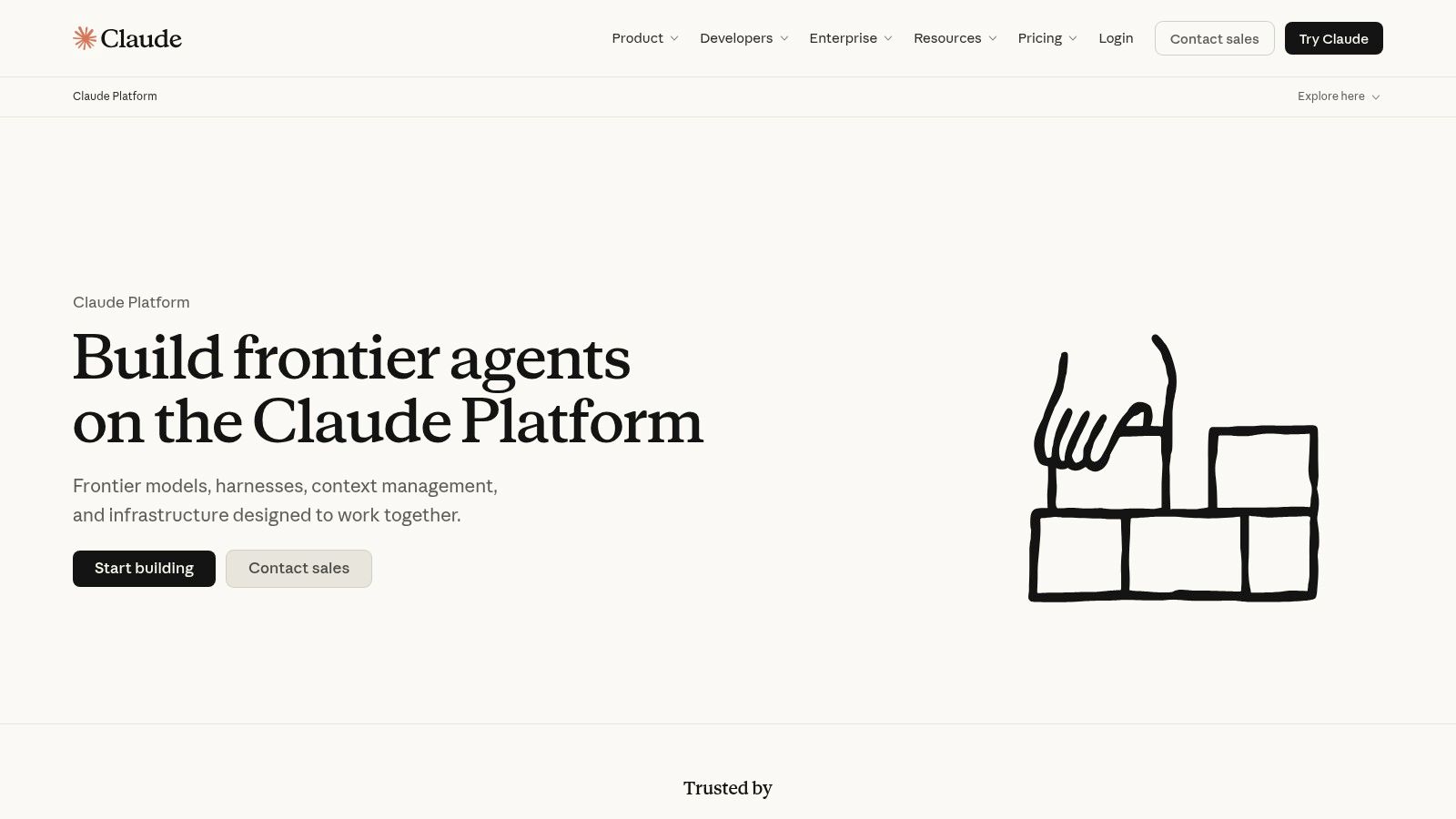
Features: direct API access to Claude models, a lineup spanning different capability and price points, published API pricing documentation and extended-context options.
Pros: direct access without a third-party model platform; model-specific pricing supports like-for-like cost comparison inside the family; strong fit for teams whose workloads centre on long-context reasoning or agentic tool calls.
Cons: model choice shifts cost significantly; performance must be measured on your tasks rather than assumed interchangeable; consumer plans don't cover API use.
Website: Anthropic API
3. Google Gemini API
Google is the provider that most changed the shape of the market, and the evidence is a price collapse rather than a feature list. Stanford's AI Index 2025 measured the cost of querying a model with GPT-3.5-level performance (64.8% on MMLU) at $20 per million tokens in November 2022, falling to $0.07 per million tokens by October 2024 using Gemini-1.5-Flash-8B, according to the Stanford HAI AI Index 2025 report. That's a reduction of more than 280 times in under two years.
The same report records inference prices falling between 9 and 900 times per year depending on the task, which is the tell: there is no single stable price curve, so a comparison that doesn't record its check date is worthless within a quarter.
The practical pick: Gemini API when the workload is multimodal or audio-first, or when you want to evaluate against real models without a procurement step.
Where the free tier fits and where it doesn't
Google publishes model-by-model pricing and offers a free tier for some access, with limits and availability that vary by model. That suits the evaluation stage and fails in production, because a workload that outgrows the free tier meets a price you didn't model and a quota you didn't test. Budget the paid tier before you commit the architecture, not after the first invoice.
For multimodal or real-time audio work, the Gemini API is one of the few places where the modality and the billing model coexist in one place. Review data-handling settings and billing configuration before you point traffic at it, because changing them after launch means retesting an application that's already live.
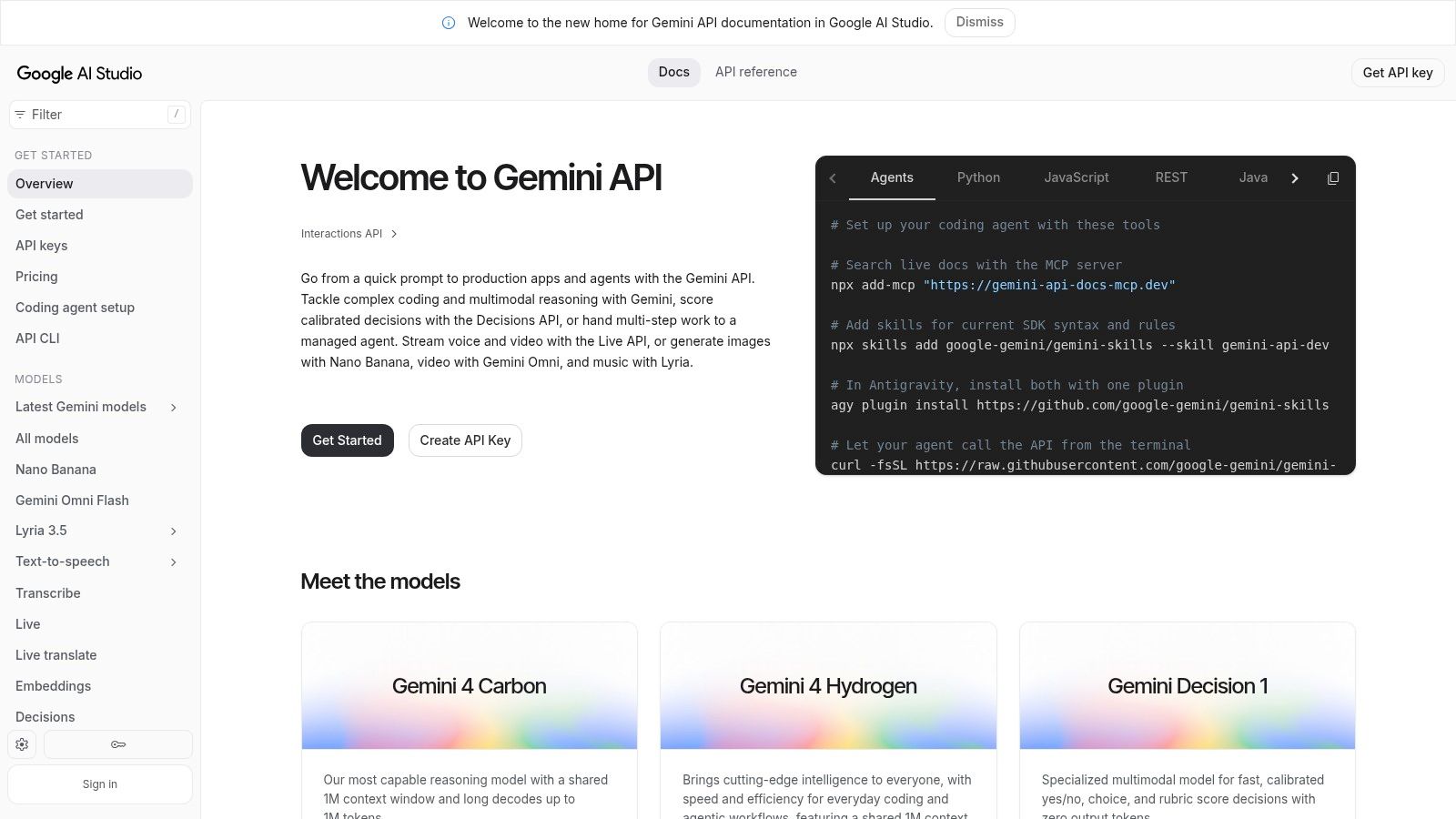
Features: Gemini models through Google's developer API, published pricing by model and service tier, audio and real-time options, AI Studio for trying eligible models.
Pros: a free tier that supports real experimentation; published model pricing that makes cost estimation possible; a strong candidate for multimodal and audio applications.
Cons: free-tier availability and limits vary by model; pricing and model availability change; data and billing settings need review alongside token rates.
Website: Google Gemini API
4. Amazon Bedrock
Bedrock's argument is organisational rather than technical. If your teams already operate in AWS, the model access, billing, IAM boundaries and audit trail land inside systems your security review already covers. That shortens procurement more than any per-token saving will.
Gartner's 2024 API Strategy Survey found 71% of organisations reported using third-party APIs, including generative-AI APIs from providers such as OpenAI, as summarised in Gartner's 2024 API strategy research. Bedrock fits that pattern: it turns model access into one more consumed API inside an existing cloud account, rather than a new vendor relationship.
The cost model is not one rate
Pricing depends on the model, the modality and the service, so a single blended figure misleads. Batch inference suits work that doesn't need an immediate response, and the discount is real, but it changes the architecture: jobs get queued, results land later, and the application has to handle asynchronous completion.
The setup cost is real too. A managed cloud service layer requires more configuration than a standalone endpoint, and model availability should be checked region by region, because a model listed globally may not be callable where your data lives.
Check before building: confirm the exact model ID, the region, the throughput option and the total service cost, not just the model's token rate.
Features: multiple providers' foundation models through AWS, model- and modality-dependent pricing, batch inference for select models, AWS ecosystem integration.
Pros: simplifies model access for AWS-native teams; lets you evaluate several model providers inside one cloud environment; batch options suit non-interactive workloads.
Cons: no single simple rate; more setup than a standalone API; availability and total service cost need checking per region.
Website: Amazon Bedrock
5. Mistral AI
Mistral's differentiator for European and regulated buyers is geographic routing. Its US or EU regional inference option routes processing to a selected geography and is listed at 1.1 times standard pricing, according to Mistral AI's published documentation. That 10% premium is the price of a documented data-location story, and it's cheap compared with rebuilding an application around a different vendor.
API use requires billing activation, which is a small friction worth knowing before a Friday deployment. The platform also publishes guidance on model lifecycle and usage limits, and organisations get usage and spending-limit administration.
When the regional premium is worth it
Buy the regional endpoint when a contract, a regulator or a customer's security questionnaire asks where inference happens. Skip it when the answer is "somewhere in the EU" rather than a named jurisdiction, because routing to a geography is not the same as pinning to a data centre.
If your team is weighing whether to run models locally instead of paying for hosted inference at all, the trade-offs in this comparison of local LLM apps are the right starting point before committing to an API bill.
Cost note: a 1.1 times multiplier applies to the whole token bill, not to a subset. Model it on projected volume, not on a pilot.
Features: direct API access to Mistral-hosted models, US or EU regional inference endpoints, organisation-level usage and spending-limit administration.
Pros: direct access to Mistral's model ecosystem; a documented regional option for data-location requirements; published lifecycle and usage-limit guidance.
Cons: regional inference costs more than standard list pricing; billing activation is required before first call; model and plan details need checking against the current catalogue.
Website: Mistral AI
6. Cohere
Cohere's fit is narrower and clearer than most: business applications where search and retrieval sit at the centre. Teams building retrieval-augmented pipelines should evaluate it on their own documents, because retrieval quality depends on the pairing of embedding, reranking and generation, not on a general benchmark.
Pricing is published per model, and limited free trial API access is available for testing. That trial is for technical evaluation, not capacity planning. A pipeline that works inside trial limits hasn't been tested against the throughput it needs.
Retrieval is the test, not the leaderboard
Build a fixed evaluation set from your own corpus before you compare. Fifty representative queries, with the answer you'd accept written down, will tell you more about retrieval fit than any public score.
The same discipline applies across the category. If you're assembling the wider stack around a provider, DBotMaker's ranking of the best LLM APIs covers the alternatives on the same scoring basis.
Features: API access to Cohere language models, published model-specific pricing, limited free trial API access.
Pros: trial access lowers the cost of a first technical evaluation; public pricing supports honest cost comparison; a credible option for language and retrieval-oriented applications.
Cons: trial access is limited and shouldn't be treated as production capacity; rates differ across models; fit depends on how well the models and tools match your retrieval needs.
Website: Cohere
7. Together AI
Together AI's case is breadth at a known price. Serverless inference spans a large catalogue of open and open-weight models with per-model input and output token rates, batch pricing for listed models, and additional fine-tuning and compute services, per Together AI's published documentation. For teams that want open models without operating inference infrastructure, that's the shortest path.
The cost of that breadth is modelling complexity. Rates differ significantly between models, and a workload that mixes a cheap model for classification with an expensive one for generation produces a blended bill that no single rate explains. Instrument per-model spend from the first week.
What one completed task really costs
Academic work on inference economics shows why token price alone misleads. Parallelising inference across two GPUs reduced latency by 40.16% while raising total energy use by 29.3%; four GPUs cut latency by 61.34% but raised energy use by 55.23%, according to research on LLM inference efficiency. Speed is bought with resources, and providers pass that trade-off into their service tiers.
Measured endpoint variation compounds it: one measured endpoint delivered 46 output tokens per second while a faster tier reached 159 tokens per second on identical weights. A low token price on a slow tier can cost more in wall-clock time and retries than a higher price on a fast one.
Scoring rule: rank on cost per completed task. Tokens, retries, latency and required service tier belong in the same number.
DBotMaker's comparison of AI inference platforms applies that lens to the wider field.
Features: serverless inference across a model catalogue, per-model input and output rates, batch API pricing for listed models, fine-tuning and compute services.
Pros: many models through one provider; published rates that support per-model comparison; no model-serving infrastructure to provision.
Cons: a large catalogue makes selection and testing essential; rates vary widely by model; confirm a specific proprietary model is available before building around the platform.
Website: Together AI
8. Fireworks AI
Fireworks AI is the option for teams that expect to customise. It runs serverless inference with per-token billing, fine-tuning and training services, on-demand GPU deployments and dedicated capacity, per Fireworks AI's published documentation. The mixture of billing units is the point and the problem: tokens for serverless, GPU time for dedicated.
GPU-hour pricing rewards utilisation and punishes idling. A dedicated deployment that runs at 20% utilisation is more expensive per token than the serverless rate it replaced, and the invoice won't say so. Model utilisation before you model price.
Choosing between serverless and dedicated
Use serverless while traffic is unpredictable and the model is available there. Move to dedicated when you have a sustained floor of traffic and a latency requirement that shared capacity can't meet, and when you can measure utilisation weekly rather than monthly.
Different deployment modes make cross-provider comparison awkward. Record the mode next to the price in any comparison you build, or you'll compare a serverless rate against a reserved-capacity rate and draw the wrong conclusion.
Features: serverless inference with per-token billing, fine-tuning and training, on-demand GPU deployments, dedicated deployment options.
Pros: multiple serving approaches for different project stages; inference and customisation in one vendor; a genuine alternative for managed open-model serving.
Cons: mixed deployment modes complicate cost comparison; GPU-hour pricing requires utilisation discipline; confirm terms and availability for your specific models.
Website: Fireworks AI
9. Groq
Groq sells latency, and latency is the one thing a price comparison usually ignores. The platform offers a developer API for supported models through GroqCloud, with a free tier and a paid Developer tier billed by usage, per Groq's published documentation. Dashboard usage tracking and spend limits are included, which matters because speed changes failure modes.
A fast provider doesn't just answer sooner. It lets a fixed number of concurrent users generate far more requests per minute, so a workload can hit a requests-per-minute ceiling it would never have reached on a slower endpoint. Fast providers surface rate limits earlier.
Test the ceiling, not the average
Run a burst test before launch: hold your expected concurrency for ten minutes and watch for throttling, retries and latency percentiles. Record p50 and p95 rather than the mean, because the mean hides the slow tail that users notice.
Free-tier limits are for evaluation. Check the model catalogue against your requirements too, since supported models are a subset of the open ecosystem, and confirm capacity for the traffic you expect rather than the traffic you measured in week one.
Features: API access through GroqCloud, free and paid Developer tiers, pay-as-you-go billing, dashboard usage tracking and spend limits.
Pros: free access for early evaluation; consumption-based paid usage rather than a flat subscription; usage monitoring and spend limits built in.
Cons: the catalogue covers only supported models; free-tier limits won't carry production; rate limits and capacity need checking against expected traffic.
Website: Groq
10. OpenRouter
OpenRouter is the pick for model evaluation and a weaker fit for single-model volume. It is a routing layer across many providers, with one API, one bill, free models subject to limits, and routing and provider-selection features on paid plans, per OpenRouter's published documentation. Paid credit purchases carry a platform fee, so confirm the current charge on OpenRouter's pricing page before modeling cost. Its pricing is public rather than quote-only, so nothing here sits in the pending bucket in our best LLM APIs comparison.
That fee is small at prototype scale and visible at production scale. Treat it as a percentage added to prepaid inference spend, then weigh it against the engineering time a second or third direct API would take.
What the fee buys
The fee replaces integration work: one key, one bill, and model changes without a new vendor contract. A team comparing five models across three providers usually gets that time back. A team serving one model at high volume usually does not. It also adds a dependency, because every request passes through an extra service with its own availability and limits; treat free models as evaluation capacity, not production capacity.
Features: one API across a catalogue of models and providers, free models subject to limits, routing and provider selection on paid plans, catalogue pricing information.
Pros: convenient model comparison through a shared interface; less integration work when experimenting; fallback and routing features for some workloads.
Cons: paid credit purchases add a platform fee; free models have request limits; an intermediary adds another service dependency.
Website: OpenRouter
10 LLM API providers compared by access, pricing and billing
The fastest shortlist is by access route. Choose a direct API for a single-provider relationship, a cloud platform where procurement already sits, managed inference for open-model operations, or OpenRouter when model routing matters more than a direct vendor relationship.
| Provider | Pick it for | Free plan or trial | Price basis | Billing and access |
|---|---|---|---|---|
| OpenAI | General-purpose applications and API tools | None listed | Usage-based | Direct API; rates vary by model and feature |
| Anthropic | Claude applications, including extended-context workloads | None listed | Usage-based | Direct API; rates vary by model and feature |
| Google Gemini API | Multimodal and real-time audio applications | Free tier for some models, with varying limits | Usage-based | Developer API and Google AI Studio; rates vary by model and service tier |
| Amazon Bedrock | Teams already operating in AWS | None listed | Varies by model, modality and service | AWS platform with multiple model providers |
| Mistral AI | Mistral models with regional inference options | None listed | Usage-based | Direct hosted API; regional inference costs more |
| Cohere | Business applications involving search and retrieval | Limited free trial API access | Usage-based | Direct API; rates vary by model |
| Together AI | Managed inference across a broad model catalog | None listed | Per-model token rates | Serverless inference API; batch and other services separately priced |
| Fireworks AI | Managed open-model inference and customization | None listed | Token-based or GPU-time billing | Serverless, on-demand or dedicated deployments |
| Groq | Early evaluation and usage-based API access | Free tier available | Pay-as-you-go after the free tier | GroqCloud developer API |
| OpenRouter | Comparing and routing across models from multiple providers | Free models, subject to limits | Model usage charges plus paid-plan platform fees | Unified API and model router |
How to Make Your Pick and Check the Price
Match the provider to your constraints in this order: cloud footprint first, retrieval and multimodal needs second, budget predictability third. A team already inside AWS gets more value from Bedrock's procurement shortcut than from a lower token rate elsewhere. A team whose product is retrieval-heavy should test Cohere on its own corpus before comparing list prices at all.
Prototype on free tiers, but set spend limits before production. Google's free tier and Groq's free access are both genuine evaluation ground, and both stop being relevant the moment real traffic arrives. Put a hard spend cap and an alert at 50% of expected monthly cost on every key you issue, and tag keys per workload so a runaway agent doesn't hide inside a blended bill.
Developers are already committed. Stack Overflow's 2025 Developer Survey reported that 84% of developers were using or planning to use AI tools in their development process, up from 76% in 2024, according to the Stack Overflow 2025 Developer Survey. Adoption isn't readiness, which is why the qualification tests matter more than the sign-up.
And the base of buyers keeps widening. A nationally representative U.S. survey summarised by the National Bureau of Economic Research working paper found 39% of adults aged 18 to 64 used generative AI by August 2024, including 28% of employed respondents who reported using it at work. Business adoption rose from 3.7% in December 2023 to 5.4% in February 2024, per Census Bureau survey data cited in the same study, while generative AI directly assisted between 0.5% and 3.5% of all U.S. work hours.
There's a caution in the sustainability numbers too. Inference may account for up to 90% of total lifecycle energy, and latency optimisations don't reliably reduce environmental impact, according to research on the environmental footprint of LLM inference. Resource-efficient small models can use under 4 mL of water for long-form prompts in some measured scenarios, while larger or less efficient deployments differ materially. Ask for energy and water estimates per successful request, and treat "faster" as unrelated to "greener".
DBotMaker scores every ranking on capabilities 40%, ease of setup 30% and value 30%, using one published formula for every product. Prices are copied word for word from each maker's own pages with the date checked shown beside them, and vendors that only quote prices on request are marked as pending rather than estimated. Every ranking is built from documented features and published prices, with no hands-on testing claimed.
Prices change faster than procurement cycles. Report errors, broken links or price changes to editorial@dbotmaker.io.
Spotted an error in this guide? Email editorial@dbotmaker.io