Review · Software & AI
 Glide review
GlideOS, Glide's new agentic platform, builds internal business apps from a spreadsheet, a prompt, a PDF or a screenshot.
By the DBotMaker research desk · Updated November 23, 2026
Short answer · output
Glide is an AI app builder for internal business apps, now sold as GlideOS: an agent builds apps, data tables and workflows from a spreadsheet, a prompt, a PDF or a screenshot. Paid plans start at $25 a month for 100 credits and 2 published apps, and the free plan cannot publish anything. It suits operations teams replacing shared spreadsheets with staff apps; prices were checked on Glide's pricing page in November 2026.
- Capabilities (40%)
- 7.7
- Ease of setup (30%)
- 8.4
- Value (30%)
- 7.5
In pictures · 1 image
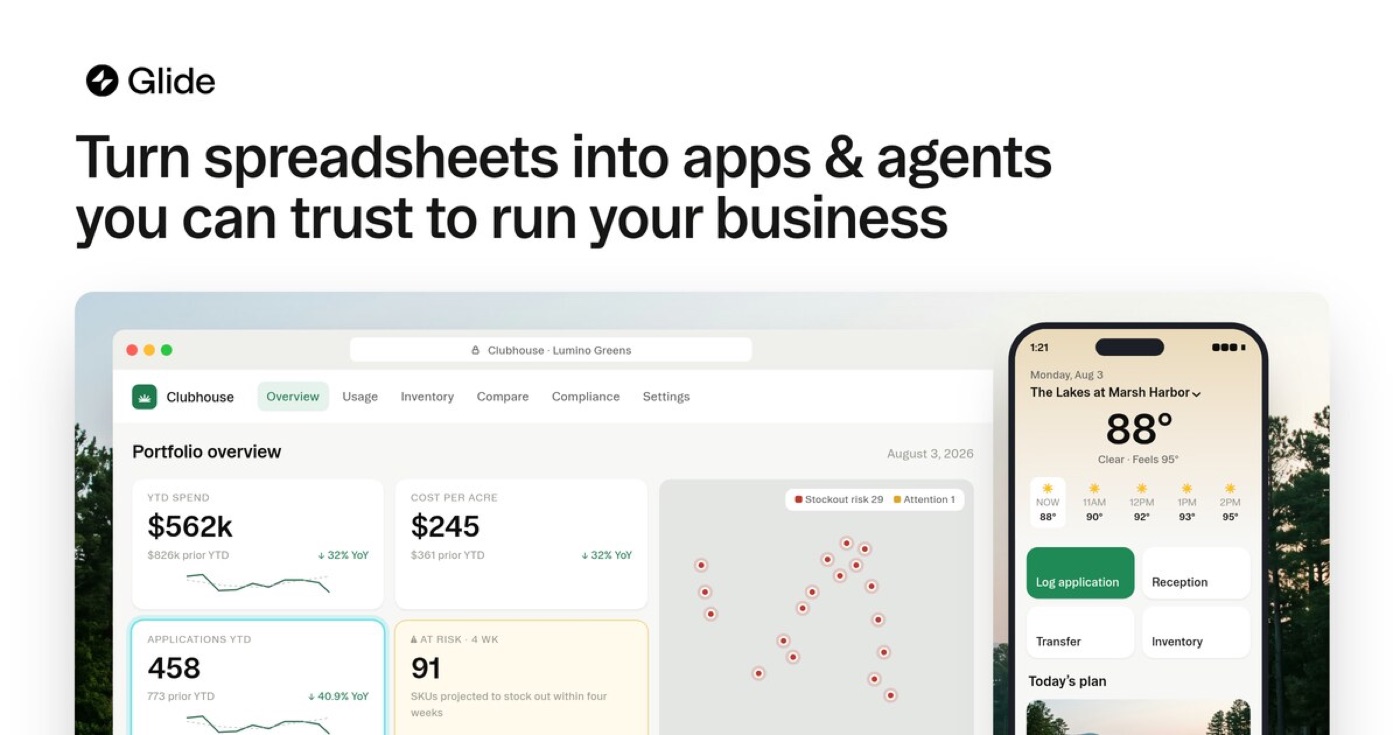
Verdict printout · Glide
Glide is worth paying for if your team already runs a process on a spreadsheet and wants a private app for staff on desktop and phone, with roles, workflows and AI features on the same data. Pro at $125 a month is the realistic team plan, since it adds 5 members, unlimited published apps and workflows, premium integrations and the MCP server for Claude, ChatGPT or Cursor. It is the wrong pick for a consumer app in the App Store, where Bubble or FlutterFlow fit better, and for existing Glide Classic builders, because Glide says there is no tool to migrate Classic apps into GlideOS. The deciding fact is the credit allowance: Basic includes 100 credits a month, unused monthly credits do not roll over, and GlideOS stops new AI requests when they run out.
ReadOverview
Glide started as a no-code tool that turned Google Sheets into apps, and its own pricing FAQ says Glide Classic has been used by more than 100,000 businesses over 7 years. In 2026 the company launched GlideOS, which it describes as an AI software development platform for building internal business apps from a spreadsheet, a prompt or a file. You work with it through chat: attach an Excel file, a CSV, a Google Sheet, a document or an image, describe what the team needs, and the agent builds apps, data tables and workflows inside a project. A proprietary system called SheetSense reads sheets, formulas, lookups and notes to work out the structure before the app is built.
GlideOS is a separate product, not an upgrade. Glide's pricing FAQ states that GlideOS has its own plans, needs a separate subscription, lives in a separate account, cannot share data with Classic apps, and that there is currently no tool or technique to migrate Classic apps across. Classic stays on sale with its own Free, Explorer, Maker, Business and Enterprise plans, and the Classic pricing page lists Business from $199 a month with 30 users included. Anyone researching Glide should check which of the two products a tutorial or review describes.
GlideOS pricing is a monthly subscription with credits, where a credit is Glide's unit for the LLM work the agent does. Free gives a one-time batch of limited credits that do not renew, 10 projects, 2 team members and no published apps. Basic is $25 a month with 100 credits, 2 published apps and 1 enabled workflow. Plus starts at $50 a month with 250 credits, 3 members, 5 published apps, 5 workflows and public apps, with larger credit bundles up to 10,000 a month. Pro starts at $125 a month with 5 members, 50 credits per member, unlimited published apps and workflows, premium integrations, database connection strings, the MCP server and human support; extra members cost $10 each up to 100. Enterprise is custom priced. Annual plans are listed as coming soon, so every price is monthly for now.
Against the other builders on this site, Glide is the most clearly aimed at internal tools. Lovable, Bolt, Base44 and Replit target web apps and products for outside customers, and Bubble and FlutterFlow can ship native apps to the app stores. GlideOS apps are web apps that open on desktop or phone and can be installed to the home screen, private to the company by default. Glide's bring your own agent option is unusual: on Pro and Enterprise, Claude, ChatGPT, Cursor or any MCP client with OAuth can build into the same Glide project, and the reasoning runs on that provider's plan rather than on Glide credits.
The limits are written in Glide's own docs. The free plan cannot publish apps or run workflows. Monthly credits reset each cycle and do not carry over, while extra credit purchases last 12 months and Basic allows only 1 top up a month. GlideOS does not write back to Google Sheets: it copies the sheet into its own database, and edits made in the app stay in GlideOS. Glide's Enterprise summary says Glide Classic is SOC 2 Type 2 certified while SOC 2 Type 1 for GlideOS is still in progress. Glide's iPhone app page still showed the app as coming in early November 2026 when checked.
How it scored
Glide fits when the starting point is a spreadsheet and the users are your own staff. GlideOS is a rebuild rather than an update: a standalone agentic platform with its own plans, separate from Glide Classic, and Glide says there is currently no tool to move Classic apps across. It can start from a written prompt, a PDF or a screenshot, and its SheetSense system maps spreadsheet data into app structure. The plan limits decide the fit. Free cannot publish apps; Basic at $25 a month includes 100 credits, 2 published apps and 1 enabled workflow; Plus at $50 opens public apps and 5 published apps; Pro at $125 brings 5 members, 500 credits, unlimited published apps and workflows and bring-your-own-agent support over MCP. Annual plans are listed as coming soon, so for now every price is monthly.
Who it is for
Ops teams turning spreadsheets into internal tools
Run it if
- Operations, warehouse and field teams that run inventory, work orders or inspections on a spreadsheet and want a phone friendly app for staff
- Small businesses that want several connected internal apps on one database, such as a CRM, a scheduling app and a dashboard, on the Pro plan at $125 a month
- Teams that already pay for Claude, ChatGPT or Cursor and want those agents to build and publish governed company apps through Glide's MCP server
- IT leaders who want business teams to build their own tools under SSO, row level roles, publishing approval and audit logs on Enterprise
- Builders who want AI features inside the app itself, such as summarizing or classifying text, billed from the same credit pool
Skip it if
- Founders building a consumer app for the App Store or Google Play: Bubble or FlutterFlow publish native mobile apps
- Developers who want to own and export the code: Replit or Lovable keep the project as editable code
- Existing Glide Classic users who want to keep their current apps and data in place: stay on Glide Classic, since GlideOS has no migration tool
- Solo builders on a tight budget who want to launch publicly for free: Bolt includes free hosting, while GlideOS needs at least Plus at $50 a month for public apps
SpecSpec sheet
| Product | GlideOS, separate from Glide Classic with its own plans and accounts | src ↗ |
|---|---|---|
| Free plan | Limited one-time credits, 10 projects, 2 team members, 0 published apps | src ↗ |
| Starting paid price | Basic, $25 a month with 100 credits | src ↗ |
| Billing | Monthly only; annual plans listed as coming soon | src ↗ |
| Published apps | 0 on Free, 2 on Basic, 5 on Plus, unlimited on Pro and Enterprise | src ↗ |
| Enabled workflows | 0 on Free, 1 on Basic, 5 on Plus, unlimited on Pro and Enterprise | src ↗ |
| Team members | 2 on Free and Basic, 3 on Plus, 5 to 100 on Pro at $10 per extra member | src ↗ |
| Credit rules | Monthly credits reset and do not roll over; extra credits last 12 months | src ↗ |
| Data sources | Excel and CSV upload, Google Sheets (one-way import), SQL and Postgres-compatible connections | src ↗ |
| Integrations | 1,000+ integrations listed; premium integrations from Pro | src ↗ |
| Bring your own agent | MCP server for Claude, ChatGPT, Cursor and other OAuth MCP clients, on Pro and Enterprise | src ↗ |
| App delivery | Web apps on desktop and phone, installable to the home screen; custom domain supported | src ↗ |
| Data backups | 24 hours on Pro, 30 days on Enterprise | src ↗ |
| Compliance | Classic is SOC 2 Type 2; SOC 2 Type 1 for GlideOS in progress; GDPR, CCPA, AES-256 | src ↗ |
| Refunds | Base subscription fee refundable within 14 days of first purchase; credits non-refundable | src ↗ |
Price
Free plan; Basic $25 per month; Plus $50 per month; Pro $125 per month.
Plans on GlideOS start at $25 per month.
Quoted from the vendor pricing page on November 16, 2026.
Plans on file · 5
| Plan | Price | Includes | Checked |
|---|---|---|---|
| Free | $0free | Limited credits that do not reset or renew; 10 projects; 2 team members and unlimited guests; Integrations; Build AI features in your apps; No published apps and no enabled workflows | Checked Nov 23, 2026 |
| Basic | $25 a monthmonthly | 100 credits a month; 2 team members and unlimited guests; 2 published apps and 1 enabled workflow; Publish personal and team apps; Choose agent mode (light, medium, heavy); 1 credit top up a month | Checked Nov 23, 2026 |
| Plus | From $50 a monthmonthly | 250 credits a month, with larger bundles up to 10,000 credits at higher prices; 3 team members; 5 published apps, 20 projects and 5 enabled workflows; Publish public apps; Customize the app login screen; 2 credit top ups a month | Checked Nov 23, 2026 |
| Pro | From $125 a monthmonthly | 5 team members, extra members $10 each a month up to 100; 50 credits per member, 500 credits with 5 members; Unlimited published apps and workflows, 100 projects; Premium integrations and database connection strings; Build with your own agent (MCP); Org-level roles and permissions, 24-hour backups and human support | Checked Nov 23, 2026 |
| Enterprise | Custom, contact salescustom contract | Custom projects, credits and team size; Single sign-on with SAML or OIDC; Enterprise integrations and choice of the organization's LLM provider; Project-level roles, publishing approval and audit logs; 30-day data backups; Dedicated success manager and priority support | Checked Nov 23, 2026 |
Key features
SheetSense spreadsheet import
Glide says SheetSense reads every sheet in a file, including formulas, lookups and notes, then the agent builds a working app for desktop and phone from it. Excel and CSV files are uploaded; Google Sheets are copied into a GlideOS table, and app edits are not written back to the sheet.
Chat-based build agent
Apps, tables and workflows are built and changed by describing them in chat, starting from a prompt, a spreadsheet, a document, an image or a mix. Paid plans let you pick a light, medium or heavy agent mode, which changes how many credits a request uses.
Projects with a shared database
Every project has one database that all of its apps read and write, so a stock app and a dashboard can work from the same records. Pro adds Postgres-compatible connection strings, read-only or read and write, for BI tools and outside systems.
Workflows
Workflows run on a schedule, from a webhook, on an app action, on a data change or by hand, and are described in chat. They can be created on any plan but need a paid plan to run: 1 on Basic, 5 on Plus, unlimited on Pro.
Bring your own agent over MCP
On Pro and Enterprise, Claude, Claude Code, ChatGPT, Cursor or any MCP client with OAuth connects to Glide's remote MCP server and can build apps, query data and ship workflows. Reasoning runs on the provider's plan, while Glide credits still cover workflows and AI features that Glide runs.
Access control and governance
New apps are private to the organization by default, and public apps start on Plus. Enterprise adds SSO, project-level roles, roles down to the row, publishing approval, audit logs, an organization AI budget with per-person daily caps and a choice of LLM provider.
Strengths and weaknesses
Plus · 7
- Built for the job most teams actually have: Glide's pricing FAQ says GlideOS is optimized for internal business apps built from spreadsheets, backed by 7 years of Glide Classic use at more than 100,000 businesses
- Unlimited guests from the free plan up, so outside contractors or partners can open an app without taking one of the 2 to 5 member seats
- Pro covers a small team well at $125 a month: 5 members, 500 credits, unlimited published apps and workflows, 100 projects and premium integrations
- The MCP server lets Claude, ChatGPT or Cursor do the building on a plan you already pay for, which saves Glide credits on build work
- Extra credits last 12 months and are only drawn once monthly credits run out, so a top up bought for a busy month is not lost
- Cancellation and downgrades are self-serve, and the base subscription fee is refundable within 14 days of the first purchase
- Apps install to the home screen on iPhone and Android from a QR code and can run on a custom domain once a DNS TXT record is added
Minus · 6
- The free plan has 0 published apps and 0 enabled workflows, so nothing goes live without paying at least $25 a month
- Basic includes only 100 credits a month, monthly credits do not roll over, and GlideOS stops new AI requests when the balance hits zero
- No migration path from Glide Classic: GlideOS uses separate accounts and cannot share data with Classic apps
- Google Sheets are imported one way, so changes made in the app do not flow back to the source sheet
- No annual discount yet, since annual plans are listed as coming soon, and public apps need Plus at $50 a month
- SOC 2 Type 1 for GlideOS is still in progress according to Glide's Enterprise page, while the Type 2 report covers Glide Classic
Key facts
- Free plan: Yes, limited credits, 10 projects, 0 published apps
- Basic: $25 a month, 100 credits, 2 published apps
- Plus: $50 a month, 250 credits, 5 published apps
- Pro: $125 a month, 500 credits, 5 members
- Glide Classic: Separate product and subscription
Where it ranks
Glide is No. 10 in our Best AI App Builders verdict.
AltAlternatives to weigh
- Bubble →Better for apps sold to outside customers and released in the app stores, with a visual workflow editor; web plans start at $32 a month billed annually.
- FlutterFlow →Better when you need native iOS and Android apps and want to download the Flutter code, from $29 a month billed yearly.
- Base44 →A cheaper start for a small web app with logins and a database, from $16 a month billed annually, with backend and authentication on every plan.
- Replit →Better if a developer will own and maintain the code, with Core at $18 a month billed annually.
- Lovable →Better for public web apps built from prompts by a team, with a stronger focus on customer-facing products than internal tools.
Questions readers ask
- QIs Glide worth it in 2026?
- AYes, for teams turning spreadsheets into internal staff apps, where Pro at $125 a month includes 5 members, unlimited published apps and workflows, and the MCP server. It is less suited to consumer apps or projects where you need to export the code.
- QDoes Glide have a free plan?
- AYes, but it cannot publish apps. Glide's GlideOS Free plan includes a limited batch of credits that does not renew, 10 projects and 2 team members, with 0 published apps and no running workflows.
- QHow much does Glide cost?
- AGlideOS paid plans are $25, $50 and $125 a month for Basic, Plus and Pro, billed monthly, and Enterprise is custom priced. Annual plans are listed as coming soon, and Plus and Pro cost more with larger credit bundles or more members.
- QWhat is the difference between GlideOS and Glide Classic?
- AThey are separate products with separate accounts and plans. GlideOS builds apps through an AI agent and credits, while Glide Classic is the original no-code builder priced by users and updates, and Glide says there is no tool to migrate Classic apps to GlideOS.
- QWhat are Glide credits and what happens when they run out?
- AA credit is Glide's unit for AI work, used both when the agent builds and when AI features run inside your apps. When monthly credits run out, GlideOS stops new AI requests until the allowance resets or you buy extra credits, which last 12 months.
- QCan Glide apps go in the App Store?
- ANo, GlideOS publishes web apps that open on desktop and phone and can be installed to a phone's home screen from a link or QR code. Glide's own iPhone app, for building and running apps, was announced on its site for early November 2026.
- QGlide vs Bubble: which should I pick?
- APick Glide for internal apps built from your team's spreadsheets, and Bubble for customer-facing products and app store releases. Glide starts at $25 a month billed monthly, Bubble's web Starter at $32 a month billed annually.
- QDoes Glide work with Google Sheets?
- AYes, GlideOS can connect a Google Sheet, but it imports the data one way into its own database table. Glide's docs say updates made through the app stay in GlideOS and are not written back to the sheet.
LogSource log
- [01]Glide pricing: Free, Basic, Plus, Pro and Enterprise plans · checked Nov 23, 2026
- [02]Glide Plans and Pricing (markdown summary) · checked Nov 23, 2026
- [03]Glide homepage: AI app builder for internal business apps · checked Nov 23, 2026
- [04]Glide site index for AI agents · checked Nov 23, 2026
- [05]Glide Enterprise summary · checked Nov 23, 2026
- [06]Glide Docs: What is GlideOS? · checked Nov 23, 2026
- [07]Glide Docs: Usage and credits · checked Nov 23, 2026
- [08]Glide Docs: Billing · checked Nov 23, 2026
- [09]Glide Docs: Workflows · checked Nov 23, 2026
- [10]Glide Docs: Data · checked Nov 23, 2026
- [11]Glide Docs: Publishing and Sharing · checked Nov 23, 2026
- [12]Glide Docs: Connect with MCP · checked Nov 23, 2026
- [13]Glide: Bring your own agent · checked Nov 23, 2026
- [14]Glide for iPhone · checked Nov 23, 2026
- [15]Glide Classic: Pricing and Plans · checked Nov 23, 2026
- [16]Bubble pricing · checked Nov 16, 2026
- [17]FlutterFlow pricing · checked Nov 16, 2026
- [18]Base44 pricing · checked Nov 16, 2026
- [19]Replit pricing · checked Nov 16, 2026
Deep review last updated November 23, 2026. Prices and specs are rechecked against these pages.
Alternatives we scored
Cite this page
DBotMaker. Glide review. Updated November 23, 2026. https://dbotmaker.io/review/glide
Visit glideapps.com · Questions or corrections: editorial@dbotmaker.io